Mapa neuronal

by Felipe Córdova
5
4
3
2
1
Score: 48/100

Description

Category: Learning & Knowledge Management

The Why Graph plugin turns the graph into a layered map that shows not just which notes connect but why they connect. It assigns folders to layers, groups notes by a frontmatter topic property and adds side panels that show a note's layer, topic, short summary and the reason behind each link. The tool can trace paths between notes, surface missing connections between topics, collapse topics, highlight long range links, export graph data to JSON and CSV and treat cited source folders as first layer inputs. It works fully offline for mapping, navigation, counting and export. Optional AI suggestions can fill missing link reasons and short summaries through Anthropic, OpenAI, Gemini or a local OpenAI compatible server, but every suggestion must pass quote verification and manual approval.

Reviews

No reviews yet.

Stats

1
stars
195
downloads
1
forks
4
days
1
days
1
days
25
total PRs
1
open PRs
1
closed PRs
23
merged PRs
2
total issues
2
open issues
0
closed issues
58
commits

Latest Version

a day ago

Changelog

What's Changed

Full Changelog: https://github.com/DBB-FC/why-graph/compare/1.30.0...1.31.0

README file from

Github

Why Graph

Obsidian's graph shows you that two notes are linked. This one shows you why.

Made for LLM wikis · works with any vault that has structure

version release Obsidian 1.8.7+ desktop + mobile MIT no telemetry

English · Leer en español

Five real views, no mock-ups: the layered map · a note with every reason · the gaps · a path between two notes · the radial view


In a vault of a few hundred notes, the standard graph is a hairball: pretty, and useless for thinking. Why Graph lays your notes out in layers, left to right, the way information actually moves through a knowledge base — what comes in → what it is about → what you learned → what it all adds up to — and on every link it puts the sentence in which that link was written.

Not a guess. The real line from your own note.

What it does · the four things you get Install · two minutes
First run · the wizard reads your folders Bring your own AI · optional, and free if local
What it expects from your vault · read this before installing Everything else · settings, cost, privacy, accuracy

What it does

And also: a radial view that centres on one note and shows its world in rings · English and Spanish, following Obsidian's own setting · the phone, same map and touch gestures, no separate build · export to PNG, to an Obsidian Canvas you can keep editing, or to a standalone HTML page.

Install

From the community directory — Community plugins → Browse → search Why Graph → Install → Enable.

With BRAT — installs and keeps updating itself

  1. Install Obsidian42 - BRAT from the community plugins.
  2. Command palette → BRAT: Add a beta plugin for testing.
  3. Paste DBB-FC/why-graph.

BRAT installs it, enables it, and updates it on every release.

By hand

Download main.js, manifest.json and styles.css from the latest release into <vault>/.obsidian/plugins/mapa-neuronal/, then enable it in Settings → Community plugins. Nothing else is needed: those three files are the whole plugin.

Open it with the command Open neural map (Cmd/Ctrl+P) or the brain icon in the left ribbon.

First run, in one minute

  1. A wizard lists your folders with a proposed layer for each one (Input / Entities / Knowledge / Topics / Don't show). Change what looks wrong and press Apply. Up top you can pick another layer template: LLM wiki, professional (legal, accounting), academic or Zettelkasten. Open it again later and it starts from the layers you already have.
  2. Click any note. The side panel names its layer, its topic, a two-line summary and every link with its reason.
  3. ··· → Path between two notes, pick two, and read the chain.
  4. ··· → Gaps between topics, to see what should be connected and is not.

That's it. No configuration beyond the wizard, and no AI key required for any of the above.
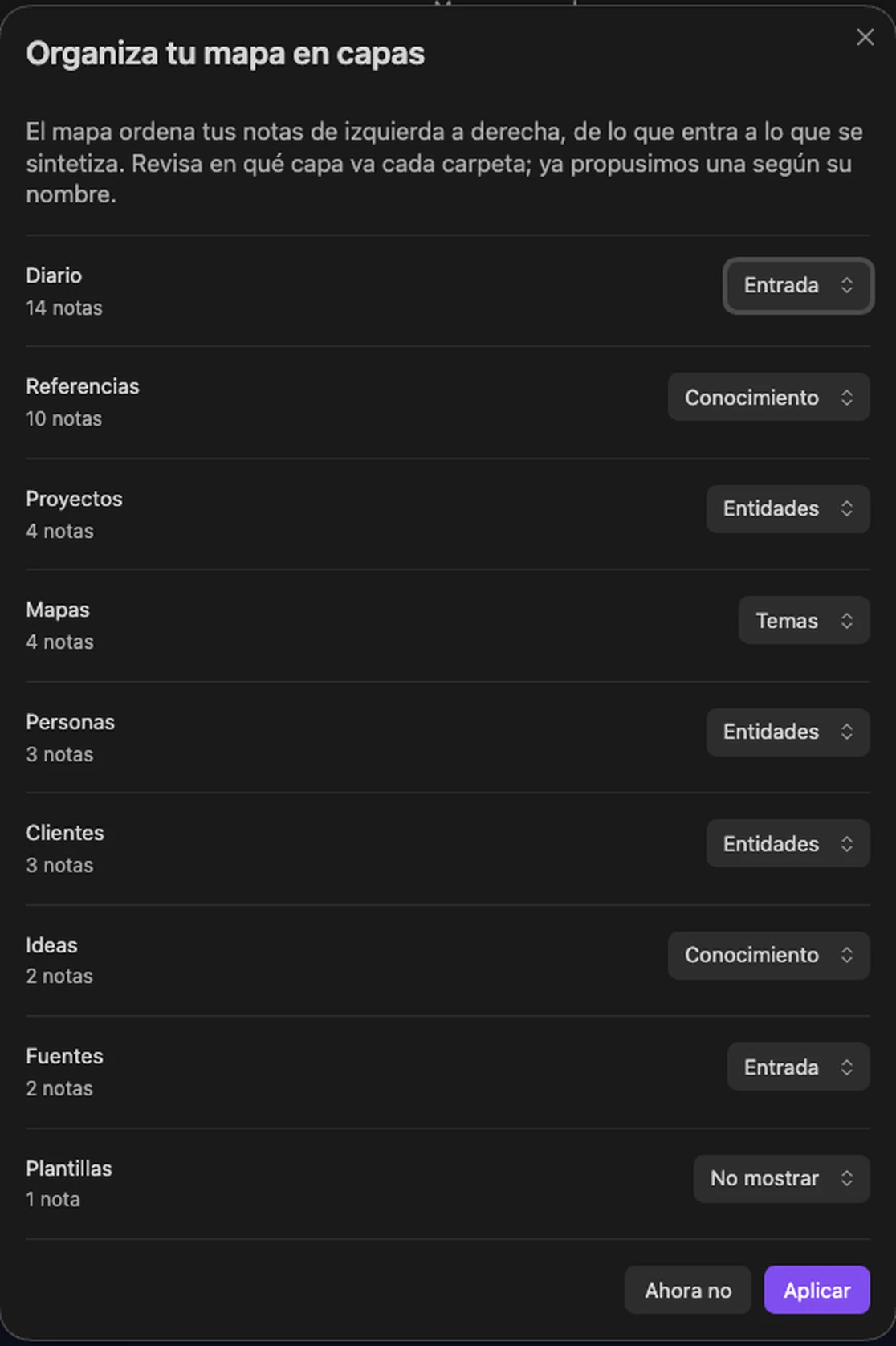
The first-run wizard: every folder with a proposed layer

Everything else lives in the tools menu — the ⋯ tools chip on the map, or the tab's own ··· menu:
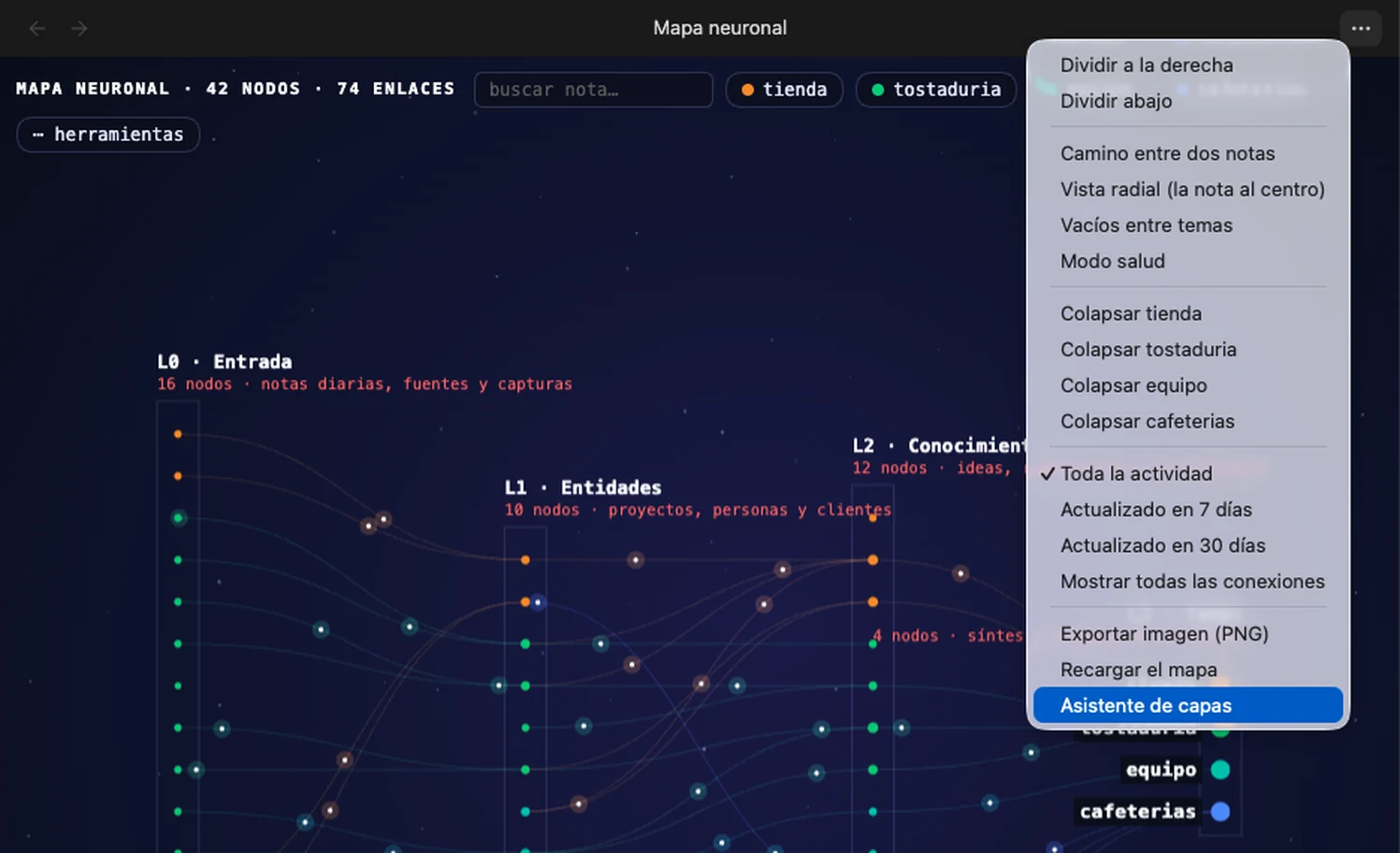
The tools menu: paths, radial view, gaps, health mode, collapsing topics, recent activity and export

What it expects from your vault

The map draws the structure you already have. If your notes live in one flat folder with no topics and no reasons written down, you will see one column and little else — not a bug, just an honest picture of a vault with no layers yet.

It pays off when your vault has, or is moving towards:

  • Folders that mean something. Not notes/, but sources, projects and people, ideas, topics. Three to five layers is the sweet spot.
  • A property that groups notes (tema by default, any name you like). That is what gives each note its colour and makes topics collapsible. Optional: without it the map still works, in one colour.
  • The habit of saying why you link. When a note carries - [[other-note]] — the reason, the panel shows your words. When it does not, it falls back to the sentence where the link appears — and the AI can propose the missing reason for you to approve.

This plugin grew inside a vault built on the LLM wiki pattern — Andrej Karpathy's original design: immutable raw sources on one side, a curated wiki the LLM maintains on the other, and a written contract between them. It does not require that pattern, and it names no folder of its own — but that is the shape it was designed against. Any vault with a deliberate structure (PARA, Zettelkasten with MOCs, a digital garden with topic hubs) gets the same benefit.

If you run an LLM wiki, the map does something specific for you: the raw layer becomes the first column, the curated wiki the middle ones, and the syntheses the last — so you can see at a glance whether your sources are actually being distilled, or just piling up.

If your vault is flat today, the map is still useful as a diagnosis: it shows you exactly how much of your thinking is sitting in one undifferentiated pile.

Bring your own AI (optional)

The map works with no AI at all. If you connect one, it can propose reasons for links that have none, and short summaries for notes that have no description.

Supported: Anthropic (Claude), OpenAI, Google (Gemini), and any OpenAI-compatible local server (Ollama, LM Studio, LocalAI) — the local option needs no key, no internet and no cost. Reasons are written in the language of your notes, not of the interface.

Three locks apply, whatever provider you pick:

  1. Quotes are verified by code. The model must return a literal quote from each note. The plugin looks for those quotes in the files; if one is not there, the proposal is marked unverifiable and cannot be approved. This is what stops confident invention.
  2. A second pass reviews the first, checking the reason against the quotes for negations and states — "we decided not to use X" must not become "we use X".
  3. Nothing is written without you. Approving is a click, and only then does the reason go into your note as a new line. Existing text is never rewritten.

No, and no plugin can. Subscriptions (Claude Pro/Max, ChatGPT Plus) pay for the vendor's own apps; there is no public API you can authenticate with a subscription. The API is a separate product, billed per token with prepaid credit.

Three ways to deal with that:

  • Local AI — free. Ollama or LM Studio on your own machine: no key, no cost, and your notes never leave the computer. This is the answer if you do not want to pay per use.
  • Your own key. A few cents per suggestion — roughly $0.04 with Claude Opus 5. New API accounts get free credit to try it.
  • No AI at all. The AI only proposes reasons for links that do not have one; everything else — layers, paths, gaps, radial, export — never makes a network call.

Plugins that appear to run on "one subscription" are doing one of two things: using a local model (free, like the option above), or paying the API with the developer's own key and charging you a subscription for it — which means your notes pass through their server. This plugin has no server, so that trade is not on the table.

Four fields: pick the provider, paste your key, choose the model, and press Test the connection — one tiny call that tells you whether it answers, without sending any note. The key is stored on this device only.

The AI section of the settings: provider, key, and the test button

Every approval is logged (date, model, quotes, resulting text) in a note under the audit folder, so you can audit or undo later.

Measured accuracy

On a real vault of 254 notes and 916 links, over a reproducible sample of 44 links reviewed blind against the source notes:

Correct Wrong or invented Unverifiable (blocked)
First attempt: small model, only the link's sentence 48% 16%
Current method: full notes + verified quotes + second pass 97.7% 0% 2.3%

That measurement was made with Claude Opus 5. With other models the locks still apply — a proposal without verifiable quotes still cannot be approved — but the hit rate is untested; treat it as unknown until you measure it on your own vault.

Everything else
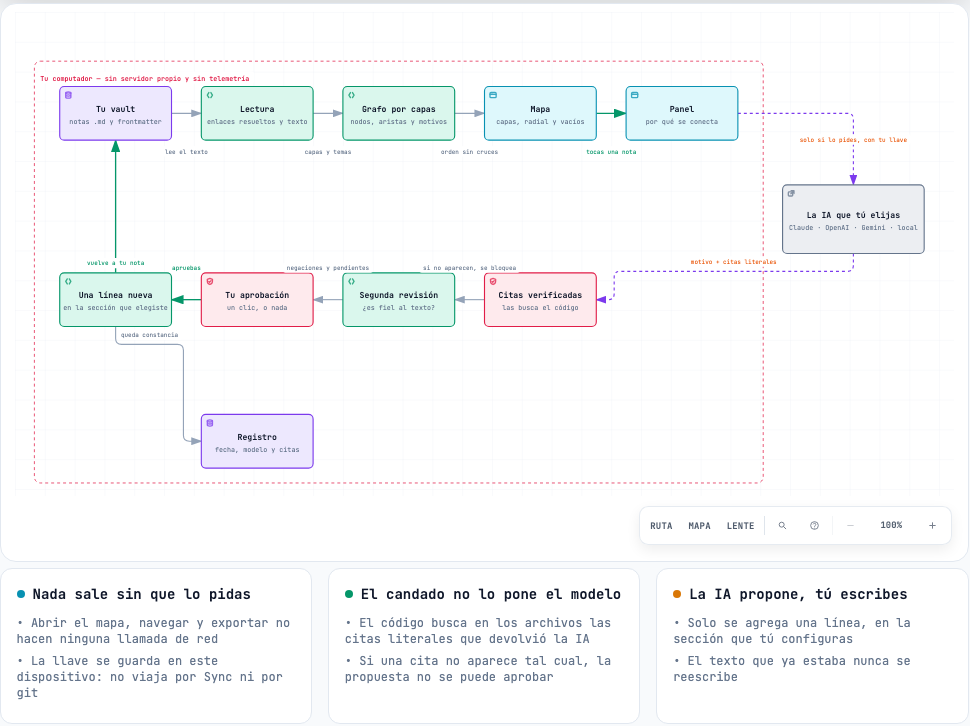
Architecture: from the vault to the map, and how a reason gets approved

Everything above the dashed AI box happens inside your computer, with no network call at all. The AI is reached only when you ask for a suggestion, with your key; whatever it proposes has to survive a code check of its quotes and your approval before a single line is written back to your note. The interactive version of this diagram is in docs/diagramas/mapa-neuronal.html — download it and open it in a browser.

Setting What it changes
Layers One line per layer: Name | description. Three to five works best.
Folders Which folder goes to which layer. The wizard writes this for you.
Topic property The frontmatter property that groups and colours notes (default tema). Empty = no topics.
Notes visible per layer In large vaults each layer shows its most connected notes; the rest appear when you search or open them. Default 150.
Source folders One per line. If your notes cite files by path (raw/articles/x.md, a PDF, a day's folder), those files appear as sources. folder/* groups each subfolder into one node. Empty by default: with no folders, the map is the one you know.
Show cited sources On demand: sources appear when you tap the note that cites them and leave with it. All: always in the first layer. Do not show. If you already had them on, you stay on All.
Connections section The heading at the end of each note where approved reasons are written.
hub: true (frontmatter) In the last layer, the note that carries the topic name on the map. When several notes share a topic there, only the hub is labelled with the topic; the others keep their title. Without the property, it is the first one.
Reload settings from data.json (command) If you edit data.json by hand, read it again without restarting Obsidian.
Export data (JSON and CSV) (tools) The graph exactly as the plugin counts it: nodes, links with reason and sentence, and the counting rules. For Python, spreadsheets or Graphify.
Only long-range links (tools) Shows only the links that jump two layers or more: where two halves of the vault touch end to end.
External links property Frontmatter properties holding web links (Title | https://…, https://…, user/repo). Empty = the section never appears. Only http/https are opened.
Last-modified property If set, approving a reason or a summary also writes today's date in that property. Empty by default: the plugin never touches your frontmatter.
Animation Light pulses travelling along the links. Only while the map is visible, and off if your system asks for reduced motion.

A user reimplemented the engine in Python to predict the counts before touching their vault, and they matched. These are the rules, written once (they also ship inside the exported JSON):

  • Node: every .md file inside a folder assigned to a layer, minus the excluded ones. The most specific folder wins. Sources cited by path do not count as notes.
  • Link: an undirected pair of notes on the map joined by at least one resolved [[wikilink]]. A→B and B→A are one link. Self-links and links to notes off the map are ignored.
  • Reason: the text of - [[note]] — reason in the connections section; failing that, the first body line where the link appears.
  • Topic: the topic frontmatter property; if missing, the most frequent topic among its neighbours.
  • Hub: per topic, the last-layer note with hub: true; if none has it, the first one in that layer with the topic declared.
  • Order within a layer: by topic, then by the weighted barycentre of its neighbours (adjacent layers weigh 1, distant ones 1/distance), six passes.
  • Off the map: notes that fall in no folder with a layer are counted in the header and flagged on load, as are configured folders that hold no notes.
  • Your notes go to the provider you choose, with your key, at your cost. The plugin has no server. The author never sees your notes, your keys or your queries.
  • Keys are stored per device in Obsidian's local storage — never in data.json, so they never travel through git, Obsidian Sync or a backup.
  • Nothing is sent until you ask for a suggestion. Opening the map, browsing, paths and gaps make zero network calls.
  • Rough cost per suggestion with Claude Opus 5: two notes of context plus the review pass. A vault with a hundred reason-less links costs single-digit dollars to work through — and you never have to do it in one go.
  • The local provider (Ollama) sends nothing anywhere: no key, no internet, no cost.
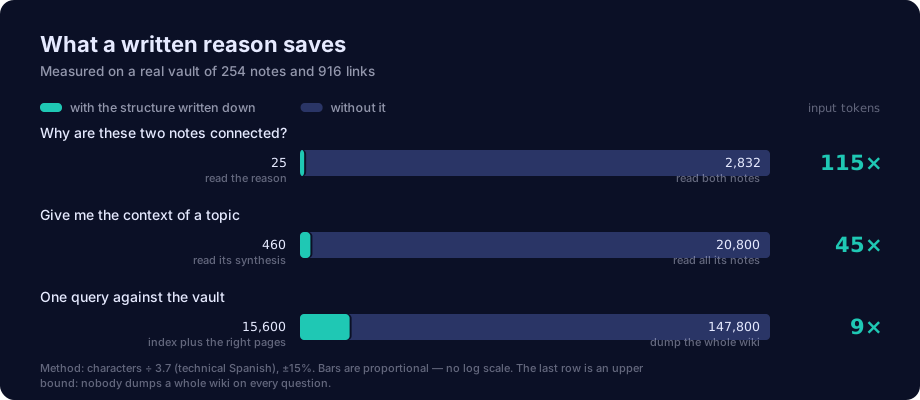
Measured token cost with and without the structure: 115x, 45x and 9x

The plugin does not save tokens by itself — the structure does, and the plugin is what makes the missing pieces impossible to ignore. Its own AI feature spends tokens: about 3,900 of input per suggestion, roughly $0.04 with Claude Opus 5.

What pays off is the other direction. A reason is written once and read many times: by you, and by any agent that works against your vault. The three rows above were measured on the author's vault — 254 notes, 916 links, ~147,800 tokens of wiki — by counting characters ÷ 3.7 and comparing what each question costs to answer with and without the written structure. Your numbers will differ; the ratios are what travel.

The honest caveat is in the figure: nobody dumps a whole wiki on every question — an agent greps. The defensible comparison is the first row, reading the reason instead of opening both notes, and that one is 115×.

Only when you press Approve on an AI suggestion, and only as an appended line in the connections section of that one note. Existing text is never rewritten or reordered, and your frontmatter is not touched unless you fill in the Last-modified property setting, which is empty by default.

Everything else — layers, colours, paths, gaps, exports — is read-only. Exports are the one other write: a PNG into the folder you choose.

There is no telemetry, no analytics and no server: the plugin makes no network request except the AI call you ask for, to the provider you configured.

It does read the list of every note in your vault — a map cannot be drawn from a subset — and the release assets carry GitHub attestations, so you can verify they were built from this source:

gh attestation verify main.js --repo DBB-FC/why-graph

With any vault you see the map. If your notes also cite their sources by path — as an LLM wiki does, with its raw sources in a folder — the map also shows where each thing came from:

  • On demand. Tap a note and the files it cites appear next to it; tap another and they change. The first layer stops growing with every clipping.
  • A source's card opens the original file, lists which notes cite it, and jumps to the exact line of the citation.
  • Broken reference. A note citing a file that does not exist shows in red in health mode.
  • Unlinked sources. Under "⋯ tools", a list of the files in your source folders that no note on the map cites, with the counter "cited: X of Y" and its scope. It says only that: not whether you processed them. Your workflow gives it meaning, not the plugin.
  • Search finds sources, hidden notes and members of collapsed topics.

A citation is an explicit path: in backticks, in a [[wikilink]], in a link, or bare up to the first space. Citing a folder is not the same as citing every file inside it.

Tested on a vault with 5,043 notes and 17,526 links. Each layer draws its most connected notes (default 150) and reveals the rest on demand, so the map stays interactive instead of drawing a grey rectangle. Radial view caps each ring at 80.

The map draws on a dark canvas in both light and dark Obsidian themes — like a night sky, so the topic colours and the light pulses along the links stay readable. The panel, the chips and the settings follow your theme.

Everything runs from src/; the release is one esbuild pass, unminified.

npm install
npm test        # builds src/main.js → main.js and checks the translations
npx eslint src/ # the official Obsidian plugin linter
./instalar-en-vault.sh /path/to/your/vault

src/main.js is the source. main.js in the repository root is the build output and is not committed — releases carry it. The build is a single esbuild pass, no minification, so the released file stays readable.

The README animation is generated the same way, from the real plugin over a demo vault: ./pruebas/mirador/demo.sh.

MIT. Free for anything — personal or commercial — and you may fork it, change it and redistribute it, keeping the copyright notice.

The plugin itself charges nothing and has no paid tier. The Obsidian directory still labels it optional payments, because it can connect to AI services that charge you directly with your own key; the local provider (Ollama, LM Studio) costs nothing at all.

Support

Bugs and ideas: GitHub issues. Include your Obsidian version, your platform, and the number of notes and links the map header shows.


Built by Felipe Córdova · Powered by DBB Labs

Don't Buy. Build.

That is the company's name, not a slogan: a studio of custom systems.Buy what is standard. Build what is strategic.

Free, MIT, no paid tier. If the map showed you something you had not seen, a beer is welcome — and if it did not, the plugin still works exactly the same.

Similar Plugins

info
• Similar plugins are suggested based on the common tags between the plugins.
Dataview
6 years ago by Michael Brenan
A data index and query language over Markdown files, for https://obsidian.md/.
Advanced Canvas
3 years ago by Developer-Mike
⚡ Supercharge your canvas experience! Graph view integration and unlimited styling options empower flowcharts, dynamic presentations, and interconnected knowledge.
Markmind
5 years ago by Mark
A mind map, outline for obsidian,It support mobile and desktop
Meta Bind Plugin
4 years ago by Moritz Jung
A plugin for Obsidian to make your notes interactive with inline input fields, metadata displays, and buttons.
Breadcrumbs
4 months ago by skepticmystic
Add typed-links to your Obsidian notes
Metadata Menu
4 years ago by mdelobelle
For data management enthusiasts : type and manage the metadata of your notes.
Better Export PDF
3 months ago by l1xnan
Obsidian PDF export enhancement plugin
Pretty Properties
a year ago by Anareaty
Supercharged Links
5 years ago by mdelobelle
obsidian plugin to add attributes and context menu options to internal links
Custom File Explorer sorting
4 years ago by SebastianMC
Take full control over the order and sorting of folders and notes in File Explorer in Obsidian
Heatmap Calendar
5 years ago by Richard Slettevoll
An Obsidian plugin for displaying data in a calendar similar to the github activity calendar
Map View
5 years ago by esm
Interactive map view for Obsidian.md
MetaEdit
5 years ago by Christian B. B. Houmann
MetaEdit for Obsidian
Juggl
5 years ago by Emile van Krieken
An interactive, stylable and expandable graph view for Obsidian. Juggl is designed as an advanced 'local' graph view, where you can juggle all your thoughts with ease.
Local GPT
3 years ago by Pavel Frankov
Local Ollama and OpenAI-like GPT's assistance for maximum privacy and offline access
Charts View
5 years ago by caronchen
Data visualization solution in Obsidian, support plots and graphs.
Digital Garden
2 months ago by oleeskild
Auto Card Link
4 years ago by Nekoshita Yuki
Update time on edit
5 years ago by beaussan
Snipd Official
4 months ago by snipd-app
Media DB Plugin
4 years ago by Moritz Jung
A plugin that can query multiple APIs for movies, series, anime, games, music and wiki articles, and import them into your vault.
3D Graph
4 years ago by Alexander Weichart
👓 A 3D graph for Obsidian!
Extended Graph
a year ago by Kapirklaa
Community plugin to add features to the graph view.
April Automatic Timelines
3 months ago by april-gras
Simple timeline generator plugin for story tellers using obsidian
Contribution Graph
3 years ago by vran
generate interactive gitxxx style contribution graph for obsidian, use it to track your goals, habits, or anything else you want to track.
Maps
a year ago by Obsidian
Map layout for Obsidian Bases. Display your notes as an interactive map view.
Bible Reference
2 months ago by tim-hub
Take Bible Study notes easily in the popular note-taking app Obsidian, with automatic verse and reference suggestions.
Heatmap Tracker
2 years ago by Maksim Rubanau
A customizable heatmap tracker plugin for Obsidian to visualize daily data trends with intuitive navigation and flexible settings.
Persistent Graph
5 years ago by Sanqui
An Obsidian plugin for saving and restoring the positions of nodes on the global graph view
Diagrams.Net
4 years ago by Jens M Gleditsch
This repository contains a plugin for Obsidian for inserting and editing diagrams.net (previously draw.io) diagrams.
Mehrmaid
2 years ago by huterguier
Rendering Obsidian Markdown inside Mermaid diagrams.
Note Gallery
3 years ago by Pash Shocky
A masonry note gallery for obsidian.
Smart Connections Visualizer
2 years ago by Evan Moscoso
Visualize your notes and see links to related content with AI embeddings. Use local models or 100+ via APIs like Claude, Gemini, ChatGPT & Llama 3
Link Exploder
4 years ago by Ben Hughes
InfraNodus AI Graph View
2 years ago by Nodus Labs
Advanced graph view for Obsidian: text analysis, topic modeling, and AI with InfraNodus AI text analysis tool: https://infranodus.com
Desmos
4 years ago by Nigecat
Embed graphs directly into your obsidian notes
Optimize Canvas Connections
4 years ago by Félix Chénier
An Obsidian plugin that declutters a canvas by reconnecting notes using their nearest edges
Metadata Extractor
5 years ago by kometenstaub
Obsidian Plugin that provides metadata export for use with third-party apps.
Graph Banner
2 years ago by ras0q
An Obsidian plugin to display a relation graph view on the note header.
Journalit
2 months ago by Cursive
Obsidian trading journal with broker sync, trade imports, analytics, prop firm tracking, reviews and rule-based trading workflows.
Enhanced Canvas
2 years ago by RobertttBS
When editing on Canvas, properties and Markdown links to notes are automatically updated, enabling backlinks in Canvas.
Vault Changelog
6 years ago by Badr Bouslikhin
An Obsidian plugin to maintain a changelog of recently edited notes
New 3D Graph
a year ago by Aryan Gupta
Visualize your vault in 3D with a powerful, highly customizable, and filterable graph.
Mindmap
2 years ago by YunXiaoYi
An Obsidian plugin for creating Mindmaps.
Show Whitespace
3 years ago by Erin Schnabel
Show leading/trailing whitespace
Nested tags graph
3 years ago by drpilman
A small plugin for Obsidian that links nested tags in graph view
D2
4 years ago by Terrastruct
The official D2 plugin for Obsidian. D2 is a modern diagram scripting language thats turns text to diagrams.
Habit Tracker
5 years ago by duo
This plguin for Obsidian creates a simple month view for visualizing your punch records.
Frontmatter Markdown Links
2 years ago by mnaoumov
Obsidian Plugin that adds support for markdown links in frontmatter
Sync Graph Settings
4 years ago by Xallt
This is a plugin for syncing graph settings (Color Groups and Search Filters) to Local Graphs
Canvas Links
3 years ago by aqav
Show the links between "Canvas" and "File"
Advanced Exclude
3 months ago by mnaoumov
Obsidian plugin that enhances the Excluded files setting bringing gitignore syntax.
Canvas Filter
4 years ago by Ivan Koshelev
Obsidian Canvas plugin that let's you show only pages / arrows with specific tags / colors / connections.
AI Tagger Universe
2 years ago by Hu Nie
An intelligent Obsidian plugin that leverages AI to automatically analyze note content and suggest relevant tags, supporting both local and cloud-based LLM services.
Living Graph
5 years ago by Garrett
Advanced Progress Bars
a year ago by cactuzhead
Obsidian plugin to create custom progress bars
CardNote
3 years ago by cycsd
Help you extract your thoughts more quickly in canvas
Binary File Manager
5 years ago by qawatake
An Obsidian plugin to manage binary files
Tasks Map
a year ago by NicoKNL
A graph view of your tasks.
Fold Properties By Default
2 years ago by Tommy Bergeron
Always have editor/metadata properties folded by default.
Graph Link Types
3 years ago by natefrisch01
Link types for Obsidian graph view.
Neo4j Graph View
6 years ago by Emile van Krieken
Chessboard Viewer
6 years ago by Davide Aversa
Plugin to render chessboards in Obsidian using chessboardjs
NetClip
2 years ago by Elhary
this plugin is for Obsidian that allows you to browse the web and clip webpages directly into your vault.
Path Finder
4 years ago by jerrywcy
A plugin that can find the paths between two notes. Not sure who will want to use it...
Canvas Mindmap Helper
3 years ago by Tim Smart
Release Timeline
4 years ago by cakechaser
Habit Tracker
4 years ago by David Moeller
A Plugin to display a Habit Tracker in Obsidian.
Nifty Links
3 years ago by x-Ai
Generating elegant, Notion-styled rich link cards to enhance your note-taking experience.
Galaxy View
2 months ago by Rick
Export Graph View
2 years ago by Sean McGhee
Plugin to export your vault's graph view.
Auto Tag
3 years ago by Control Alt
Easily generate relevant tags for your Obsidian notes.
Arrows
3 years ago by artisticat
Draw arrows across different parts of your notes, similar to on paper
Argument Map with Argdown
5 years ago by amdecker
Media Companion
2 years ago by Nick de Bruin
Dirtreeist
4 years ago by kasahala
Render a directory Structure Diagram from a markdown lists in codeblock.
Conditional Properties
8 months ago by Diego Eis
Automate frontmatter property updates in your Obsidian notes using simple conditional rules.
Metadata Auto Classifier
2 years ago by Beomsu Koh
AI-powered Obsidian plugin that automatically classifies and generates metadata (tags, frontmatter) for your notes.
Metadata Icon
3 years ago by Benature
change metadata entry icon
Content Cards
2 years ago by leo
Insert content cards in Markdown, such as timeline, highlightblock, target card, book information card, music information card, movie information card, photoes ablum, business card, content subfield, countdown, SWOT,BCG.
Notes dater
3 years ago by Paul Treanor
Adds created_on and updated_on dates of the active note to status bar
Bulk Exporter
3 years ago by symunona
Bulk export Markdown filtered, renamed and sorted by front matter metadata into a new structure.
Chemical Structure Renderer
3 years ago by xaya1001
Render chemical structures from SMILES strings into PNG or SVG format using Ketcher and Indigo Service.
Update Time
2 years ago by Sébastien Dubois
Obsidian plugin that updates front matter to include creation and last update times
Kanban Status Updater
a year ago by Ankit Kapur
Obsidian plugin that automatically updates the note property when card is moved to a column.
WaveDrom
5 years ago by Alex Stewart
Linked Data Vocabularies
3 years ago by kometenstaub
Add linked data to the YAML of your Obsidian notes.
Bases Toolbox
2 months ago by Grub Basket
Adds Quality of Life features to Obsidian Bases
Node Factor
a year ago by CalfMoon
Customize factors effecting node size in obsidian graph.
Adamantine Pick
4 years ago by Urist McMiner
Embeddable Pikchr(https://pikchr.org) diagrams renderer plugin for Obsidian(https://obsidian.md)
Graphs
3 years ago by Dylan Hojnoski
Plugin for Obsidian that renders interactive graphs from YAML.
Frontmatter generator
3 years ago by Hananoshika Yomaru
A plugin for Obsidian that generates frontmatter for notes
Note aliases
4 years ago by Pulsovi
This plugin manages wikilinks aliases and save them on the aliases list of the linked note
File Title Updater
2 years ago by wenlzhang
An Obsidian plugin that synchronizes titles between filename, frontmatter, and first heading in your notes.
YourPulse - Your Writing Activity Visualised
2 years ago by Jiri Sifalda
YourPulse.cc - Obsidian.md plugin that turns your vault into a reflection of your creativity, and put your writing on steroids 💪
Additional Icons
3 years ago by Matthew Turk
Add additional iconsets to Obsidian
Symbol linking
a year ago by Evan Bonsignori ; Mara-Li
Adds ability to link with any trigger in Obsidian. Each trigger can limit linking to specific folders or file.
Mermaid Icons
7 months ago by toshs
Obsidian plugin enabling the use of icons in Mermaid diagrams.
Lilypond
3 years ago by DOT-ASTERISK
Lilypond for Obsidian
KoReader Highlight Importer
2 years ago by Tahsin Kocaman
Imports highlights and metadata from KoReader into Obsidian notes
Flowcharts
2 years ago by land0r
Flowchart Plugin for Obsidian – Create and customize flowcharts seamlessly within your Obsidian vault. Powered by Flowchart.js and designed for productivity
Desk
3 years ago by David Landry
A desk for obsidian
Copy Metadata
3 years ago by wenlzhang
An Obsidian plugin to copy metadata to clipboard and insert it into file name.
Lineup Builder
5 years ago by James Fallon
An Obsidian plugin that lets you build football lineups
Tier List
2 years ago by Mox Alehin
Obsidian plugin for visual ranking and organizing content into customizable Tier Lists.
Laws of Form
3 years ago by Kevin German
ASCII Tree Generator
2 years ago by Matěj Michálek
Generate Timeline
a year ago by Shanshuimei
An obsidian plugin to generate timelines from tags, folders, files or metadata automatically. 根据标签,文件夹,文件或者属性自动生成时间轴的插件。
Easy Timeline
2 years ago by Romeliun
The Easy Timeline plugin for Obsidian allows you to create timelines easily.
File Index
3 years ago by Steffo
Obsidian plugin to create a metadata file about the files present in the Vault
Note UID Generator
a year ago by Valentin Pelletier
Allow you to automatically generate UID for the notes in your vault.
Weather Widget
8 months ago by mr-asa
Weather widget for display in notes, Canvas, and a separate tab.
Storyclock Viewer
3 years ago by Jonathan Fisher
Obsidian plugin for creating a storyclock
Folder Canvas
2 years ago by Nancy Lee
Generate a canvas view of your folder structure
Mathematica Plot
3 years ago by Marcos Nicolau
Insert functions on Obsidian using Wolfram Mathematica!
BattleSnake Board Viewer
3 years ago by EnderInvader
Plugin to render battlesnake boards in Obsidian
Markline
3 years ago by 闲耘
Markline: Markdown timeline view in Obsidian.
Folder Navigator
a year ago by wenlzhang
An Obsidian plugin that allows you to quickly navigate to folders in your vault using fuzzy search.
Dataview Autocompletion
2 years ago by Daniel Bauer
Extended File Support
2 years ago by Nick de Bruin
Adds opening and embedding support for various filetypes to Obsidian
GitHub Integration
a year ago by Kirill Zhuravlev
Plugin that fetch your github stars into notes
Mapbox Location Image
2 years ago by Aaron Czichon
Render a mapbox location image based on provided coordinates
Alfonso Money Manager
3 years ago by SmartLifeGPT Innovation
This is the repository for the obsidian plugin of the Alfonso Money Manager mobile application
Quran Helper
2 years ago by Ammar Alakkad
Obsidian plugin to find and insert any Quran Ayah (verse) in your notes
LLM Tagger
2 years ago by David Jayatillake
Image Metadata
2 years ago by alexeiskachykhin
Adds image metadata editing capabilities to Obsidian
Inline Local Graph
8 months ago by TKOxff
Inline Local Graph of Obsidian
Canvas Explorer
2 years ago by Henri Jamet
A plugin that enables users to explore their vault by iteratively adding or ignoring linked notes, ultimately generating a customizable canvas that visually represents the preserved notes and their connections.
Plot Vectors and Graphs
2 years ago by Nicole Tan YiTong
Obsidian Plugin to generate graphs given the function.
Life in Weeks Calendar
10 months ago by Jeff Szuc
Plugin for the Obsidian markdown editor. Displays a calendar of your life in weeks with weekly Periodic Notes plugin integration. Includes options for the traditional Memento Mori/Stoic style calendar, as well as a Gregorian calendar accurate version.
Paste Image Into Property
2 years ago by Nito
Hide Index Files
a year ago by d7sd6u
Hides folder notes from the file explorer
Magic Move
2 years ago by imfenghuang
Animating Code Blocks in Obsidian
NodeFlow
2 years ago by LincZero
Render node streams like `ComfyUi`, `UE`, `Houdini`, `Blender`, etc., to make it easy to write relevant notes. json describes the chart, compared to screenshots, making it easier to modify later. The plugin is also compatible with blogs.",
Book Clipper
9 months ago by Hossein Fardmohammadi
Save book details from websites into your notes
Waveform Player
2 years ago by Zhou Hua
Virus Total Enrichment
2 years ago by ytisf
An Obsidian plugin to enrich a note with VirusTotal API.
Note Codes
a year ago by Ezhik
Reference your Obsidian notes from anywhere with simple 4-character codes.
Metadata Validator
a month ago by flowing-abyss
Manifest-driven metadata validation for Obsidian.
Timelive
a year ago by aNNiMON
Turn a list of dates into a timeline
Sentinel
2 years ago by Giorgos Sarigiannidis
A plugin for Obsidian that allows you to update properties or run commands based on document visibility changes.
Boardgame Search
2 years ago by Marlon May
A plugin to create notes for boardgames based on the BGG API
Every Day Calendar
2 years ago by QuBe
Obsidian plugin to create calendars inspired by Simone Giertz's Every Day Calendar
Papers
a year ago by William Liang
An obsidian plugin to retrieve and import research papers.
Note Favicon
2 years ago by mdklab
Obsidian plugin – Show Favicon from Metadata
Visited Countries
a year ago by Ivan Peshykov
Obsidian plugin to mark and visualize the countries you've visited on an interactive world map.
Auto Math
6 months ago by Vladislav Sorokin
Auto-expand LaTeX math snippets in Obsidian — write equations faster.
Sankey
2 years ago by Finn Romaneessen
An Obsidian plugin to create sankey diagrams
Offline Whisper Transcription
2 months ago by David Manthey
Canvas Folding
25 days ago by hkohlhoff
Collapse and expand hierarchical branches in Obsidian Canvas.
ExMemo Assistant
2 years ago by ExMemo AI
Using LLMs to manage files and generating metadata such as tags and summaries.
Crosslink Advanced
a year ago by d7sd6u
Ftags commands toolkit
NyanBar
2 years ago by xhyabunny
Give life to your Obsidian notes with NyanBar !
Current File Tags
2 years ago by Trung Tran
Kale Graph
2 years ago by Oli
Render mathematical graphs in Obsidian
Simple File Info
a year ago by Lukas Capkovic
My Thesaurus
2 years ago by Mara-Li
A plugin that auto tags file based on contents and a csv file or a Markdown table (inspired by https://github.com/pmartinolli/MyThesaurus)
Watched-Metadata
2 years ago by Nail Ahmed
Watches for changes in metadata and updates the note content accordingly.
Course Module Loader
a year ago by Sebastian Kamilli
Downloads and unzips course module zip files from a URL into a specified vault folder, skipping existing files.
Another Name
a year ago by Jiyuan Wang
Add a subheading to your note in Obsidian
GLSL Viewer
8 months ago by iY0Yi
Preview GLSL shaders on Obsidian.
Mahgen Renderer
2 years ago by Michael Francis Williams
Obsidian plugin to render mahgen automatically
Property Panels
2 months ago by Eva Chen
Display and edit Obsidian frontmatter properties in configurable panels that stay inside the note's scrollable content.
Discrete
a year ago by shkarlsson
Poker Range
2 years ago by marplek
Easily create, view, and interact with poker hand ranges in your obsidian.
Just Simple Excalidraw
a month ago by David Hurt
A local-first Excalidraw editor for native .excalidraw files in Obsidian, preserving the original's brilliant simplicity.
Onto Tracker
2 years ago by Jacob Hart
Plugin for obsidian allowing project management with ontologies.
Frontmatter Metadata Link Classes
a year ago by Varvara Zmeeva / zmeeva.io
Enhanced internal links with automatic classnames based on frontmatter metadata.
ShaahMaat-md
2 years ago by Mihail Kovachev
Class Relation Visualization
2 years ago by Yong
Frontmatter to HTML Attributes
6 months ago by Tarek Saier
GoBoard
8 months ago by Dmitry I. Sokolov
Obsidian plugin for rendering Go game diagrams from markdown code blocks
Vault Shelf
7 days ago by Lukas Proprentner
Your Obsidian vault as a browsable library: shelves of books built from titles, dates, people, tags, folders or any note property. Customizable to make it your own.
PixNote
a month ago by Sofia Milton
Store
2 months ago by shimeoki
Manage your notes within a single folder.
Mahjong Renderer
2 years ago by hypersphere
OsyC
6 days ago by 3yesore