
README file from
GithubApple System Colors
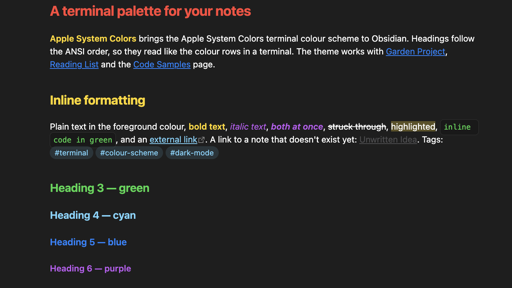
An Obsidian theme based on the Apple System Colors terminal scheme (macOS system colours). Dark mode only.
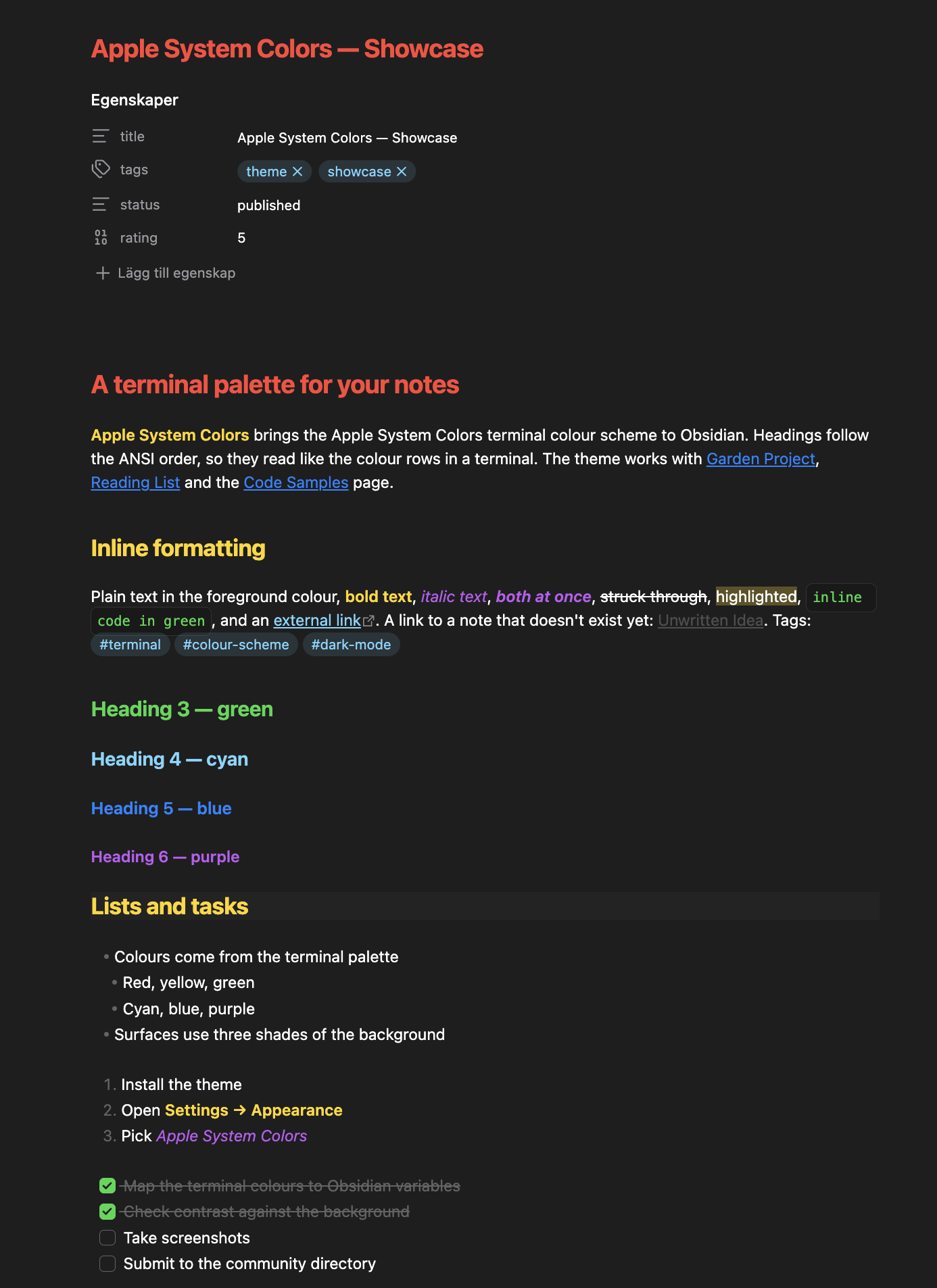
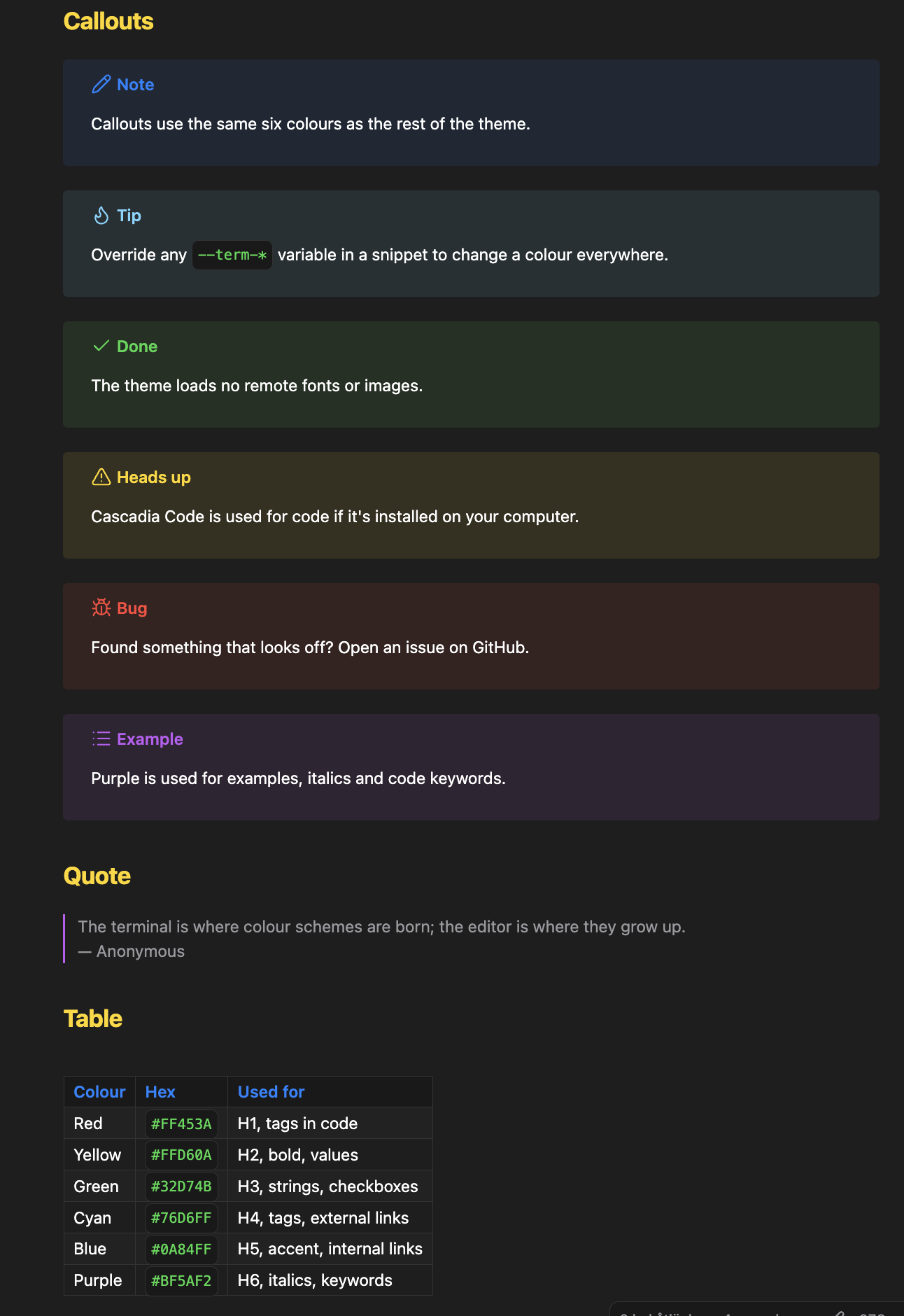
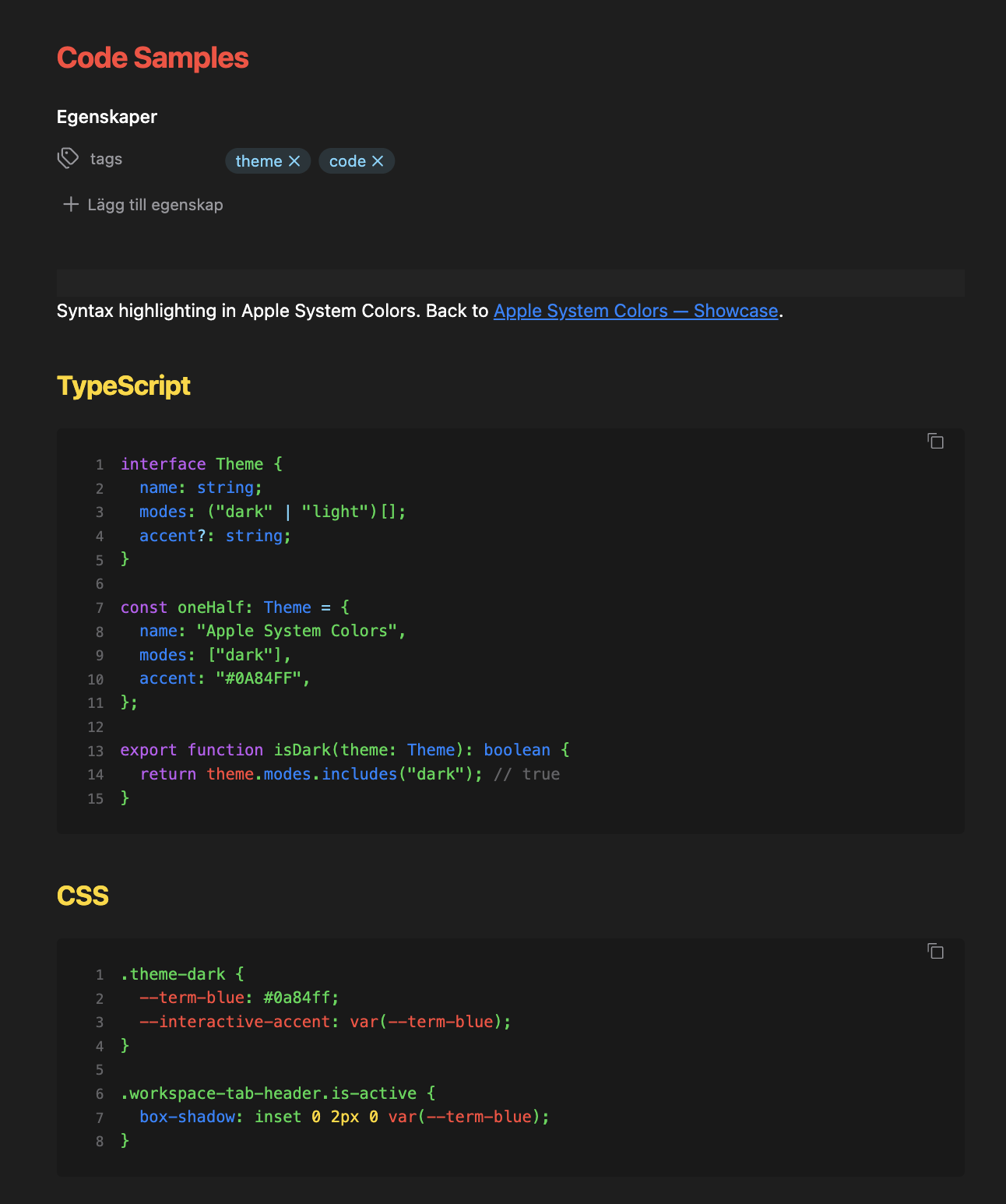
| Callouts | Code highlighting | Tables and code | Project note |
|---|---|---|---|
 |
 |
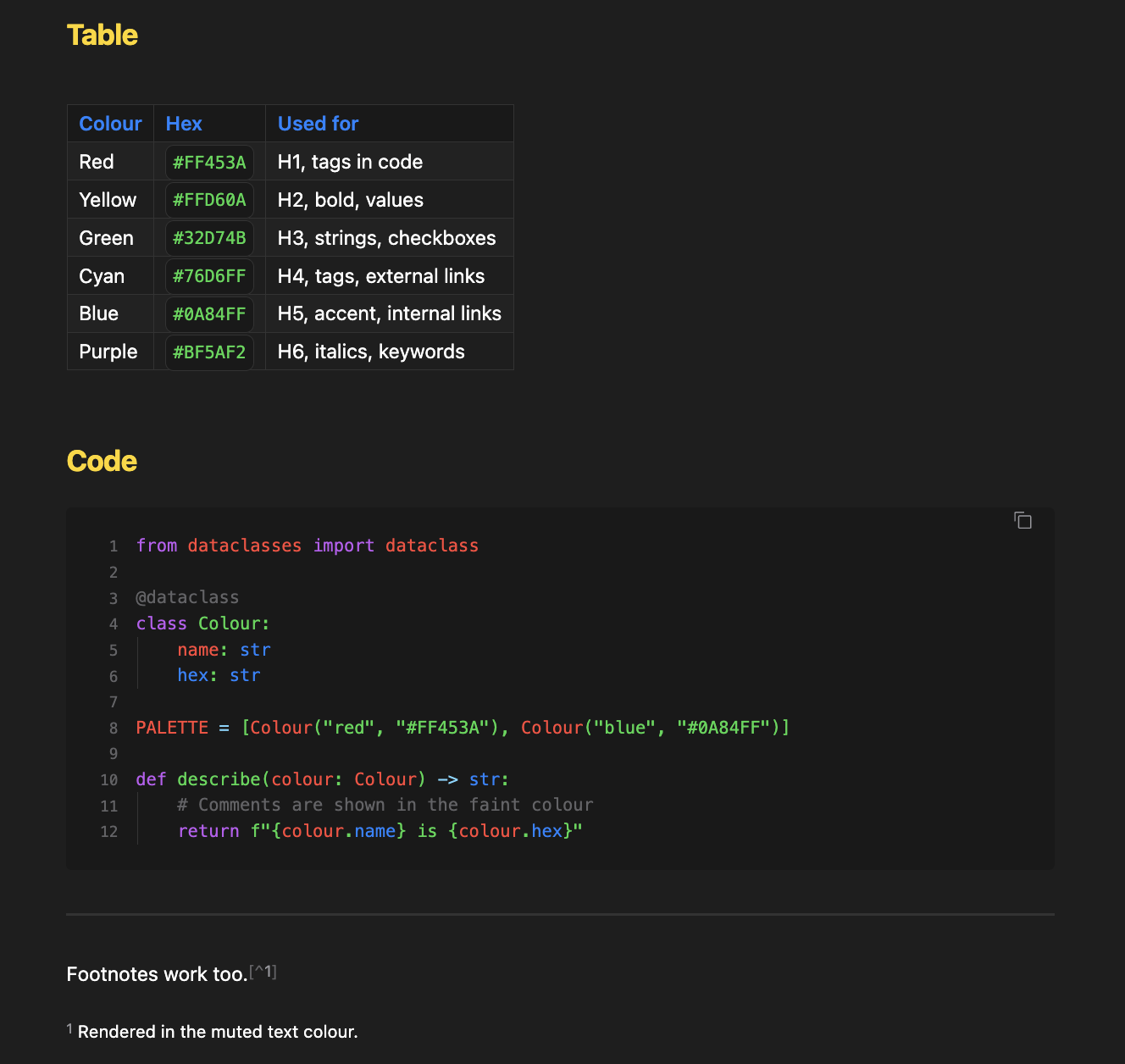 |
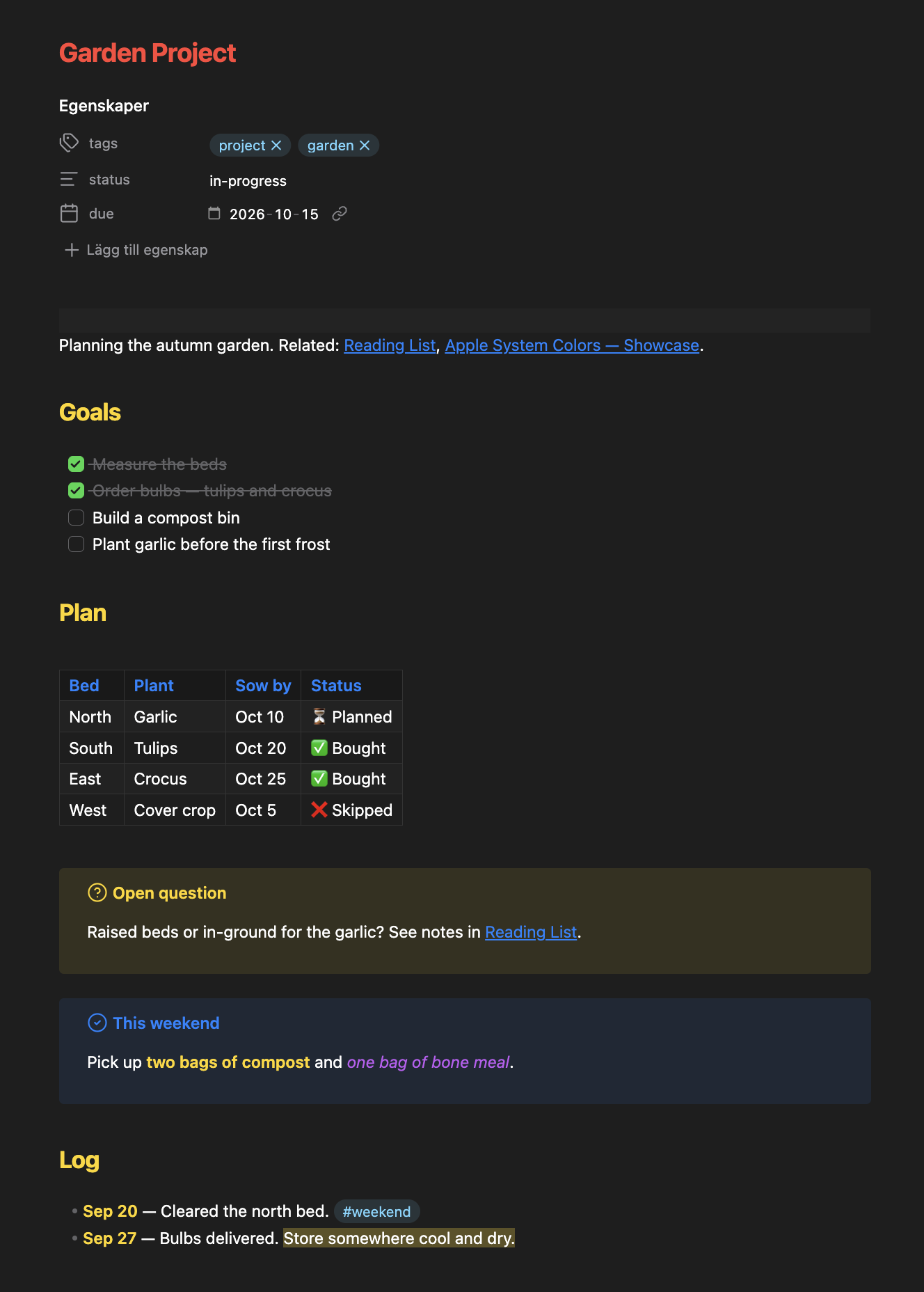 |
Palette
| Role | Colour | Used for |
|---|---|---|
| Background | #1E1E1E |
Editor |
| Foreground | #FFFFFF |
Body text |
| Faint | #636366 |
Comments, unresolved links, finished tasks |
| Red | #FF453A |
H1, note title, tags and properties in code |
| Yellow | #FFD60A |
H2, values in code |
| Green | #32D74B |
H3, inline code, strings, checkboxes |
| Cyan | #76D6FF |
H4, tags, external links |
| Blue (accent) | #0A84FF |
H5, accent, internal links, functions |
| Purple | #BF5AF2 |
H6, italics, quote bar, keywords |
Text uses the scheme's bright colours; the normal ANSI colours are too dark for readable text on #1E1E1E.
Features
- Headings H1–H6 follow the ANSI order: red → yellow → green → cyan → blue → purple
- Code syntax highlighting, callouts, tables, tags, graph view and checklists use the same palette
- Accent line on the active tab, like a terminal
- Monospace font order: Cascadia Code → JetBrains Mono → SF Mono → Menlo, using fonts already on your computer (no remote assets)
- Built only on Obsidian CSS variables with low-specificity selectors and no
!important, so you can override anything with a snippet
Installation
From Obsidian (recommended)
- Open Settings → Appearance.
- Under Themes, select Manage.
- Search for Apple System Colors and select Install and use.
Manual installation
- Download
manifest.jsonandtheme.cssfrom the latest release. - In your vault, create the folder
.obsidian/themes/Apple System Colors/and put both files in it. - Restart Obsidian or reload the theme list, then pick Apple System Colors under Settings → Appearance → Themes.
Usage
- Dark mode only: set Settings → Appearance → Base colour scheme to Dark. In light mode Obsidian's default light colours are used.
- Code font: install Cascadia Code to get the Windows Terminal font in code blocks.
Customising
The theme has no Style Settings options. You customise it with a CSS snippet instead:
- Open Settings → Appearance → CSS snippets and select the folder icon to open the snippets folder.
- Create a file such as
obsidian-apple-system-colors-tweaks.cssand add your overrides (examples below). - Back in Obsidian, reload the snippets and switch on your snippet.
Every colour is set once at the top of theme.css as a --term-* variable (--term-red, --term-yellow, --term-green, --term-cyan, --term-blue, --term-purple, --term-bg, --term-fg and so on), and everything else is built from them.
/* Plain foreground-coloured bold text */
.theme-dark {
  --bold-color: var(--term-fg);
}

/* All headings in one colour */
.theme-dark {
  --h1-color: var(--term-blue);
  --h2-color: var(--term-blue);
  --h3-color: var(--term-blue);
  --h4-color: var(--term-blue);
  --h5-color: var(--term-blue);
  --h6-color: var(--term-blue);
}
Credits
The palette comes from the "Apple System Colors" colour scheme in the iTerm2 Color Schemes collection (MIT), as listed on windowsterminalthemes.dev. The theme structure is shared with One Half Dark.