
README file from
GithubVault Inspector
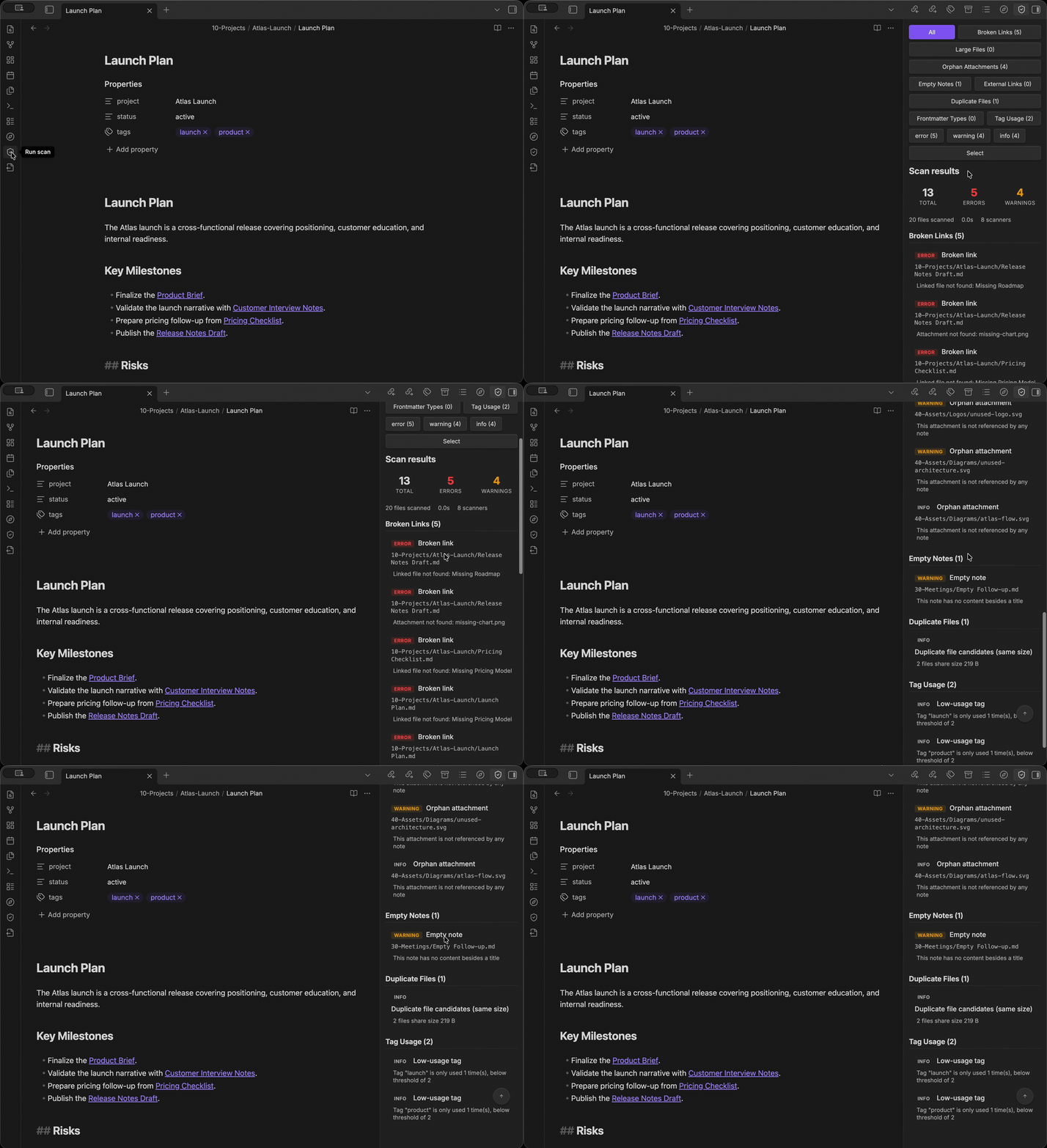
Scan your Obsidian vault for maintenance problems: broken links, missing attachments, orphan files, duplicate files, empty notes, tag issues, and large files.
Use it before publishing, exporting, migrating, or cleaning up a long-lived vault.
Features
- Broken Links — Detect wiki links, markdown links, and embeds pointing to non-existent notes or headings.
- Orphan Attachments — Find images, PDFs, audio/video, and archives not referenced by any note.
- Empty Notes — Flag notes with no meaningful content beyond frontmatter and title.
- External Links — Optionally check external URLs for availability (HTTP status).
- Duplicate Files — Identify duplicates by name, size, and optional SHA-256 content hash.
- Frontmatter Types — Report properties used with inconsistent value types across notes.
- Tag Usage — Watch for missing or underused tags from a configurable watchlist.
- Large Files — Flag Markdown files and attachments exceeding configurable size thresholds.
- Scan Progress — Show scanner progress in Obsidian and optional CLI progress on stderr.
- Explainable Findings — Classify each finding as
confirmed,candidate, orunverified, with Why, an optional Caveat, a Next step, and expandable raw evidence. - Scan Lifecycle — Compare successful scans made with the same detection profile to distinguish new, persisting, and resolved findings.
- Verified Actions — Preflight fix actions against fresh scan data, then report each attempted fix as fixed, still present, skipped, or failed after final verification.
Install
Community Plugins
Search Vault Inspector in Obsidian → Settings → Community plugins → Browse.
Manual
Download main.js, manifest.json, and styles.css from the latest release and place them in .obsidian/plugins/vault-inspector/.
CLI
The npm package also includes a read-only terminal scanner for local vaults, automation, and CI workflows:
npx vault-inspector /path/to/your/vault
Or install it globally:
npm install -g vault-inspector
vinspect /path/to/your/vault
The Obsidian Community Plugin release assets contain only the in-app plugin
files. The npm package additionally includes cli.js and exposes the
vault-inspector and vinspect commands. Starting with 0.4.10, the npm
package is the supported CLI distribution path again.
Agent Skill
Vault Inspector includes a read-only Agent Skill for CLI-based vault checks:
gh skill install rogerdigital/vault-inspector vault-inspector
It can also be installed with the skills CLI:
npx skills add rogerdigital/vault-inspector --skill vault-inspector
The skill teaches agents to run scans, interpret JSON/Markdown output, use baselines, and avoid modifying vault files.
Usage
- Open the command palette and run Vault Inspector: Run scan.
- The Inspector view opens in the right sidebar.
- Filter results by scanner, severity, lifecycle, or classification. Expand Evidence to inspect the raw scanner evidence behind the explanation.
- Click paths, URLs, targets, properties, or tags to jump to the relevant location.
- Open an active finding's Actions menu to ignore it, choose Exclude parent folder, or open its scanner settings. Parent-folder exclusions apply only to that scanner and can be removed from Scanner-specific ignored folders in settings.
- Click Select to enter selection mode, then batch delete or ignore issues. Fix results remain visible until dismissed and show whether each item was fixed, still present, skipped, or failed after verification.
- Expand Resolved items to review read-only rows from the previous compatible successful scan. Expand Ignored items to restore previously ignored issues.
- Run Vault Inspector: Export report to save results as Markdown. When a complete in-vault report would exceed 1 MiB, choose a compact summary, explicitly export the complete report anyway, or cancel.
Scan results are selectable for copying. Duplicate file results show each file
separately, tag results show #tag chips, and exported Markdown reports include
scanner-specific detail fields.
Plugin exports measure the complete Markdown output before writing into the vault. Reports larger than 1 MiB require an explicit choice because large Markdown files may make Obsidian unresponsive while indexing. Summary exports keep scan totals and per-scanner counts but omit per-finding details. This in-vault protection does not change CLI Markdown output.
Each finding is classified as confirmed, candidate, or unverified and
includes a plain-language explanation: why it was reported, an optional caveat,
and a suggested next step. Raw evidence remains available separately for deeper
inspection.
Lifecycle comparison is available only after a successful scan and only when the previous successful scan used the same detection profile. The first successful scan establishes a baseline; changing detection settings or scanner semantics also establishes a new baseline instead of marking every finding as new. Ignoring a finding does not resolve it: ignored findings remain part of the active lifecycle comparison. Resolved rows are read-only historical records from the previous compatible snapshot, not current findings or proof that an action fixed them.
CLI
Vault Inspector also exposes a read-only CLI for generated or agent-managed vaults.
Scan a vault:
vinspect /path/to/your/vault
From inside a vault, . means the current directory:
cd /path/to/your/vault
vinspect .
The full command also remains available:
vault-inspector /path/to/your/vault
Pin a specific npm version when repeatability matters:
npx [email protected] /path/to/your/vault
vault-inspector scan /path/to/vault is also supported for scripts that prefer
an explicit subcommand.
The default output format is JSON. It includes summary counts, scanners run, issues, ignored issues, fingerprints, classification, explanation, evidence, and available fix-action metadata so other tools can decide what to do next.
Common options:
vinspect . --format markdown --output report.md
vinspect . --scanner broken-links,empty-notes
vinspect . --scanner external-links
vinspect . --progress
vinspect . --config vault-inspector.config.json
--progress writes scanner progress to stderr so JSON and Markdown output on
stdout remain machine-readable.
For CI baseline checks:
vinspect . --baseline .vault-inspector-baseline.json --fail-on new
Config files are JSON and use the same option names:
{
  "scanners": ["broken-links", "empty-notes", "large-files"],
  "severity": ["error", "warning"],
  "include": ["notes/**"],
  "exclude": ["templates/**"],
  "ignoredFolders": [".trash"],
  "failOn": "warning",
  "largeMarkdownBytes": 102400
}
CLI flags override config file values.
Settings omitted from a config file fall back to the plugin defaults — for
example, ignoredLargeMarkdownFrontmatterKeys already defaults to
["excalidraw-plugin"], so Excalidraw drawings are ignored without any config.
If your config lists the older "excalidraw" key, update it to
"excalidraw-plugin".
JSON output has a stable top-level protocol for automation:
schemaVersion— currently1tool— alwaysvault-inspectortoolVersion— package versionsummary— stable counts and scanner metadata, including the issue count insummary.issuesissues/ignoredIssues— issue records with stablescannerId,severity,classification,explanation,primaryPath,relatedPaths,evidence,fingerprint, andfixActionfieldsgeneratedAt,durationMs, titles, and messages are informational and should not be used as stable identifiers
classification and explanation are additive stable fields. Existing stable
fields have not been removed or renamed.
Baseline comparison uses issue fingerprint values from a previous JSON report.
When --baseline is provided, each issue includes isNew, and summary.newIssues
counts issues not found in the baseline.
CLI baseline comparison is separate from the Obsidian plugin lifecycle. In version 0.5.0, CLI output does not include plugin scan snapshots, persisting or resolved lifecycle rows, or the plugin's resolved-history view.
Exit codes:
0— scan completed and did not match the configured--fail-onthreshold.1— scan completed and matched the configured--fail-onthreshold.2— invalid CLI usage or scan setup failure.
--fail-on accepts any (default), warning, error, new, and none.
CLI scan mode is read-only. --fix is reserved for a future explicit opt-in fix
command and currently exits with an error instead of modifying files.
The CLI and the Obsidian plugin share scanner logic, but they are different runtimes. The Obsidian plugin uses Obsidian metadata and UI actions; the CLI uses a local filesystem adapter and is intended for terminal, CI, and automation workflows.
Scanners
Broken Links
Supports wiki links ([[Note]]), aliased links ([[Note|Display]]), heading links ([[Note#Section]]), markdown links, and embeds (![[image.png]]).
error— unresolved link targetwarning— missing heading in existing note
Orphan Attachments
Scans for attachment files not referenced by any Markdown file.
warning— unreferenced file older than 24 hoursinfo— unreferenced file modified within 24 hours- Supported: png, jpg, jpeg, gif, webp, svg, pdf, mp3, mp4, wav, mov, zip
Empty Notes
Flags notes that have no content beyond frontmatter and a title heading.
warning— empty note
External Links
Opt-in scanner for checking HTTP/HTTPS URLs found in notes for availability. It is disabled by default because it makes network requests and depends on external sites, DNS, and rate limits.
warning— HTTP status 400 or higherinfo— timed out, failed, or skipped URL checks- Checks Markdown links, frontmatter links, images/embeds, and bare HTTP/HTTPS URLs in note bodies.
Duplicate Files
Groups files by basename + extension, then by size. Files below the hash cap are verified with SHA-256.
warning— hash-identical filesinfo— same-name or same-size candidates without hash
Deletion is offered only for files confirmed identical by content hash. By default, Vault Inspector asks which file to keep. Automatic mode keeps the first complete vault-relative path in alphabetical order. Modification time, access time, and file size do not choose the keep file.
Frontmatter Type Inconsistencies
Reports keys used with incompatible value types across notes.
warning— incompatible types (e.g., string vs array)info— string vs date-like ambiguity
Tag Usage
Reports watched tags not present in the vault, and tags below a usage threshold.
info— all tag issues
Large Files
Flags files exceeding configurable size thresholds.
warning— file above threshold- Markdown files with configured frontmatter keys, such as Excalidraw files, can be excluded from this scanner.
Excalidraw Markdown files are ignored by default when they include the
excalidraw-plugin frontmatter key. If your vault uses filename-based Excalidraw
files without that frontmatter, add a path pattern such as
**/*.excalidraw.md to Ignored large Markdown path patterns.
You can use the same path patterns for other generated or workflow-specific
Markdown files, for example index/**/*.md or exports/**/*.md.
Settings
| Setting | Default | Description |
|---|---|---|
| Enabled Scanners | All local scanners on; External Links off | Toggle individual scanners |
| Enable fix actions | On | Allow batch delete of fixable issues |
| Duplicate file keep mode | Always ask | Require a keep-file choice, or automatically keep the alphabetically first vault-relative path |
| Large Markdown threshold | 100 KB | Markdown files above this size are flagged |
| Large attachment threshold | 5 MB | Attachments above this size are flagged |
| Ignored large Markdown frontmatter keys | excalidraw-plugin | Markdown files with these frontmatter keys are excluded from large file checks |
| Ignored large Markdown path patterns | (none) | Vault-relative glob patterns excluded from large Markdown checks |
| Duplicate hash cap | 1 MB | Max file size for content hash comparison |
| Empty note word threshold | 5 | Notes with fewer words (excluding frontmatter/title) are flagged |
| Watched tags | (none) | Tags to watch for missing usage |
| Low usage tag threshold | 2 | Tags below this count are flagged |
| Ignored folders | (none) | Folders excluded from every scanner |
| Scanner-specific ignored folders | (none) | Additional folders excluded only from the selected scanner |
| Ignored properties | (none) | Frontmatter properties excluded from type checks |
| Report folder | Vault Inspector Reports | Folder for exported Markdown reports |
Global ignored folders apply to every scanner. Scanner-specific ignored folders
are additional exclusions. For example, add syncTrash only to Broken Links if
you want Duplicate Files to inspect that folder while broken-link checks skip it.
Privacy
Vault Inspector does not make network requests unless the External Links scanner is enabled. That scanner checks URLs you explicitly have in your notes. In Obsidian this uses Obsidian's requestUrl; in the CLI it uses HTTP HEAD requests through the runtime fetch API. No vault content leaves your device beyond those link-check requests.
Vault Inspector enumerates vault files and Markdown metadata so scanners can detect broken links, orphan attachments, duplicate files, large files, tag usage, and frontmatter type drift. This access is local and read-only during scans.
Limitations
- Read-only — does not modify, move, or delete vault files (except exported reports and optional batch-delete via trash).
- Broken link detection relies on Obsidian's metadata cache; links inside code blocks or comments may be missed.
- External link checks are opt-in and network-dependent; timeouts or blocked requests do not necessarily mean a URL is dead.
- Orphan detection cannot account for references from CSS, Canvas, Dataview queries, or external tools.
- Duplicate detection above the hash cap reports candidates only (no content verification).
Development
npm install
npm run dev       # watch mode
npm run lint      # eslint
npm run lint:obsidian-warnings # Obsidian review warning checks
npm run build     # production build
npm test          # unit tests
npm pack --dry-run # inspect npm package contents, including cli.js