
README file from
GithubBurnish
Polish your notes with an LLM, like burnishing a stone.
Burnish sends the current note (or selection) to an LLM, applies a cleanup action, and always shows a diff preview with per-hunk accept/reject before anything is written. Edits apply as a single undo step, and code, math, embeds and frontmatter are protected from changes.
Use a one-tap preset (Tidy, Restructure, Distill...), write your own reusable prompts, generate Mermaid diagrams and tables, build a Map of Content, or merge several people's meeting notes into one deduplicated note without losing information.
Screenshots
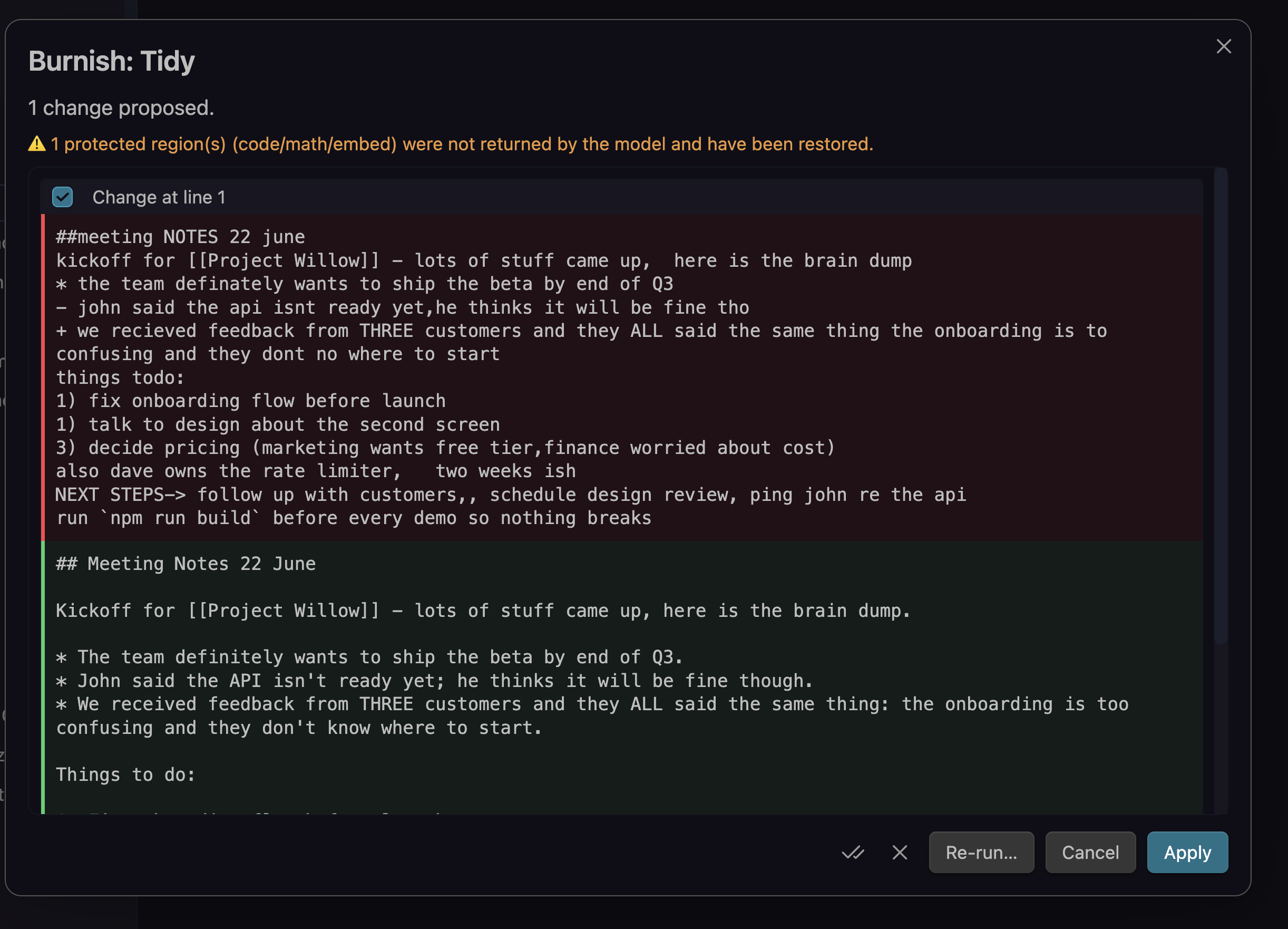
Tidy - fix grammar, spelling and punctuation, with a per-hunk diff before anything is written:
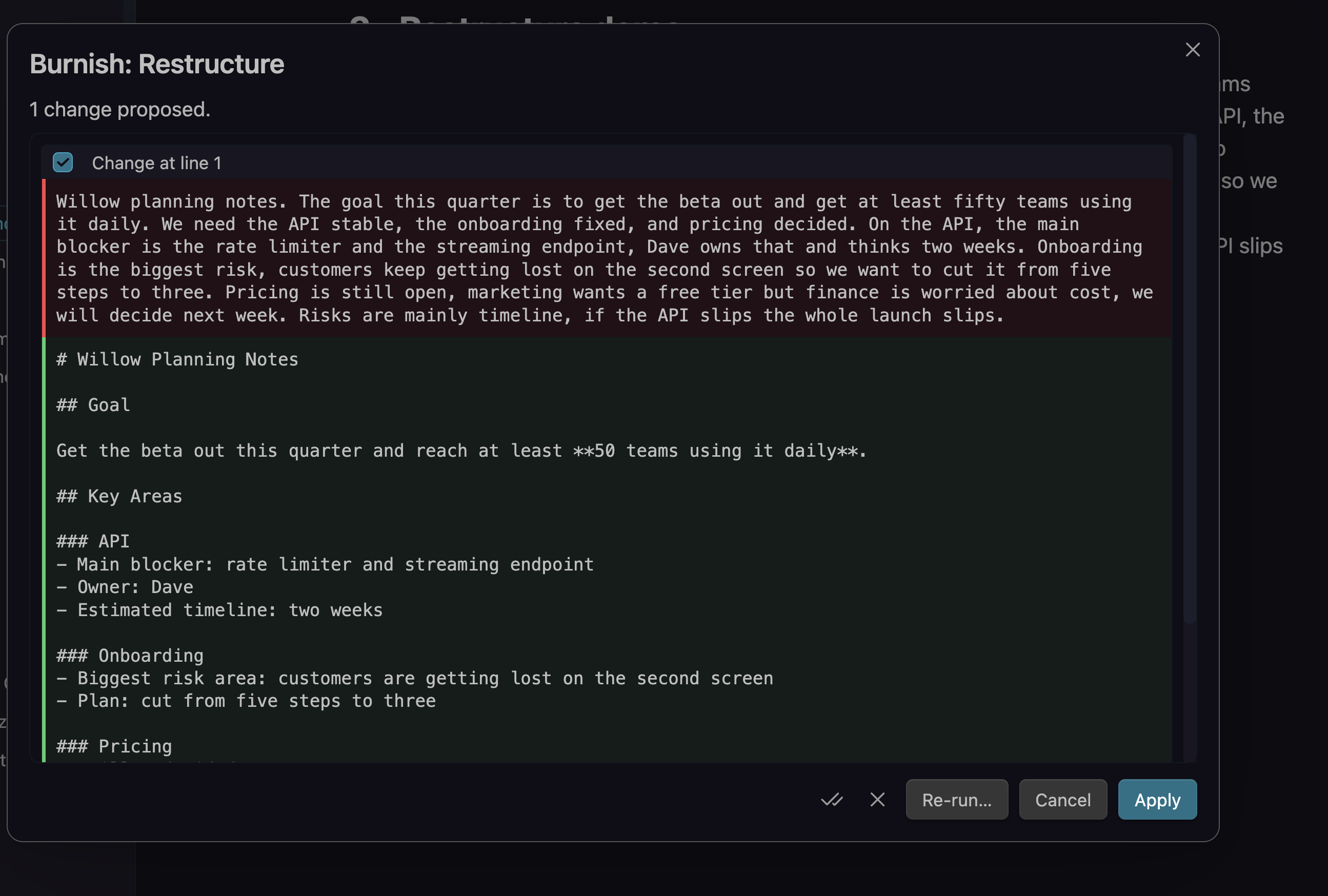
Restructure - turn a wall of text into clean headed sections:
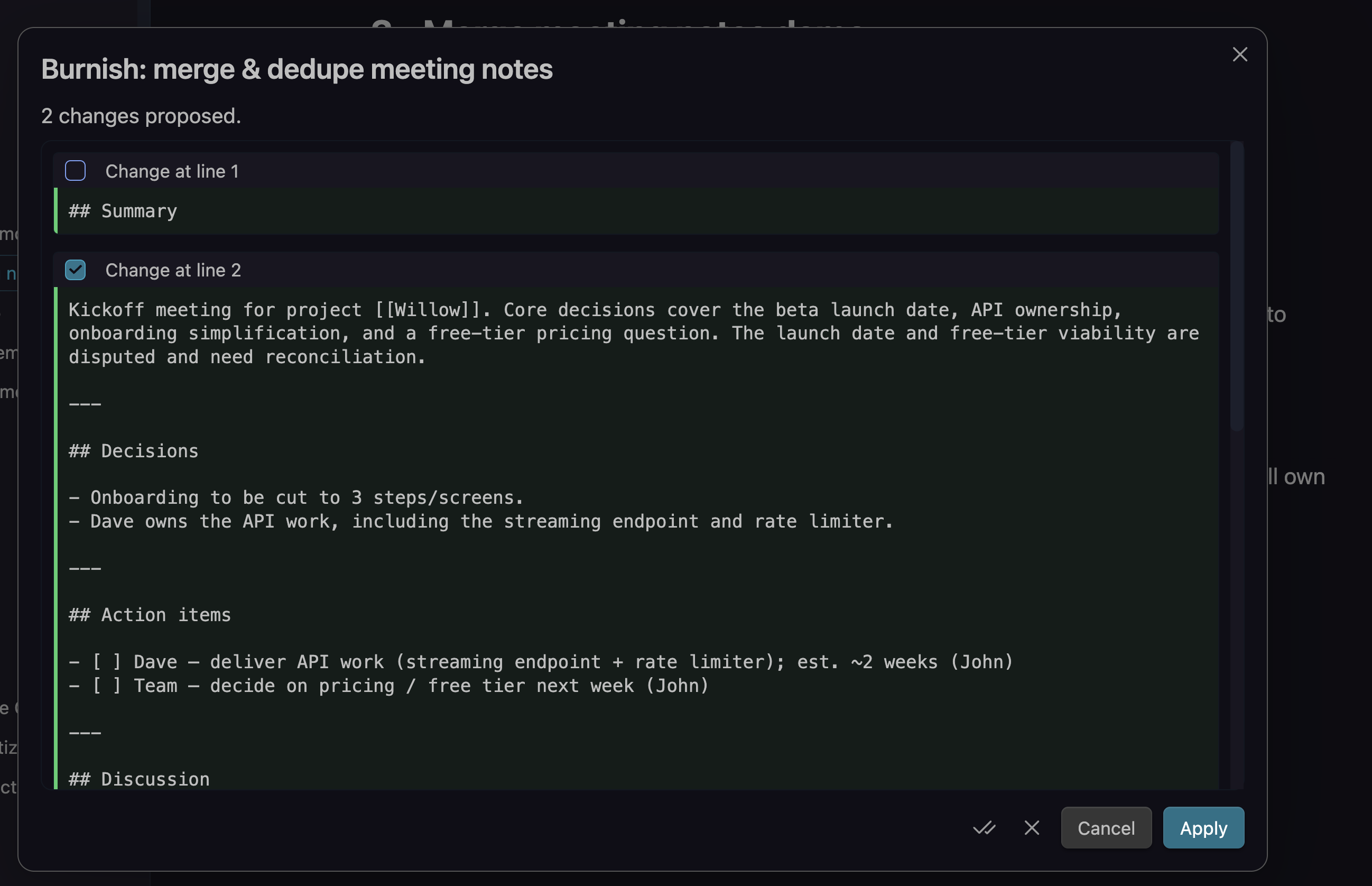
Merge & dedupe meeting notes - combine several people's notes into one structured note, flagging conflicts that need reconciliation:
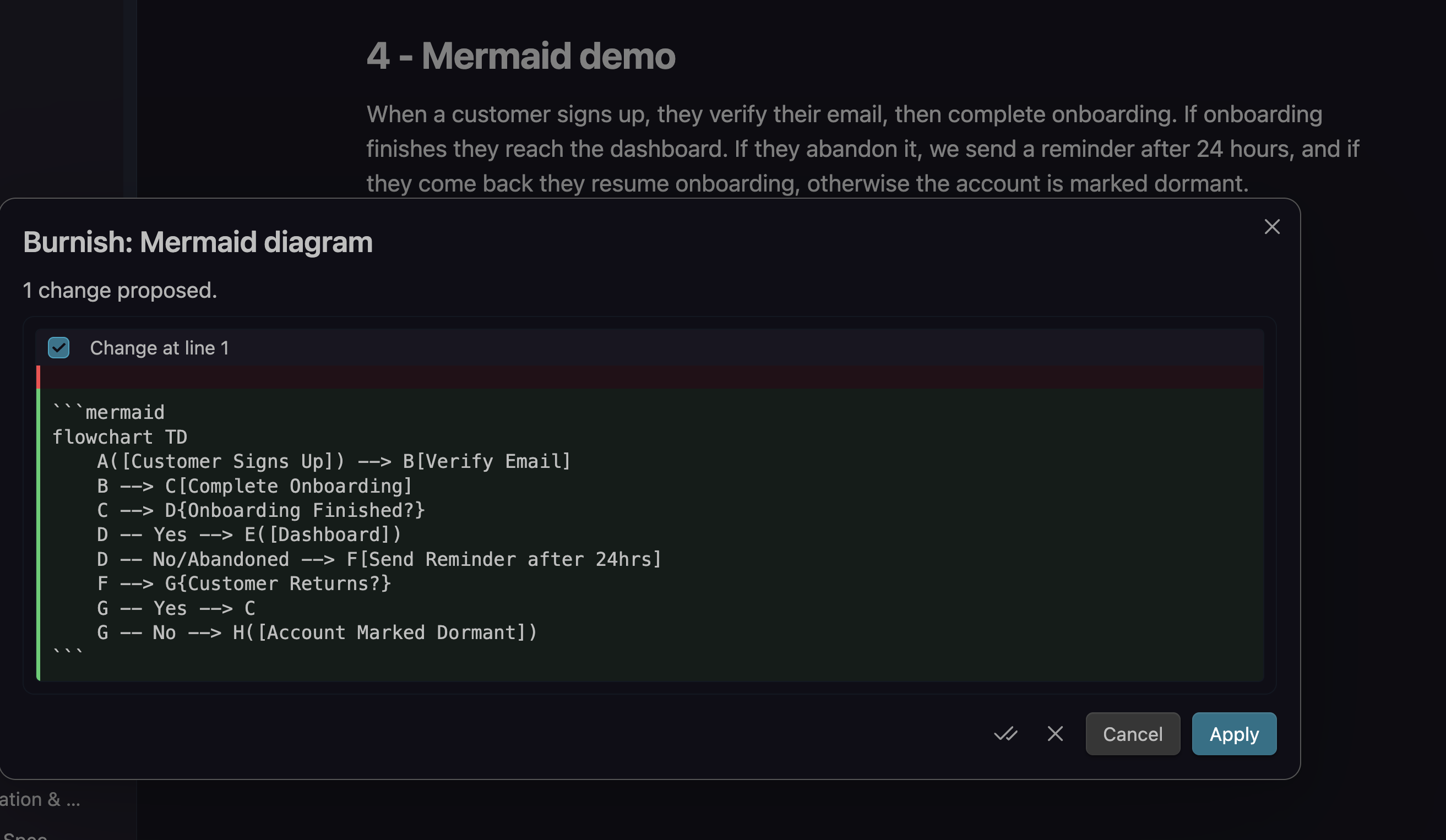
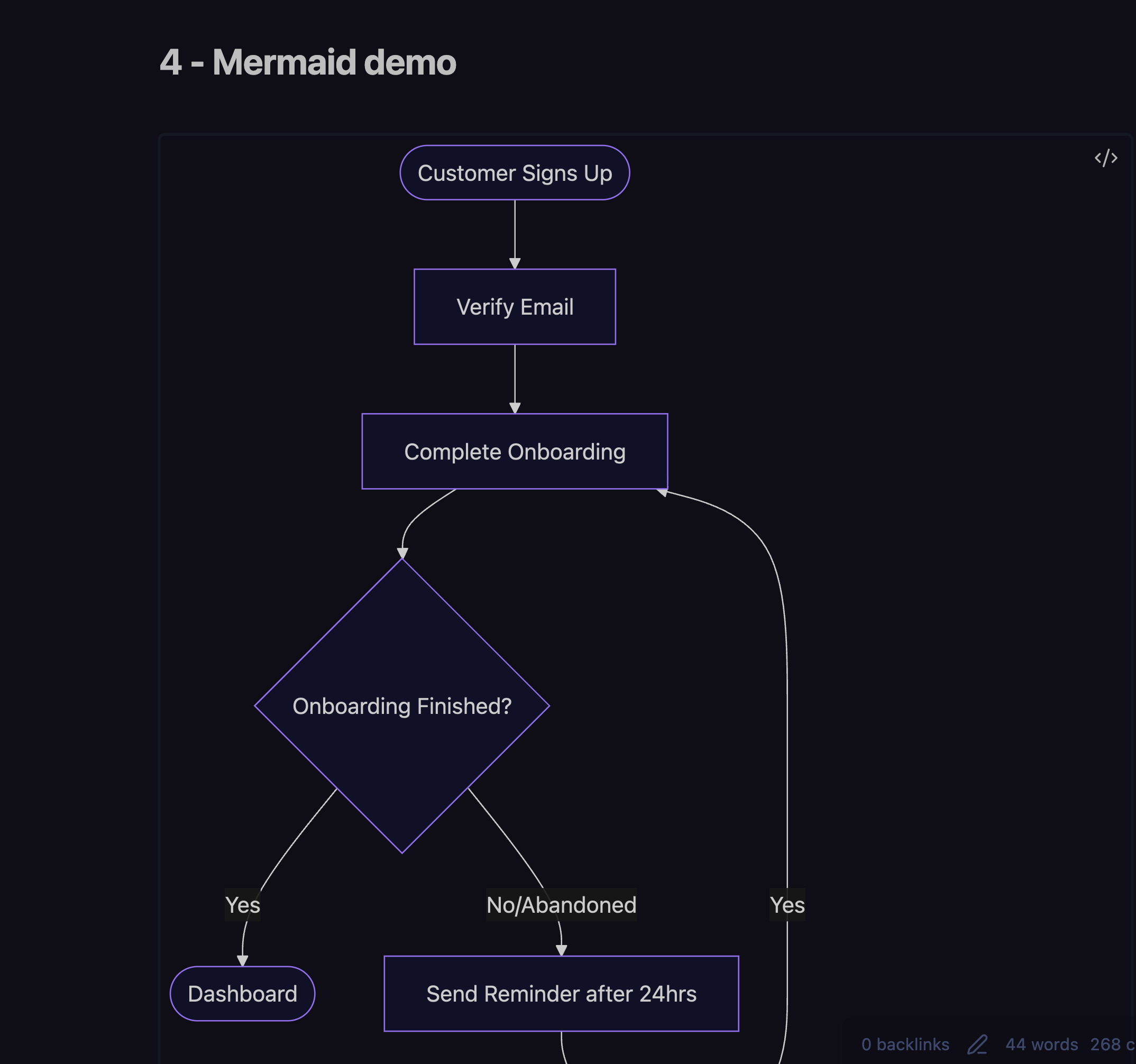
Generate a Mermaid diagram from prose, previewed then inserted at the cursor:
Features
- Diff preview, always. Every change is shown as a per-hunk diff you accept or reject. Nothing is written until you click Apply, and Apply is a single Cmd/Ctrl-Z undo.
- Presets and custom prompts share one mechanism. Edit the built-ins or add your own, each with an optional hotkey, command and context-menu entry.
- Prompt variables -
{{title}},{{date}},{{selection}},{{path}},{{frontmatter.key}},{{grit}}. - Grit levels (light / medium / deep) control rewrite aggressiveness.
- Per-folder defaults - different default action/model by path glob.
- Merge & dedupe meeting notes into one structured note, flagging conflicts and keeping anything unmergeable verbatim in an appendix.
- Generative: Mermaid diagrams and Markdown tables (inserted at the cursor), and Map-of-Content scaffolding across notes.
- Protected regions - fenced code, inline code, math, embeds and YAML frontmatter are masked before sending and restored after.
- History & rollback - Burnish snapshots a note before it rewrites it, so any edit (including batch and scheduled runs) can be rolled back.
- Batch & scheduled - run an action across many notes, or tidy a folder once a day.
- Cost guard - warns before sending very large notes.
Network use
Burnish makes network requests only to the LLM provider you configure, and only when you trigger an action. There is no other network activity. Specifically:
- Anthropic - requests go to
https://api.anthropic.com(or a base URL you set). - OpenAI-compatible - requests go to the base URL you enter (OpenAI, OpenRouter, Groq, or a local server such as Ollama / LM Studio / vLLM). Nothing is sent anywhere else.
- Burnish Plus (optional, hosted) - if you opt in and paste a license key, requests go to the Burnish proxy, which forwards them to a model provider. See Privacy below.
The content sent is the note or selection you run an action on (with code/math/embeds/frontmatter masked) plus your instruction. Your API keys are sent only to the provider they belong to.
Privacy & data
- Burnish itself collects no data and contains no telemetry or analytics.
- With your own API key (the default, free), your note content goes directly from Obsidian to the provider you chose. Burnish operates no server in this mode and never sees your content.
- API and license keys are stored in this plugin's settings inside your vault (
data.json). Obsidian does not encrypt plugin settings - treat the file accordingly. - The optional hosted Burnish Plus tier processes note content transiently on its server to proxy the model call and does not retain note content. Full details are in PRIVACY.md.
Payment & account
- No payment or account is required. All features work with your own API key (or a free local model).
- An optional paid "Burnish Plus" tier (a hosted endpoint, no key needed) is planned. It is not required for any feature listed above.
Install
From the community plugin browser
Once listed: Settings → Community plugins → Browse → search "Burnish" → Install → Enable.
Manual
- Download
main.js,manifest.json, andstyles.cssfrom the latest release. - Copy them into
<your vault>/.obsidian/plugins/burnish/. - Reload Obsidian and enable Burnish under Settings → Community plugins.
Setup
- Open Settings → Burnish.
- Choose a provider and paste your API key (or set a local base URL).
- Open a note and run Burnish: Tidy from the command palette, the ✨ ribbon icon, or the editor right-click menu. Review the diff and Apply.
Usage
- Selection vs. note - if text is selected, the action runs on the selection; otherwise the whole note (frontmatter excluded).
- Merge meeting notes -
Burnish: Merge & dedupe meeting notes(current note, or pick files). - History -
Burnish: Version history for current noteto roll back.
Hotkeys
Every preset and every custom prompt is registered as its own Obsidian command, so each can have its own hotkey:
- Open Settings → Hotkeys.
- Search for Burnish (or the action's name, e.g.
Burnish: Tidy). - Click the + next to a command and press your key combination.
Notes:
- Obsidian ships with no default hotkeys for Burnish, so there are no conflicts to clear; you bind only the ones you want.
- Commands run on the active note's selection (or the whole note if nothing is selected), exactly like triggering from the palette.
- When you add or rename a prompt in Burnish settings, its command updates immediately - the new
Burnish: <name>entry appears in the Hotkeys list ready to bind. (After deleting a prompt, its command disappears from the list on the next Obsidian reload.) - Useful ones to bind:
Burnish: Tidy,Burnish: Custom instruction…, andBurnish: Pick an action…(the fuzzy picker) for one keystroke to everything.
Development
npm install
npm run dev      # watch build
npm run build    # typecheck + production bundle
npm test         # unit tests (diff, protect, variables, chunk, history, generative)
The plugin frontend is open source (MIT). The hosted Burnish Plus proxy, if/when shipped, is a separate backend.
License
MIT © John Cattrall
Burnish is an independent community plugin and is not affiliated with or endorsed by Obsidian.