
README file from
GithubArchivist
Your vault's quiet historian. Versioned vault backups to Dropbox with content-addressed storage, hierarchical retention, and file-level restore.
What it does
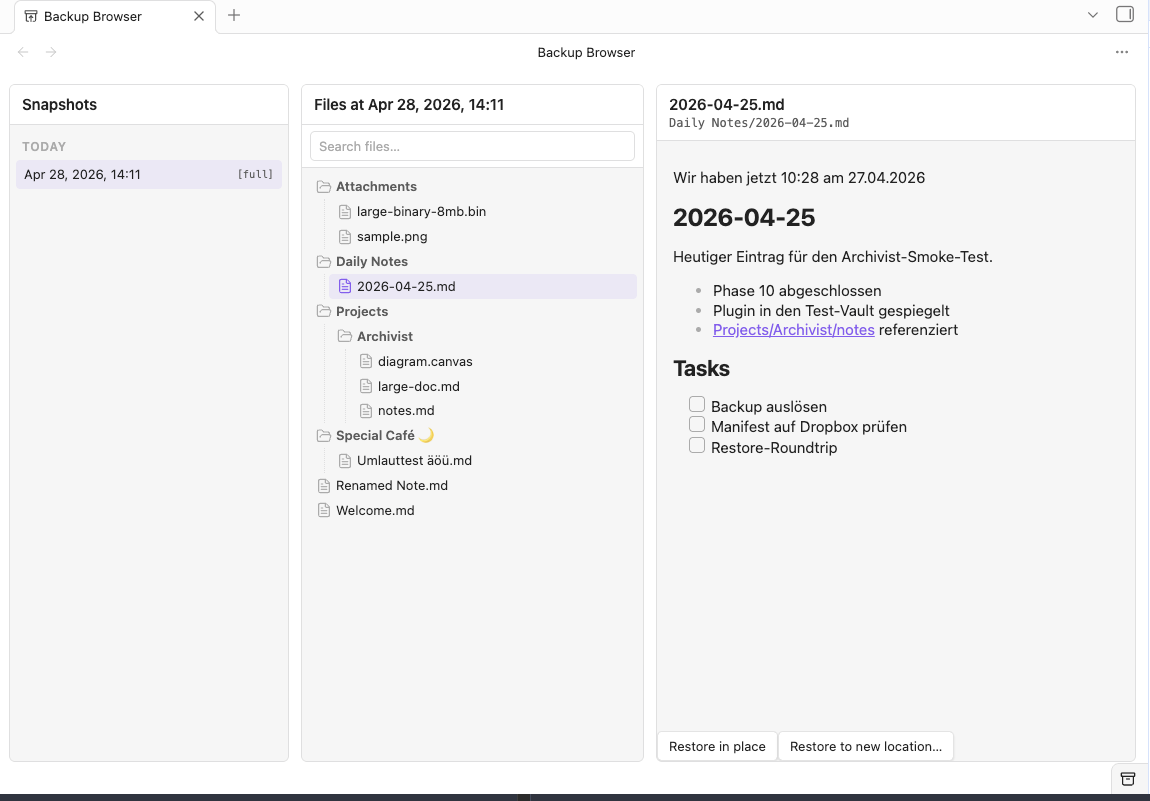
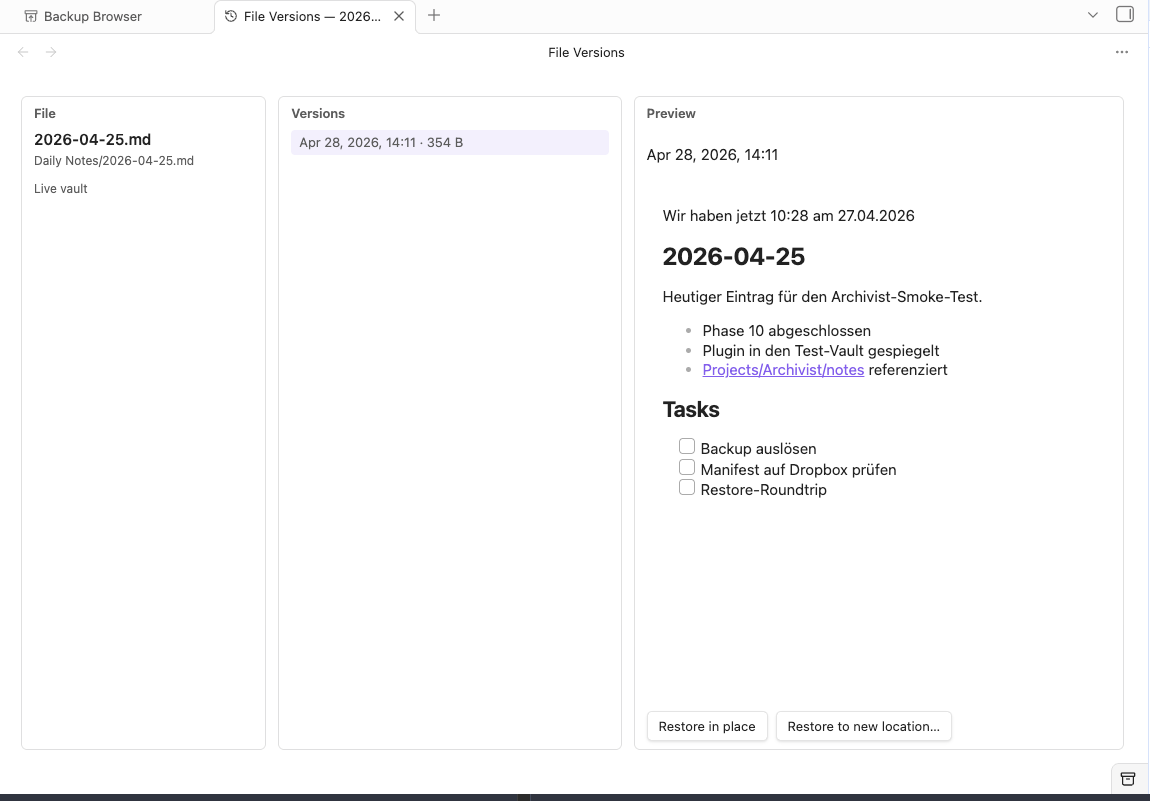
Archivist runs in the background, snapshots your Obsidian vault to Dropbox on a schedule you control, and lets you walk back through every version of every note. When something goes wrong — an accidental delete, a botched merge, a mystery overwrite — you find the version you wanted in the Backup Browser or the Show history of current file modal, click Restore, and the file comes back exactly as it was.
Who it's for
- Obsidian users who already pay for Dropbox and want backups that are theirs (no third-party service holding your notes).
- Power users who want per-file version history, not just whole-vault snapshots.
- Anyone who's been bitten by syncing tools and wants a separate, audit-able backup channel.
A note of caution. Backups are NOT stored as plain files on Dropbox — Archivist uses content-addressed blobs and per-snapshot manifests, not a 1:1 mirror of your vault. So you can't just open Dropbox in your browser and grab a file out of it. Recovery happens through the in-app Backup Browser / Show history of current file, or — if the plugin or Obsidian themselves break — through the bundled standalone CLI which works on your local Dropbox-synced folder with zero plugin dependencies.
I use this plugin personally on my own vault with roughly 6000+ files and I'm not planning to break it. But: never trust a backup you haven't restored. Try a restore once in a while — the Restore to new location button is non-destructive (it adds a timestamp suffix), so you can compare against the live file before deciding what to keep.
For a deeper look at how the storage layout works (and why it's not just files in folders), see docs/architecture-overview.md.
What's different about it
- Content-addressed storage: identical files dedupe automatically. Renaming a 50 MB attachment costs zero new bytes.
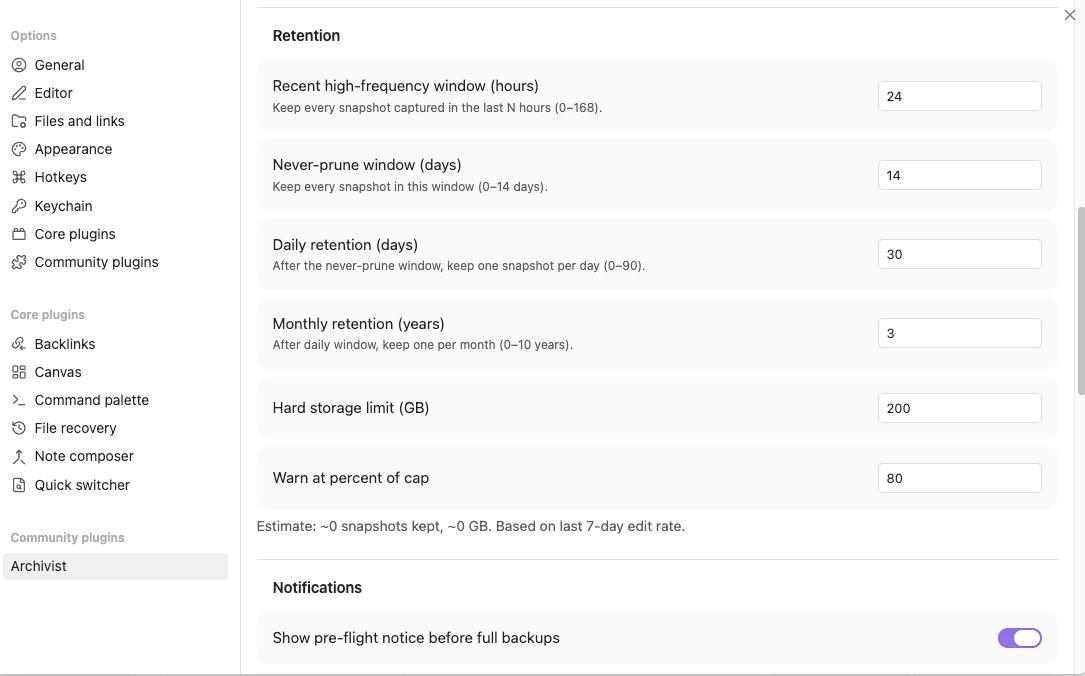
- Hierarchical retention: high-frequency snapshots in the last 24 h, daily for a month, monthly for years — without you tuning anything.
- Local-first: your tokens and indexes live in the vault. The plugin opens exactly three network hosts (listed below) and never phones home elsewhere.
- Standalone Restore CLI: a zero-dependency Node script ships in every release. If the plugin or Obsidian ever goes south, you can still recover any file from your Dropbox folder using only
node.
Screenshots
Backup Browser — three-column layout: snapshots (grouped by Today / Yesterday / This week / This month / Older), files at the selected snapshot, and a Markdown preview with Restore controls.
File Versions — invoke Show history of current file from the command palette on any note. Rename markers, preview, and one-click restore.
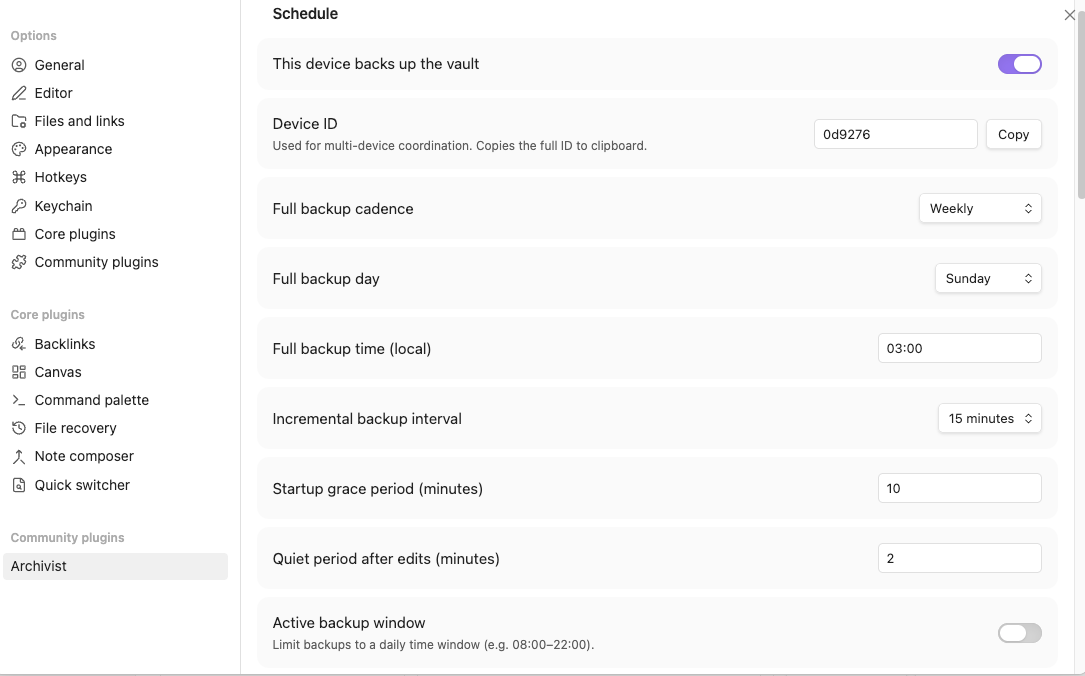
Settings — Schedule (designated-device toggle, full + incremental cadence, active window).
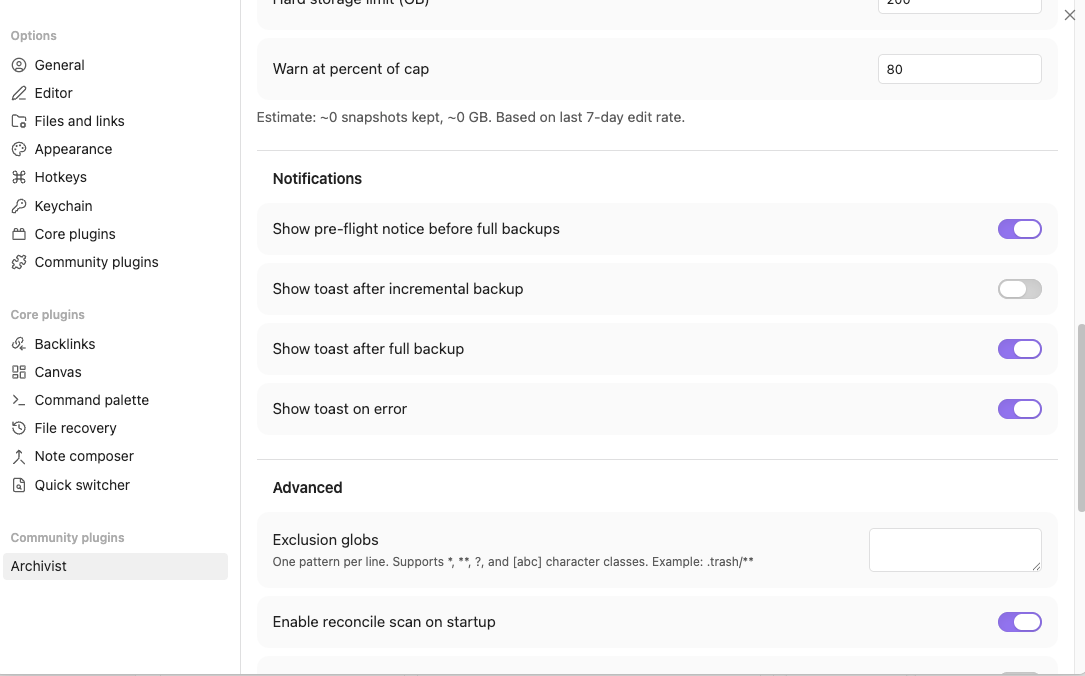
Settings — Retention (3-tier hierarchical retention + storage cap).
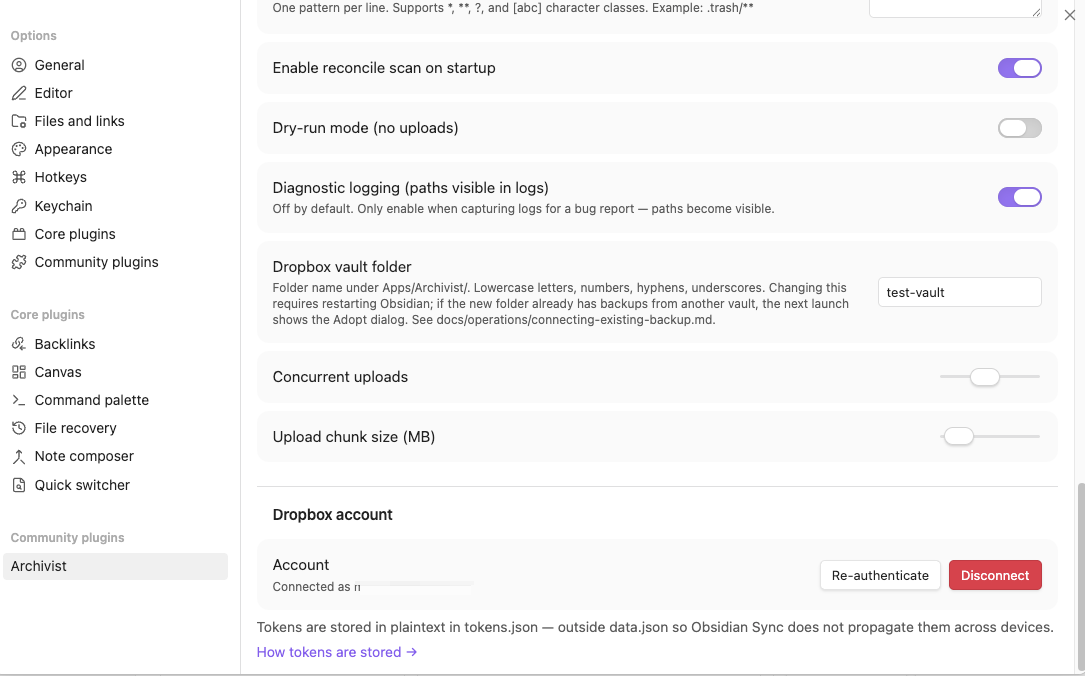
Settings — Dropbox (OAuth connect, account info, vault folder).
Setup
-
Install Archivist (see Installation below).
-
Open Settings → Archivist → Schedule and toggle This device backs up the vault on. Pick the device that will perform backups (only one device per vault should be designated; multiple-device safety is built in but the simplest setup is one designated device).
-
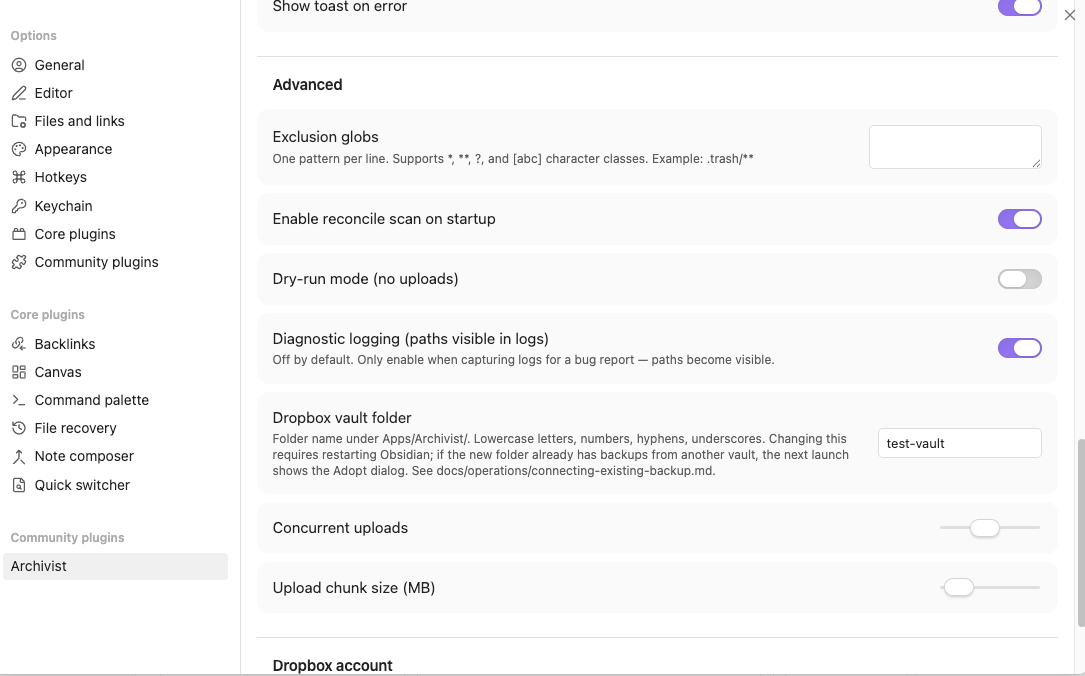
Open Settings → Archivist → Advanced and set Vault folder name — this is the folder name under
Apps/Archivist/where this vault's backups will live (lets you back up several vaults into separate folders). Default: a slug of the Obsidian vault name. Note: if you change this after the plugin already loaded, disable + re-enable Archivist (or restart Obsidian) so all services pick up the new path. -
Open Settings → Archivist → Dropbox and click Connect Dropbox. The browser opens, you log in, you authorize the app, and you're returned to Obsidian.
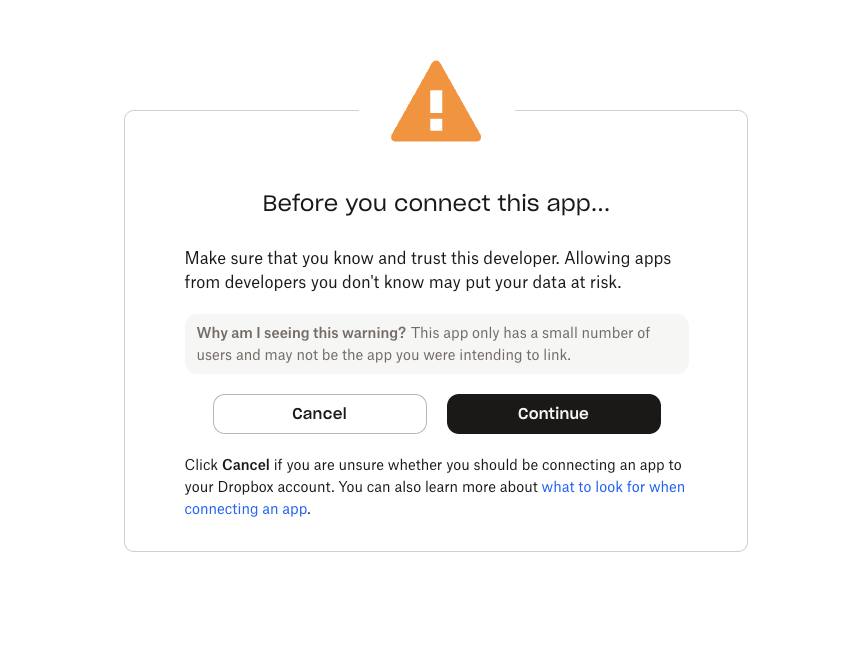
You will see a Dropbox warning that this app is "not yet verified by Dropbox" — this is expected. Dropbox marks every new third-party integration this way until it has accumulated enough usage to be auto-promoted. Archivist is open source (source on GitHub) and only requests the four scopes documented under Dropbox scopes below; you can audit exactly what is requested before clicking Allow. The warning will go away on its own as the user base grows.
-
The first full backup will run after a 10-minute startup grace + a 2-minute quiet period (configurable). After that, incrementals run every 15 minutes when there are changes; fulls run weekly by default.
Dropbox scopes
Archivist requests these Dropbox scopes during OAuth. They are the minimum needed for the plugin to function, in line with Dropbox's principle-of-least-privilege guidance.
| Scope | Why we need it |
|---|---|
files.content.write |
Upload backup blobs and manifests to the plugin's app folder. |
files.content.read |
Download blobs for restore + manifest fetch for history. |
files.metadata.read |
List the contents of the app folder (for orphan-blob detection during garbage collection). |
account_info.read |
Display the connected account's email in Settings (so you can confirm which account you're connected to). |
The plugin uses the App Folder permission model — it can ONLY read or write files inside Apps/Archivist/<vault-prefix>/ in your Dropbox. It never sees the rest of your Dropbox. This is enforced by Dropbox's OAuth scope, not just by our code.
Network hosts
Archivist opens connections to these hosts and only these hosts. They are declared in manifest.json for community-plugin review.
| Host | Purpose |
|---|---|
api.dropboxapi.com |
OAuth token exchange + JSON metadata API. |
content.dropboxapi.com |
Binary upload + download. |
www.dropbox.com |
OAuth authorization endpoint (browser redirect). |
If you see Archivist contacting any other host, that's a bug — please file it.
How tokens are stored (read this)
Archivist stores your Dropbox access token and refresh token in Obsidian's encrypted secret store (app.secretStorage, introduced in Obsidian 1.11.4 and backed by Electron's safeStorage). They are kept under the id archivist-dropbox-tokens as a single JSON-encoded blob. They are not written to data.json, not written to disk as plaintext, and not synced by Obsidian Sync.
Where the encryption keys live (varies by OS):
| OS | Master key location | At-rest encryption |
|---|---|---|
| macOS | Login Keychain, entry "Obsidian Safe Storage" (application password) |
Real — AES via the keychain-resident key. The encrypted blob lives in ~/Library/Application Support/obsidian/; a casual read of it yields ciphertext. |
| Windows | User-scoped DPAPI | Real — tied to your Windows user account. A different account on the same machine cannot decrypt. |
| Linux | libsecret / GNOME Keyring / KWallet | Real if a secret service is available. If it isn't, Electron falls back to basic obfuscation — not real encryption. Linux users without a configured keyring should rely on full-disk encryption instead. |
Best practices:
- Don't share
data.jsonor your vault's.obsidian/folder with anyone — even though tokens aren't in there anymore, your settings, vault id, and per-device backup state still are. - In-Obsidian threat model: any other plugin running in the same Obsidian instance can read your token by calling
app.secretStorage.getSecret('archivist-dropbox-tokens'). Obsidian does not isolate secrets per plugin. Only install plugins you trust. - Multi-device sync: Tokens are per-machine — each device authenticates separately, by design. Obsidian Sync replicates only
data.json(settings + vault id), which is intentional. Other vault-syncing tools (iCloud, Syncthing, Dropbox Desktop) will replicate.obsidian/plugins/obsidian-archivist/files (the local backup index, the pending-changes queue) but not your tokens, since those live in your OS keychain. - If you suspect a token leak, click Disconnect Dropbox in Settings (this revokes the token server-side) and reconnect. You can also revoke from https://www.dropbox.com/account/connected_apps.
- If you sync the
Apps/Archivist/folder locally (e.g. via the Dropbox Desktop app's selective-sync) consider excluding it if disk space is tight — the backup data has nothing useful for live work, only for the standalone CLI's break-glass recovery.
Upgrading from earlier versions: 0.7.x and earlier stored tokens in <vault>/.obsidian/plugins/obsidian-archivist/tokens.json (plaintext + chmod 0o600 on desktop). On your first start with 0.8.0 Archivist reads that file once, writes its contents into the encrypted secret store, and deletes it. No re-authentication is required. If you want to confirm the legacy file is gone, check the plugin's folder after restarting.
Already using Aut-O-Backups?
There's another Obsidian community plugin that also backs up to Dropbox: Aut-O-Backups by ryanpcmcquen (plugin id obsidian-dropbox-backups). The two are independent — they're separate Dropbox apps, talking to separate folders, with no shared state. So running both isn't dangerous, but it backs up the same vault twice and burns double the CPU + bandwidth for no benefit. Archivist will show a one-time advisory if it detects Aut-O-Backups enabled, suggesting you pick one.
If you decide to switch from Aut-O-Backups to Archivist:
- Disable Aut-O-Backups in Settings → Community plugins.
- Set up Archivist (see Setup above).
- Once you've verified Archivist is backing up reliably, uninstall Aut-O-Backups and delete its old backup folder on Dropbox (it's not migrated — the storage layouts are incompatible).
Differences worth knowing about
| Aut-O-Backups | Archivist | |
|---|---|---|
| Storage layout | One copy of every vault file written into Dropbox at every backup | Content-addressed blobs (SHA-256) + per-snapshot manifests |
| Deduplication | None — every backup uploads everything again | Identical files uploaded once across all snapshots |
| Renames | Treated as new file (re-upload at the new path) | Tracked as a manifest entry, no new bytes |
| Retention | Manual (you delete old backups yourself) | Hierarchical 3-tier (never-prune window + daily + monthly) with garbage collection |
| Per-file restore | Manual: copy a file out of the latest backup folder | Backup Browser tab + Show history of current file command |
| Recovery without the plugin | Files are plain copies on Dropbox — open the folder | Standalone Node CLI (scripts/restore.mjs) reconstructs any snapshot from a local Dropbox-mirrored folder. See docs/restore-guide.md |
| Storage growth | Grows linearly with backup count × vault size | Grows with unique-content additions, capped by retention |
| Failure mode if left unattended | Storage fills the Dropbox account | 3-tier retention prunes old data automatically; backups pause if a hard storage cap is reached |
Whichever plugin you pick, never trust a backup you haven't restored — try a recovery on both before deciding.
Troubleshooting
For corruption-recovery scenarios (broken chain, repair commands, GC lock cleanup, what to capture for a bug report), see docs/troubleshooting/dropbox-corruption.md. For the "I'm pointing this vault at an existing Dropbox folder" / vault-id adoption flow, see docs/operations/connecting-existing-backup.md. The common cases below cover the rest.
"Dropbox disconnected" / Archivist lost access to your account
This usually means the refresh token was revoked (manually or by inactivity). Open Settings → Archivist → Dropbox and click Connect Dropbox again. Your existing backups in Dropbox are NOT affected by re-authenticating.
"Backups paused — storage cap reached"
Archivist defaults to a 200 GB hard limit. Either raise the cap (Settings → Retention → Hard storage limit) or reduce retention windows (shorter daily/monthly windows). Existing snapshots are not deleted automatically when the cap is reached — backups simply pause until you adjust.
"Two devices are designated as the backup owner"
You have two devices both flagged as the designated backup device. Pick one in Settings → Archivist → Schedule → This device backs up the vault and toggle the other off. Archivist won't lose data — both devices can read from the same Dropbox folder; only one should write at a time.
Backups feel slow / are using too much CPU
Tune Settings → Advanced → Concurrent uploads (default 4, range 1–8) and Upload chunk size (default 8 MB, range 4–64). Lower values reduce CPU and memory; higher values speed up large file uploads.
Where do I find logs?
Archivist logs to Obsidian's developer console. To open it: Cmd/Ctrl + Shift + I → Console tab. Filter for [archivist] to drop unrelated Obsidian noise. Default-mode logs are minimal and contain no path data. For a bug report: toggle Settings → Advanced → Diagnostic logging on, reproduce the issue, copy the console output, then turn it back off. The full bug-report capture flow is in docs/troubleshooting/dropbox-corruption.md.
Standalone Restore CLI
Every release ships a zero-dependency Node script — scripts/restore.mjs — that can reconstruct any snapshot from your local Dropbox-synced folder. No Obsidian, no plugin, no internet, no npm install. Just node 18+ and the bytes on your disk.
This is your break-glass recovery tool. The full walkthrough — where to get the script, --at selectors, dry-run / verify modes, current limitations — is in docs/restore-guide.md.
Installation
Community Plugins (after listing)
- Open Obsidian Settings → Community Plugins
- Search for "Archivist"
- Install and enable
Manual
- Download
main.js,manifest.json,styles.css, andrestore.mjsfrom the latest release - Create folder
<vault>/.obsidian/plugins/obsidian-archivist/ - Copy
main.js,manifest.json, andstyles.cssinto that folder - Keep
restore.mjssomewhere safe — it's your break-glass recovery tool - Restart Obsidian and enable the plugin
BRAT (Beta)
- Install BRAT
- Add beta plugin:
MMoMM-org/obsidian-archivist
Release notes
Per-version changes are tracked in CHANGELOG.md. The latest release is also pinned at the top of the GitHub Releases page.
Issue tracker / contact
Bug reports + feature requests: https://github.com/MMoMM-org/obsidian-archivist/issues
When filing a bug, please include:
- Obsidian version (Settings → About).
- Archivist version (
manifest.jsonin the plugin folder). - Operating system + version.
- A reproduction recipe if possible.
- Don't paste your
data.json— it contains your vault id and settings. (Your Dropbox tokens are in Obsidian's encrypted secret store, not in any file in the plugin folder; on 0.7.x installs that haven't restarted under 0.8.0 yet, also avoid pasting anytokens.jsonthat may still be present.)
Security issues: please email the maintainer (see package.json author field) instead of filing a public issue.
Development
git clone https://github.com/MMoMM-org/obsidian-archivist.git
cd obsidian-archivist
git config core.hooksPath .githooks
npm install
npm run dev       # Watch mode
npm run build     # Production build
npm test          # Run tests
npm run lint      # Lint
npm run typecheck # TypeScript only
npm audit         # Dependency audit
License
MIT — see LICENSE.