
README file from
GithubSidecar Agent
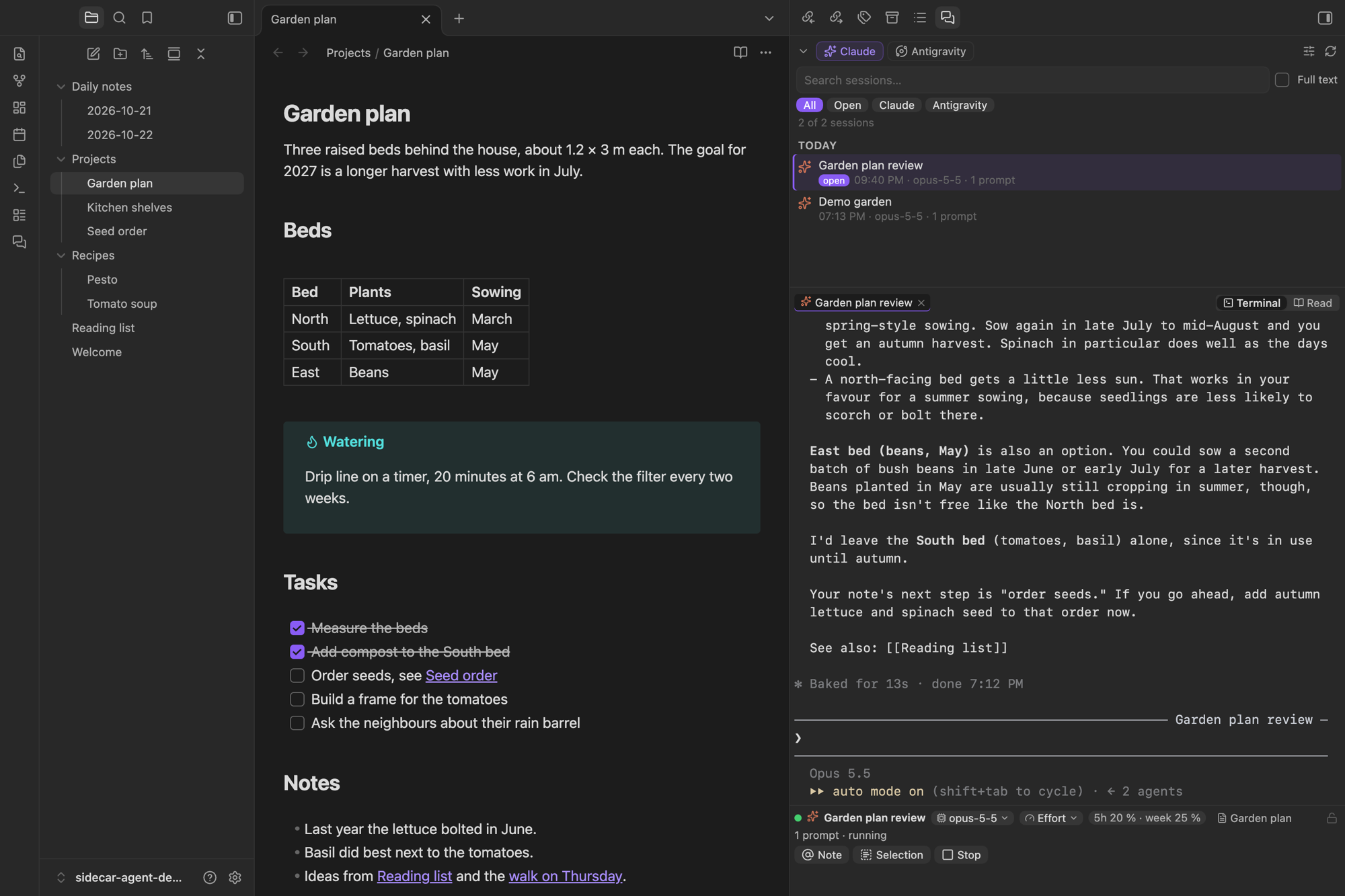
Run Claude Code and Antigravity in a real terminal in Obsidian's right sidebar, right next to your notes.
Sidecar Agent does not reimplement the agents. It starts the official command-line tools in a real pseudo-terminal, so everything works exactly as in your terminal app: slash commands, /model, permission prompts, @ file completion, hooks, status lines and Remote Control. Around that terminal it adds what is missing in a sidebar: a searchable session list, a reading view and a few conveniences for working with notes.
Features
-
Real terminal sessions for Claude Code (
claude) and Antigravity (agy), several in parallel as tabs. -
Session list of every session started in this vault, grouped by day, with quick search and optional full-text search through the complete history. Click to resume, right-click to fork, rename or resume with another model.
-
"This note" filter: the sessions that read or edited the note you are looking at (from the agents' tool calls, shell commands and
@mentions). -
Session state on the tabs: the agent icon pulses while it works, an orange dot when it waits for a permission or an answer, an accent dot when it finished while you were looking elsewhere. Optional notification when a session finishes or needs you and you are not looking at it (outside Obsidian as a system notification).
-
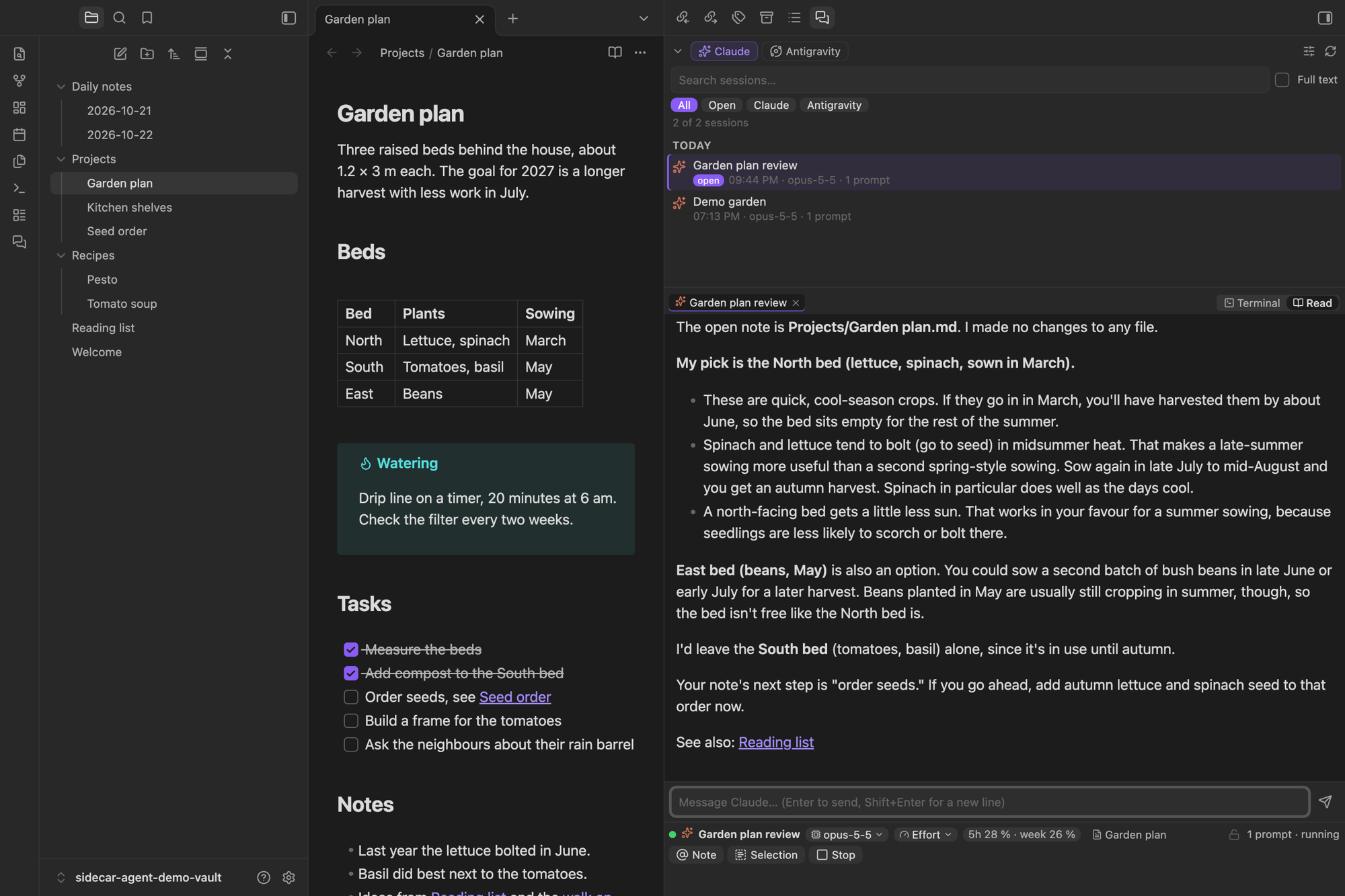
Reading view for Claude sessions: the conversation rendered like a note, with Obsidian's Markdown, tables, code blocks and clickable wikilinks. Updates live while Claude works and has its own input field.
-
Model and effort per session. The chips below the terminal switch the model or effort of this session only, without changing your global Claude default. The session restarts with its history kept.
-
Note context. Optionally, every Claude message silently carries the path of the note you are looking at (and a selection in it), so you can just ask "summarize this". Toggle it with one click.
-
Usage limits as small bars below the terminal, like the context chip: 5-hour and weekly window of your Claude plan, or of the Antigravity model group the session uses, plus Antigravity's separate Gemini 4 Argon weekly quota. Orange from 70 %, red from 90 %, hover for the reset time. A thin mark shows the even pace, the tooltip the expected use at the reset or when the limit would be reached.
-
Context window fill level of the active Claude session as a small bar in the info line, updated after every answer. Click it to compact now or with a focus; from 85 % a compact button appears. For Antigravity the token count in the context (agy reports no window size); clicking it compacts as well.
-
Clickable vault paths and
[[wikilinks]]in the terminal: notes open in a tab, other files show in Finder. -
Scheduled runs (
/loop, cron, wakeups) of a Claude session as an alarm clock on its tab, with the next runs in the tooltip. -
Usage credits warning: when Claude switches to paid usage credits after a limit, a red chip in the info line and a notice tell you.
-
Resume after the usage limit. When a Claude session hits the limit, Sidecar Agent sends a short message after the reset so the task continues. Claude Code does not do this by itself in sessions with Remote Control.
-
Chat history in the vault (optional, off by default): a readable copy of every chat as a note, written after each answer. With a vault sync such as Obsidian Sync, chats from your other devices appear in the session list, open as a note, are found by the search and can be continued as a new session, also with the other agent.
-
Send notes and selections to a session from the editor, the file explorer, by drag and drop or with commands.
-
Reload when idle: the command "Reload plugin when no session is working" waits until no answer is running, then reloads the plugin. A reload ends the panel terminals (they resume afterwards), so this keeps it from cutting off an answer. An agent working in a panel session can run it itself.
-
Progress row under the tabs while an agent works: bar, "3/7" and the current step from Claude's task list, plus the elapsed time. Claude Code's task list tools are switched off by default in current versions; plugin sessions turn them back on (
CLAUDE_CODE_ENABLE_TODO_TOOLS=1, setting "Task list for the progress row"). -
What's new: after an update, the changes of the new version appear once (from the bundled changelog, no network access). Can be turned off; the command "What's new in this version" shows it again.
-
Copy from Claude's fullscreen view: Claude Code copies its own mouse selection via OSC 52, which the terminal passes to the clipboard.
-
Focus lock (optional) keeps the keyboard focus in the terminal, handy for dictation tools that type into the focused window.
-
Calm terminal colors that follow your Obsidian theme and accent color.
-
English and German interface.
Requirements
- macOS (Sidecar Agent is desktop only and has been tested on macOS only. It does not work on Windows.)
- Python 3 at
/usr/bin/python3or from Homebrew. It runs the small pseudo-terminal helper. On a fresh Mac,/usr/bin/python3asks to install the Command Line Tools on first use. - Claude Code (
claude) and/or the Antigravity CLI (agy), installed and logged in. Sidecar Agent looks for them in~/.local/bin,~/bin,/opt/homebrew/bin,/usr/local/binand/usr/bin, or uses the path you set in the settings. - An account for the agent you use: a Claude subscription or API access for Claude Code, a Google account for Antigravity. Sidecar Agent itself needs no account.
- Optional: ripgrep (
brew install ripgrep) makes the full-text search faster.
Installation
In Obsidian, open Settings → Community plugins → Browse, search for "Sidecar Agent", install and enable it. The panel opens in the right sidebar. Use the ribbon icon or the command Sidecar Agent: Open panel to bring it back.
Manual installation: download main.js, manifest.json and styles.css from the latest release into <vault>/.obsidian/plugins/sidecar-agent/ and enable the plugin.
Usage
| What | How |
|---|---|
| New session | Claude or Antigravity button at the bottom of the panel. The sliders button opens a dialog with agent, model, effort, name, first message and the current note. |
| Standard tasks | Save a recurring job from that dialog with Save as standard task (agent, model, effort, first message, current note yes or no). The sliders button then opens a list of your tasks; one click starts the session. "Newest Flash model" stays current for Antigravity. Sort, edit and delete under Edit standard tasks… in the same list. |
| Resume | Click a session in the list. If it is already open, the panel just switches to it. |
| More actions | Right-click a session: resume, fork (Claude), resume with another model, rename, copy ID. Right-click a tab: rename, restart, close. |
| Type | Directly in the agent's prompt line in the terminal. Shift+Enter adds a new line. |
| Reading view | Read switch above the terminal. Enter sends, Shift+Enter adds a line, Escape in the empty field interrupts Claude. Menus and permission prompts appear only in the terminal. |
| Note or selection | Note / Selection buttons below the terminal, the editor or file context menu, or drag a file into the terminal. The text lands in the prompt line without being sent. |
| Model / effort | Chips below the terminal. The switch applies to this session only. |
| Stop | Stop button or Esc in the terminal. |
| Compact | Click the context chip in the info line, the compact button from 85 % (Claude), or the command Compact active session. |
| Session state | Pulsing agent icon = working. Dots on the tabs: orange = waiting for you, accent = finished while you were away (cleared when you open the tab). |
Keyboard shortcuts in the terminal: Shift+Enter new line, ⌘C copy selection, ⌘K clear, ⌥←/→ word left/right, ⌘←/→ line start/end, ⌘⌫ delete line. Other ⌘ shortcuts stay with Obsidian. Option stays a character key, so @, [, ], {, }, |, \ and ~ work on layouts that need Option for them.
Privacy, network use and files outside the vault
Sidecar Agent itself sends nothing over the network and contains no telemetry. It starts claude and agy on your computer. These programs talk to Anthropic's and Google's servers under your account and their own terms, exactly as when you run them in a terminal.
Like the agents themselves, the plugin works with files outside your vault:
| Path | Access | Why |
|---|---|---|
~/.claude/projects/<vault>/*.jsonl |
read, append | Claude Code's session files of this vault, for the session list, search and the reading view. When you rename a session, the name is appended like /rename does. |
~/.claude/themes/sidecar-agent.json |
write | The muted color scheme for plugin sessions (setting "Color scheme"). Not written when you choose Claude's own colors. |
~/.gemini/antigravity-cli/ |
read only | Antigravity's conversation list, last conversation per folder, conversation transcripts (context size, state, touched files) and last chosen model. |
~/Library/Caches/sidecar-agent/ |
write | Session index (including the vault files each session touched), which chats already have a note, Claude usage limits, context fill level per Claude session, the current note context (one file per vault), the current session id and state per panel terminal. |
~/Library/Application Support/sidecar-agent/ |
write | Small Python scripts that Claude runs in plugin sessions: the status line (reads your usage limits and the context fill level), the note-context hook, and hooks that report the session id and the state (working, waiting, done). |
Your global ~/.claude/settings.json is never changed. Plugin sessions also get the environment variable CLAUDE_CODE_ENABLE_TODO_TOOLS=1 (task list tools, can be switched off). Plugin sessions get their status line, hook, color scheme and autoContinueAtUsageLimit through --settings, which applies to that process only.
With Chat history in the vault turned on, the text of your chats is also written into the chosen vault folder, where your vault sync and backups pick it up. It is off by default.
The note context sends only the path of the open note and a selection you made. The agent reads the note itself, like any other file in the vault it has access to.
Settings worth knowing
- Permission mode (Claude) and Allow tool calls automatically (Antigravity, off by default) decide how much the agent may do without asking. Sidecar Agent passes them through and does not add any sandbox of its own. Agents can change and delete files in your vault, so keep backups.
- Remote Control: with Claude's
remoteControlAtStartupor the setting "Always on", plugin sessions show up in the Claude app on your phone. - Resume after usage limit is on by default and can be turned off or given your own message.
- Notifications report finished or waiting sessions you are not looking at. Turn them off in the settings.
Known limitations
- macOS only. Linux may work but is untested, Windows does not work.
- The reading view is available for Claude sessions only. Antigravity stores its history in a binary format.
- The session list shows sessions started in this vault (the vault folder is the working directory).
- Automatic resume needs Obsidian and the session to stay open.
- Session state for Antigravity comes from its transcript (agy accepts hooks only in a global or workspace
hooks.json, not per session): there is no "waiting for you" state, and it updates every 5 s. - Do not resume a conversation in the panel while it is still open in a terminal. Sidecar Agent detects this for Claude and refuses to start.
Support
Sidecar Agent is a personal project, shared as is. There is no support: issues are disabled and questions will not be answered. New versions appear whenever the plugin improves in daily use. If you want to change something, fork it under the MIT license.
Credits
The terminal is xterm.js (MIT license, Copyright (c) The xterm.js authors), bundled with its fit, unicode11, web-links and webgl add-ons.
Sidecar Agent is not affiliated with Anthropic, Google or Obsidian.
License
MIT © Manuel Niehues