
README file from
GithubOneNote Style
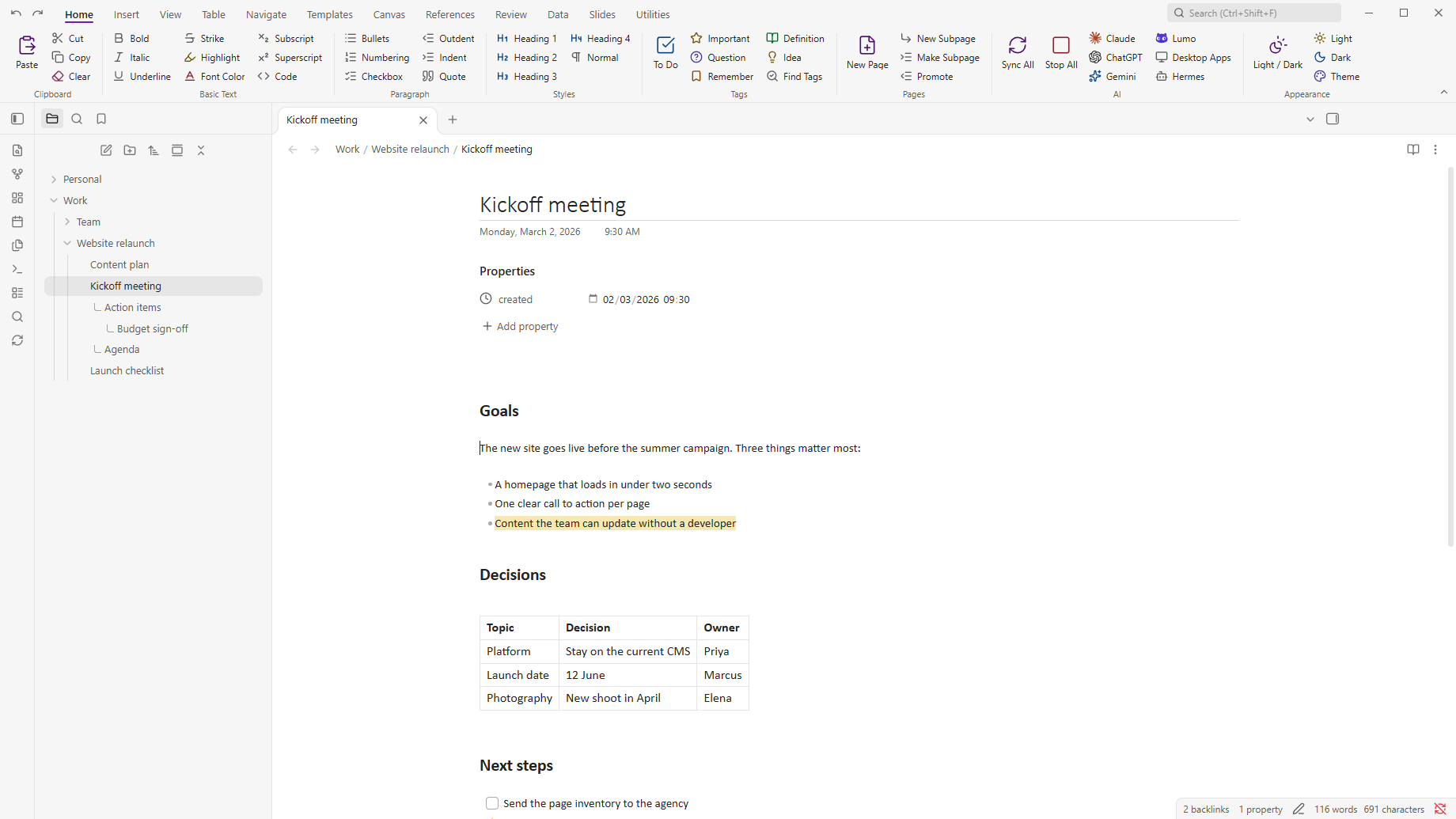
The ribbon you already know, in your Obsidian vault. OneNote Style puts Office-style tabs, groups and buttons above your notes - Home, Insert, View and nine more tabs, filled and ready - so you click instead of remembering commands. Any command of Obsidian or of your other plugins can be a button, and a right-click changes anything. Note tags, subpages and OneNote-like editing come along too.
Part of the Sundowna Second Brain Suite - an easy, low-friction second brain in Obsidian, in the spirit of Karpathy's LLM wiki. The other pieces: AI ChatBridge (all your AI chats in your vault) and the OneNote Style theme (the look you already know).
New in 2.1: edit like in OneNote and Word - no Markdown syntax while you type, and a Quick Bar for selected text. See the releases for everything else.
Why
Obsidian is powerful, and most of that power sits behind a command palette and hotkeys. If you come from Office, that is friction. OneNote Style removes it.
- Familiar. Home, Insert, View and nine more tabs, laid out the way Office taught you.
- Zero setup. The default ribbon is filled and ready the moment you turn the plugin on.
- Any command, one click. Every button runs an Obsidian command, including the commands of your other plugins.
- Yours. Right-click or drag to change anything. No settings page needed.
- Never in the way. It shrinks with the window like Office does, with no scroll bar, and follows your theme in light and dark.
Just get started
- Install OneNote Style and turn it on.
- Click a button.
That's it. When you want to change something, right-click it.
See it
Make it yours with a right-click. Rename a button, change its icon or colour, make it large or small, move it, remove it.
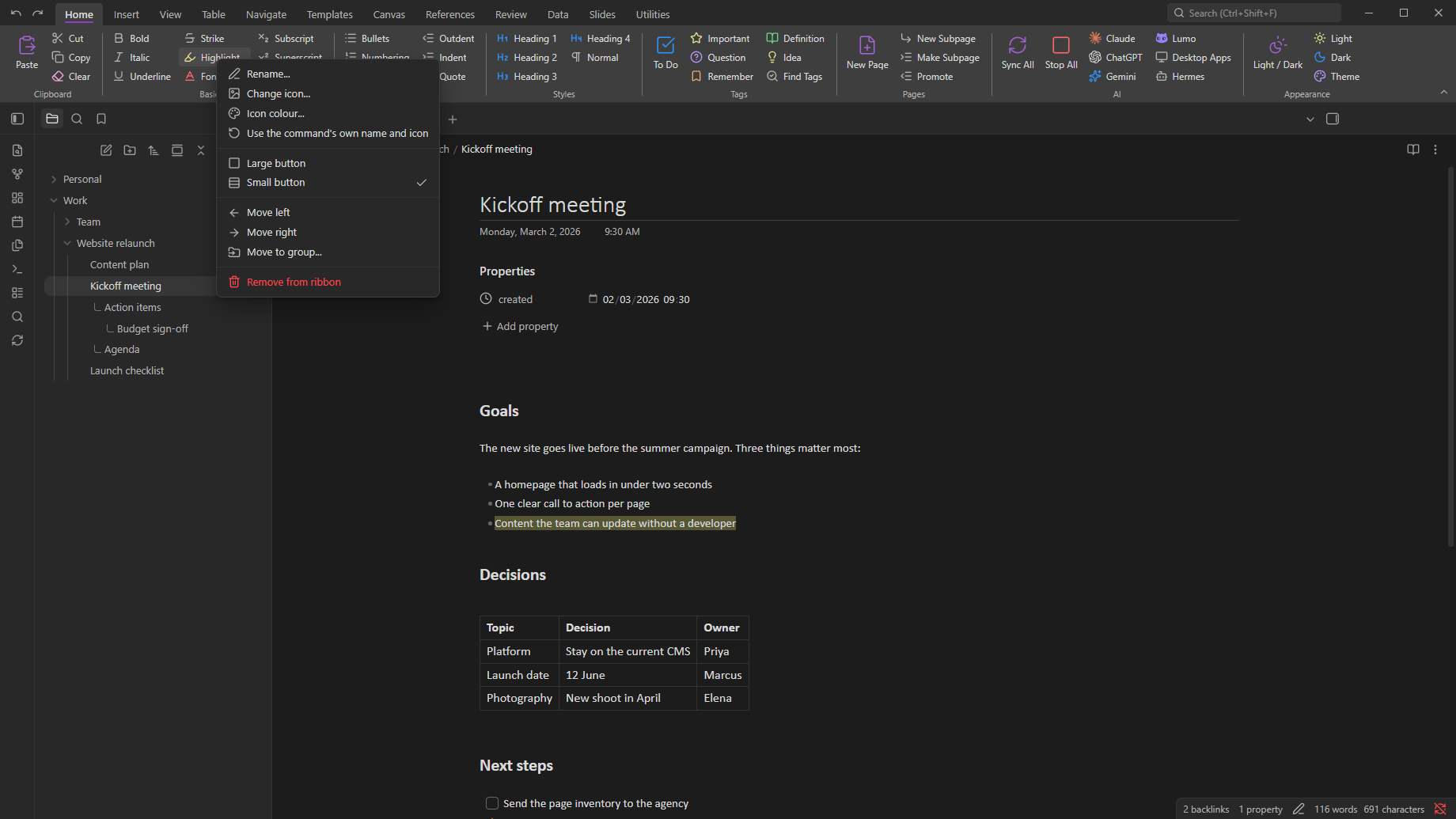
Any command of any plugin. Right-click a group, choose Add command and type, like in the command palette. Here: the sync commands of AI ChatBridge.
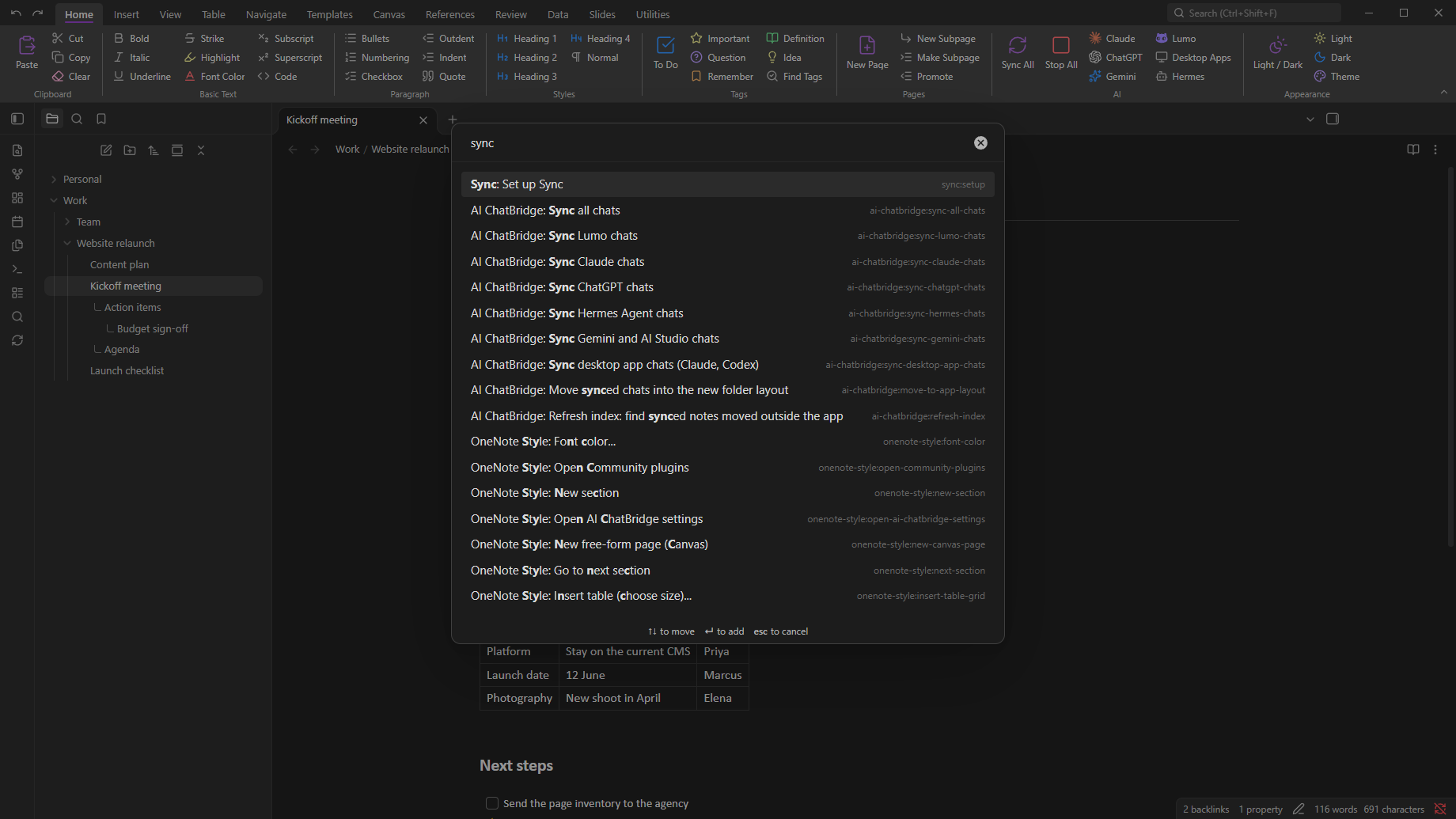
It adapts like Office. Narrow the window and the groups shrink step by step: large, small, icon-only, then one drop-down per group. Never a horizontal scroll bar.
Customise mode. Drag tabs, groups and buttons where you want them. The + tiles add new ones.
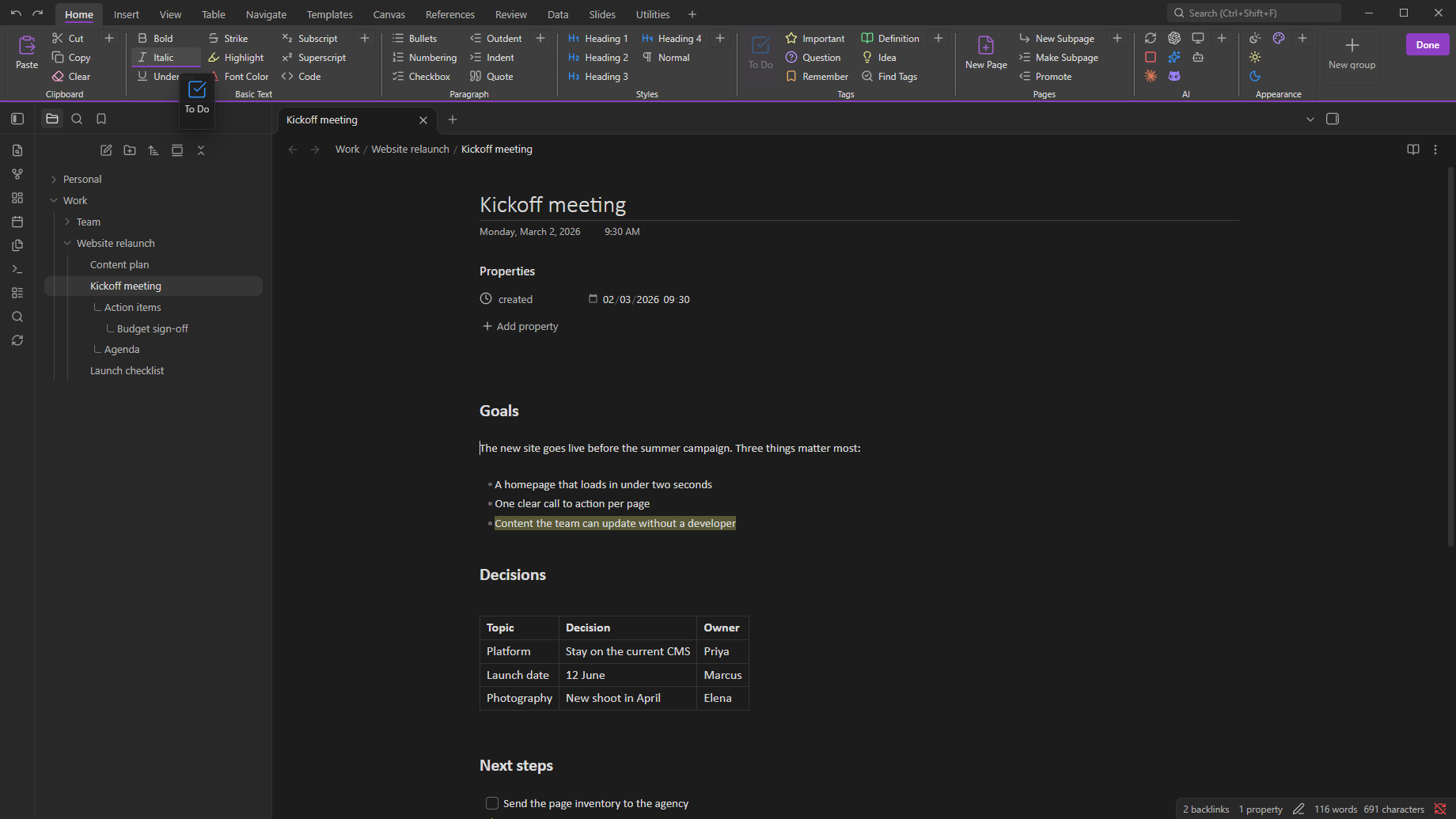
What's in the ribbon
Twelve tabs, ready to use: Home, Insert, View, Table, Navigate, Templates, Canvas, References, Review, Data, Slides, Utilities.
They use the commands of Obsidian and its core plugins, this plugin's own commands and, if you have them, AI ChatBridge, Editing Toolbar, Excalidraw, Tasks, Omnisearch and Notebook Navigator. A button whose plugin you don't have stays in place, greyed out, and its tooltip says why. Remove it or leave it.
Buttons show what is on. A button whose mode is on stays pressed, like the ¶ button in Word: Light or Dark, reading view, Source Mode, hidden syntax, Syntax Guard, Quick Bar, line numbers, line width, spelling, the sidebars, section tabs, stacked tabs, a pinned tab. While AI ChatBridge syncs, the Sync All icon turns and the icon of the chat app being synced pulses.
Make it yours
| Right-click | You can |
|---|---|
| a button | rename it, change its icon or icon colour, make it large or small, move it, move it to another group, remove it |
| a group label | add a command, rename, move, choose when it shrinks, add a group, delete |
| a tab or an empty area | add, rename, hide, show, move or delete tabs, export or import the layout, reset to default |
- Drag a button to move it, also into another group. Hover over a tab while dragging to drop it on another tab.
- Customise with drag and drop (in the right-click menu) lets you drag tabs and groups too and shows + tiles for new tabs, groups and buttons. Done or Esc ends it.
- Large or small. Each button is large (icon above label) or small (icon and label, stacked three high).
- Shrink first, normally or last. Per group you choose what gives way when the window gets narrow. What still doesn't fit goes into More at the right end.
- Colours. Icons use your theme's palette, adjusted for light and dark so they stay readable. Product logos keep their brand colour.
- One file. Export layout saves the whole ribbon as one JSON file in your vault; Import layout reads it back. An import or reset can be undone once.
OneNote extras
The ribbon is the main thing. These come with it:
- No Markdown syntax while you type. Like OneNote and Word, you see the formatted text and never the markers (
**,#,>,[[ ]], link addresses,<mark>tags), not even on the line the cursor is in. Bullets, checkboxes, tags and code fences stay. The arrow keys step over the hidden markers, and Backspace never eats one by accident. - Syntax Guard. While syntax is hidden, a note that opens in Source mode switches to Live Preview. The Source Mode button still shows the Markdown when you want it, until you open another note.
- Quick Bar. Select text and a small toolbar appears above it: bold, italic, strikethrough, highlight in seven colours, No colour, internal link, copy and clear formatting. Every button toggles, and the selection stays, so you can apply several in a row. Coloured highlights are written as
<mark style="background: #FFF3A3A6;">text</mark>, the same format as the Highlightr plugin. - All three are on by default. Turn each off and on with its button in the Editing group on the Home tab (Syntax, Syntax Guard, Quick Bar), its command (Toggle syntax visibility, Toggle Syntax Guard, Toggle Quick Bar) or its switch under Settings → OneNote Style → Editing.
- Note tags. To Do, Important, Question, Remember for later, Definition and Idea, with a Tags Summary across the section, notebook or vault. They are stored as task statuses (
- [!] Call the bank), so your notes stay plain Markdown. - Subpages without folders. A subpage is a plain note next to its parent that names the parent in a property (
parent: "[[Parent page]]"). In Obsidian's file explorer it sits under its parent, indented, with a small "L", and your sort order applies within each level. - Page title with date, page colours, rule lines, page width, date and time stamps, a table grid picker and a symbol picker.
- OneNote keyboard shortcuts (Ctrl+1 for To Do, Ctrl+Alt+1 for Heading 1 and so on). Off by default; turn them on in the plugin's settings.
- Notebooks, section tabs and a page list like OneNote. Off by default; turn them on in the plugin's settings.
Part of the Sundowna Second Brain Suite
This is one of three pieces of the Sundowna Second Brain Suite (SSBS). Together they turn Obsidian into a second brain that feels like home: your knowledge in plain Markdown that you own, with tools that work like the ones you already use.
| Piece | Kind | What it does | Get it |
|---|---|---|---|
| AI ChatBridge | Plugin | Brings your chats from Claude, ChatGPT, Gemini and others into the vault as Markdown | Obsidian community |
| OneNote Style (you are here) | Plugin | The ribbon you already know: Office-style tabs, groups and buttons for any command, plus note tags, subpages and editing without Markdown syntax. Its AI group runs AI ChatBridge's sync commands with one click | Obsidian community |
| OneNote Style theme | Theme | OneNote's look: white pages, Calibri, OneNote's heading styles, light and dark | Obsidian community |
Each works on its own. Together they are low friction from the first minute.
Install
From Obsidian: Settings → Community plugins → Browse, search for OneNote Style, then Install and Enable. Or open OneNote Style on the Obsidian community site.
By hand: copy main.js, manifest.json and styles.css from the latest release into <your vault>/.obsidian/plugins/onenote-style/, then enable OneNote Style under Settings → Community plugins.
Needs Obsidian 1.10.6 or newer, on desktop: Windows, macOS or Linux.
Good to know
- It restyles a little. By default the plugin sets a purple accent colour, Segoe UI and Calibri. To keep your own look, turn off OneNote theme in the plugin's settings. The ribbon itself always follows your theme.
- Obsidian's own ribbon stays. The icon strip on the left and Obsidian's menus are not touched.
- Collapse the ribbon with a double-click on a tab or the small arrow at its right end.
- Subpages in Notebook Navigator are indented and marked, but that plugin keeps its own sort order.
- Pages made with version 1.x that turned a parent page into a folder can be converted back with the command Turn page folder into plain subpages.
- Not possible in Markdown: OneNote's click-anywhere canvas. For that, Insert → Canvas Page creates an Obsidian Canvas. Ink, audio recording and OneNote import are not included.
OneNote keyboard shortcuts
After you turn them on in settings (and reload Obsidian). Change any of them under Settings → Hotkeys.
| Keys | Action |
|---|---|
| Ctrl+1 … Ctrl+6 | To Do, Important, Question, Remember for later, Definition, Idea tag (press again to remove) |
| Ctrl+Alt+1 … 6 | Heading 1 … 6 |
| Ctrl+Shift+N | Normal style (removes heading) |
| Ctrl+U | Underline |
| Ctrl+Alt+H | Highlight |
| Ctrl+. | Bulleted list |
| Alt+Shift+D / T / F | Insert date / time / date and time |
| Ctrl+Shift+Alt+N | New subpage |
| Ctrl+Alt+] / Ctrl+Alt+[ | Make subpage / promote subpage |
| Alt+PageDown / Alt+PageUp | Next / previous page |
| Ctrl+F1 | Collapse or expand the ribbon |
On a Mac use ⌘ (Command) where the table says Ctrl and ⌥ (Option) where it says Alt. One key differs: Highlight is ⌃⌘H (Control+Command+H), as in OneNote for Mac, because ⌥⌘H is macOS's own "Hide Others". Tooltips in the ribbon show the keys the Mac way.
If Ctrl+1 … Ctrl+6 switch tabs instead of tagging, Obsidian has them bound to "Go to tab". Remove those bindings under Settings → Hotkeys (search "tab #").
Notebooks and sections
With the Notebooks and Pages panes turned on, every top-level folder is a notebook, its folders are sections and the notes are pages (Work/Meetings/Standup.md is the page Standup in section Meetings of notebook Work). You can also treat the whole vault as one notebook, and hide folders such as Attachments with Excluded folders.
Privacy
No network calls, no telemetry, no account. The plugin reads and writes only its own data.json, the notes you edit with it, and the layout file you export.
For developers
src/main.js              the plugin (commands, note tags, subpages, panes, settings)
src/subpages.js          subpage ordering (pure, unit-tested)
src/syntax.js            hides Markdown syntax in Live Preview (editor extension)
src/syntax-rules.js      which tokens count as syntax (pure, unit-tested)
src/quickbar.js          the Quick Bar; its buttons are the list QUICK_BAR_ACTIONS, its colours HIGHLIGHTS
src/selection-format.js  toggling formatting on the selection (pure, unit-tested)
src/ribbon/model.js      ribbon layout: tabs, groups, buttons (pure, unit-tested)
src/ribbon/collapse.js   adaptive sizing decisions (pure, unit-tested)
src/ribbon/defaults.js   the default layout
src/ribbon/view.js       drawing, menus, drag and drop, drop-downs
src/ribbon/modals.js     command picker and icon picker
src/ribbon/internal.js   the only file that uses Obsidian internals, with the reason for each
main.js in the repository root is built from src/; edit the sources, not that file.
| Command | Does |
|---|---|
npm install |
installs the build and test tools |
npm run build |
bundles src/ into main.js |
npm test |
unit tests for the layout model, the collapse logic, subpage ordering and the editing rules |
npm run test:e2e |
end-to-end tests in a sandboxed Obsidian (downloaded once into .obsidian-cache) |
The end-to-end tests never open a real vault. test/e2e/prepare-vault.mjs builds a throw-away vault from fixture notes plus the configuration (theme, snippets, a few offline plugins) of the vault named in RIBBON_TEST_VAULT. The README screenshots come from test/e2e/tools/showcase.e2e.mjs, which runs on a demo vault with the default theme.
License
MIT.
OneNote, Word and Office are trademarks of Microsoft. Claude, ChatGPT, Codex, Gemini and Lumo are trademarks of their owners, and their logos are used only to label the sync buttons. This plugin isn't made by or affiliated with any of them.