
README file from
GithubInscriptum — local-first rich text editor



A comfortable WYSIWYG editor for creating structured documents.
Inscriptum lets you create and edit rich documents without having to write Markdown.
Write structured documents with headings, lists, todo items, tables, images, links, code blocks, and more — using a familiar visual editor.
Your documents stay local and under your control. No cloud storage, no account, and no lock-in.
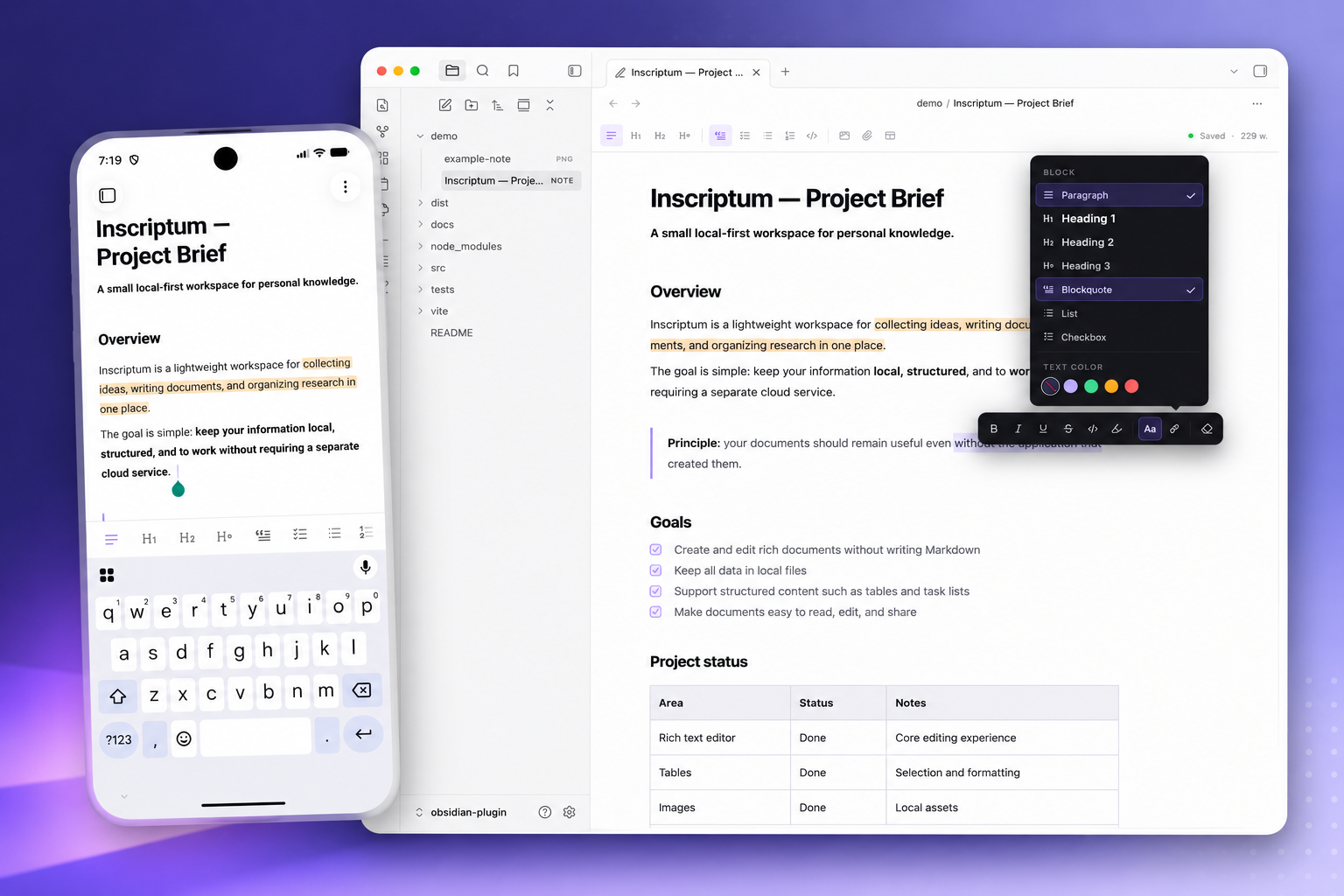
The Obsidian plugin brings Inscriptum to your Obsidian vault, allowing you to use the editor alongside your existing notes and workflow.
Features
- WYSIWYG rich text editing
- Headings and structured documents
- Todo lists and regular lists
- Blockquotes
- Tables with cell selection and styling
- Images
- Links and automatic URL/email linking
- Code blocks with syntax highlighting
- Switchable syntax highlighting themes
- Bubble menu for quick formatting
Local-first
Inscriptum keeps your documents in your Obsidian vault.
There is no cloud service, no account, and no external storage required. Your documents and data remain on your device and under your control.
Installation
Via Community Plugins (recommended)
- Open Settings → Community plugins in Obsidian.
- Disable Restricted mode if it is on.
- Click Browse and search for Inscriptum.
- Install and enable it.
Alternatively, open the plugin page directly: Inscriptum on Obsidian Plugins.
Via BRAT
If you want to try the latest development versions before they are released, install Inscriptum using BRAT.
-
Install BRAT in Obsidian.
-
Open BRAT → Add Beta Plugin.
-
Add:
inscriptum/obsidian-plugin -
Install and enable Inscriptum.
Manually
-
Download
main.js,manifest.json, andstyles.cssfrom the latest release. -
Create the plugin directory:
.obsidian/plugins/inscriptum/ -
Copy the downloaded files into it.
-
Reload Obsidian.
-
Enable Inscriptum under Settings → Community plugins.
Development
Clone the repository and install dependencies:
git clone https://github.com/inscriptum/obsidian-plugin.git
cd obsidian-plugin
npm ci
Start the development build:
npm run dev
The development build runs in watch mode and automatically deploys the plugin to:
.obsidian/plugins/inscriptum/
Create a production build:
npm run build
Run tests:
npm test
Release
Releases are built automatically by GitHub Actions.
Create a new version and push the tag:
npm version patch
git push --follow-tags
The workflow builds the plugin, takes the release notes for the new version from CHANGELOG.md, and publishes the release automatically.
Before pushing the tag, add a ## [x.y.z] section to CHANGELOG.md describing
the changes — the release will be created only if that section exists.
License
MIT © 2026 sumbad