
README file from
GithubGnosis for Obsidian
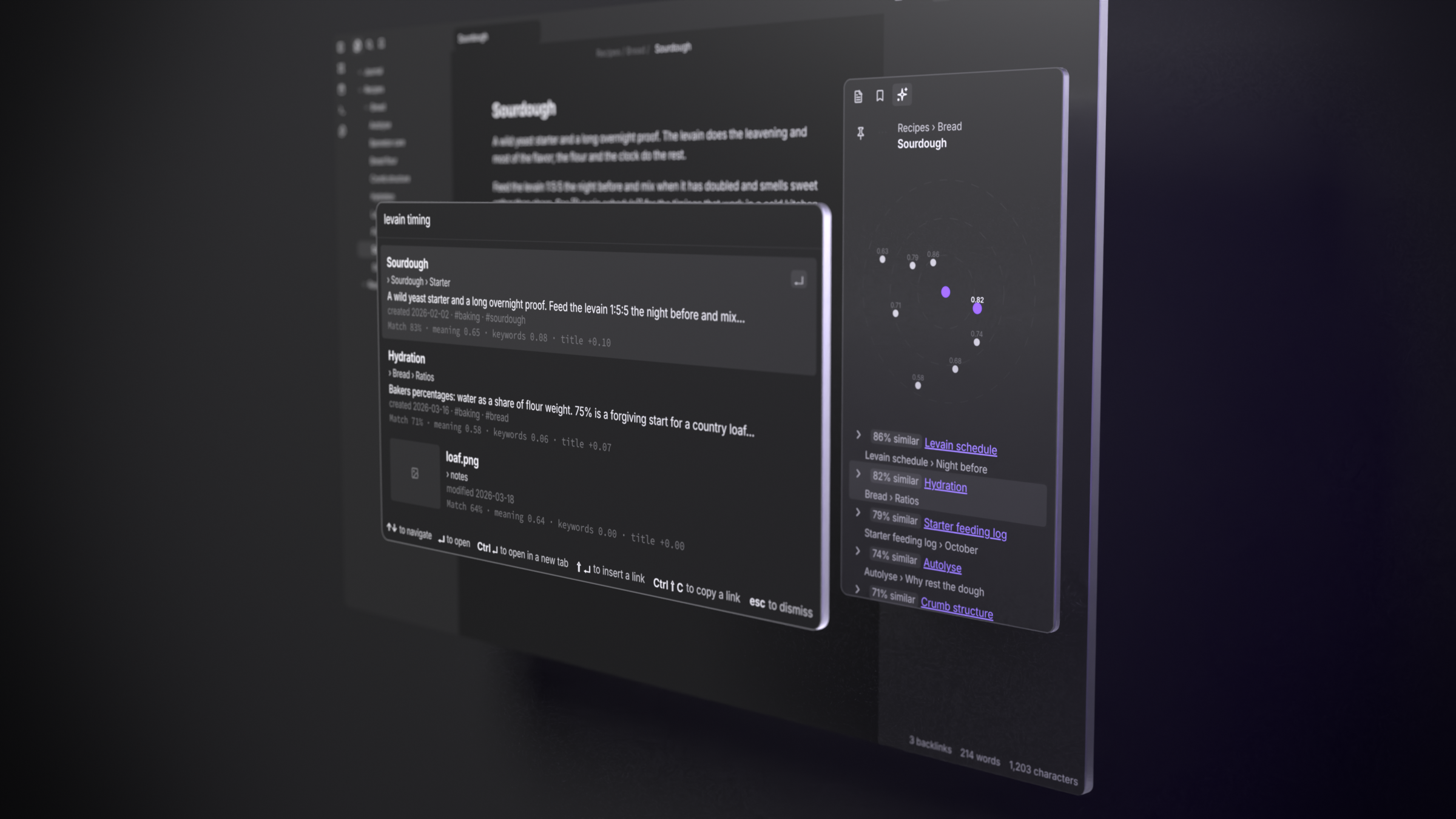
Search your vault with gnosis's own retrieval pipeline, reading a portable index you built on your own machine. No server, no API key, nothing leaves the vault.
Desktop only. The models run in a worker with WebAssembly or WebGPU, and their downloads run to hundreds of megabytes, which this plugin does not ask of a phone. Obsidian does not offer it on mobile.
The ranking code is not reimplemented here. gnosis's query pipeline is
compiled to WebAssembly and vendored in vendor/gnosis-wasm/, so the lexical
channel, BM25+'s parameters, the title bonus, the fusion weight and the vector
comparison behind related-notes are the same code — and the same measurements —
as the CLI's. This plugin reads bytes out of the vault, calls into it, and
shows what comes back.
What it does
Works with no model and no download:
- Search vault — BM25+ over the index's own text. On the scifact benchmark this tier scores 0.666 nDCG@10 against the hybrid pipeline's 0.722: worse than semantic search, and far from nothing.
- A prefix scopes the search —
txt:for notes,img:for images,pdf:for PDFs (img: red bicyclesearches images only). The prompt says what the scope is searching, and a scope nothing can match — image search off, an index without images or PDFs — says so in the result list. The same prefixes work in hybrid search, and then each model is queried only for the kinds its scope needs. - Related notes — the most similar notes to the current one, at full quality, because both sides of that comparison are vectors the index already carries. Notes the current one already links to are excluded, so what is left is unlinked mentions. A map above the list puts the current note at the center: a note's distance is its score, and notes alike to each other sit in the same direction.
- Show index info — what built the index, when, and how much it holds.
Semantic search, once you turn it on (Settings → Semantic search):
- Search vault becomes hybrid: the query is embedded with the model your index was built with and fused with the keyword channel, by gnosis's own ranking code. While the model loads, search answers with keywords and says so.
- A word the index has never seen is also matched to the words a typo or two away ("hydraton" finds "hydration"), at half weight, so an exact match always ranks first. This works in keyword search too.
- Turning it on asks first, and lists what it downloads: the model's files from Hugging Face at the revision the gnosis CLI uses (bge-small-en-v1.5: 134 MB; multilingual-e5-small: 487 MB), and ONNX Runtime's WebAssembly engine from jsDelivr: 14.3 MB to run on the CPU, or 26.9 MB to run on a graphics card through WebGPU (Settings → Compute → CPU keeps to the first). Both are cached; a second session downloads nothing.
- The engine is downloaded, not bundled, because it would make
main.js14 to 41 MB larger, and Obsidian reads and parses that file every time it starts, for every reader, including the ones who never turn semantic search on. It is fetched only after you agree, from the URL of the exact onnxruntime-web release the plugin was built with, and checked against that file's SHA-256, fixed at build time, before it is cached and every time it is loaded. A file that does not match is refused and never run. It is the engine's WebAssembly only: its JavaScript is part ofmain.js, and no code is fetched from anywhere else. - Nothing leaves the device. The model runs locally in a worker; notes and queries are never uploaded.
- How a query is embedded — pooling and the query prefix — is read from the
index rather than assumed, so an index built with
query_instruction = falseis queried without the instruction, as the CLI would.
Image search, once you turn it on (Settings → Search images):
- Images the CLI indexed turn up in Search vault, mixed in with notes and
shown with a thumbnail; choosing one opens the image. A text query reaches
them through CLIP's text tower (
Qdrant/clip-ViT-B-32-text, 258 MB, the files the CLI uses), a second model that is asked for separately and only does anything when the open index has an image space. - It reproduces the CLI's image scores to 2e-7 and ranks them identically
(
test/image-parity.test.ts). - Delete model removes CLIP too and turns this off; the model card counts it.
- Indexing images here. With the switch on, Build index also embeds the
vault's PNG, JPEG and WebP files with CLIP's vision tower
(
Qdrant/clip-ViT-B-32-vision, 352 MB) and gives every document a CLIP-text title proxy, which is whatgnosis indexwrites with[embed.image]on. The one switch covers both towers: its prompt names the vision tower, which is downloaded only when a build first needs to embed an image. An automatic update never fetches it. A file that will not decode is skipped, as the CLI skips it. Preprocessing follows fastembed (a squash to 224x224 with a Catmull-Rom filter, alpha dropped), not transformers.js, which scores 0.69 against the CLI's vectors for a 16:9 photo where this scores above 0.9999.
Building the index here (command: Build index), desktop only:
- Builds with gnosis's own
Builder, compiled to WebAssembly — the same parsing, chunking, content hashing and shard layout asgnosis indexandgnosis export. Built from nothing on the kepano-obsidian vault, it matches the CLI's export byte for byte except the per-chunk i8 scales, which differ in their last bits (under 1e-6 relative) between the two runtimes. - Incremental: only notes whose content changed are embedded; an unchanged vault writes nothing at all, and an edit rewrites the shard it is in and the manifest.
- Resumable and cancelable: progress is checkpointed to this device's IndexedDB — never the vault, so a half-built index never syncs anywhere. Cancel index build, or closing Obsidian, keeps the existing index untouched; the next Build index picks up where it stopped.
- Rebuild from scratch (command: Rebuild index from scratch): embeds every note again instead of carrying unchanged ones over, after asking. An index in an older artifact format cannot be updated in place, so Build index offers the same rebuild for it; an automatic update leaves it alone.
- An existing index keeps its own model and settings. A vault with none is built with Model for new indexes (bge-small-en-v1.5 by default).
- Two writers: if the index in the vault was written by another device or by the CLI, the plugin asks before replacing it, and says what a rebuild here drops (images, other folders).
Limits:
- PDFs are indexed only by the gnosis CLI; the
pdf:prefix finds them in Search vault once they are in the index. - The index card's "notes changed" line counts notes, not images; a build picks up changes to images.
Getting started
Install the plugin and run Build index. It asks before downloading the model, then indexes in the background with progress in the status bar.
Or build with the gnosis CLI, which is faster on a large vault and the only way to index images and PDFs:
cd /path/to/vault
gnosis index .
gnosis export --out .gnosis/artifact
Either way the index lives in .gnosis/artifact (the default; configurable).
It is a manifest plus shards; shard names are stable and only changed
documents are rewritten, so it syncs as a handful of files rather than one
large one.
Building
npm install
npm run build     # writes main.js
npm test          # the suites below
script/install.sh /path/to/vault
No Rust toolchain needed: the WebAssembly module and its JS glue are committed
under vendor/gnosis-wasm/, with the gnosis revision they came from recorded
in vendor/gnosis-wasm/GNOSIS_REV.
A gnosis release refreshes them. Its tag publishes the wasm bundle as a release
asset and notifies this repo, and .github/workflows/update-wasm.yml vendors
that asset, checks it against its published SHA-256, runs the tests and opens a
chore: Re-vendor gnosis-wasm for vX.Y.Z pull request. The asset is used as
published, never rebuilt. The same can be done by hand:
script/update-wasm.sh --release v0.1.0   # a gnosis release; no tag means the latest
script/update-wasm.sh ../gnosis          # build from a gnosis checkout, for local work
main.js is about 1.4 MB: the inlined 666 KB gnosis .wasm, and the
embedding worker (transformers.js and ONNX Runtime's JavaScript, 509 KB), which
is inlined as source and started from a blob. Both are inlined because the
community-plugin channel ships only main.js, manifest.json and
styles.css. The only network access is the consented download above: the
plugin fetches no JavaScript at run time.
License
MIT. main.js also bundles transformers.js and its tokenizer and
template packages (Apache-2.0 and MIT), ONNX Runtime Web (MIT), and the gnosis
query client compiled to WebAssembly (MIT) with the Rust crates it links. Their
licenses are in THIRD_PARTY_NOTICES.md, generated
from what the build reads by npm run notices.