
README file from
GithubAchmage Bases Look 1.7.0
Thumbnails, group colors and spreadsheet-style cell formatting for core Obsidian Bases: cards, kanban, table and list views. No separate view or interface: your bases stay plain Bases, they just look and work better.
한국어 설명은 아래에 있습니다. · Changelog · Security · Contributing
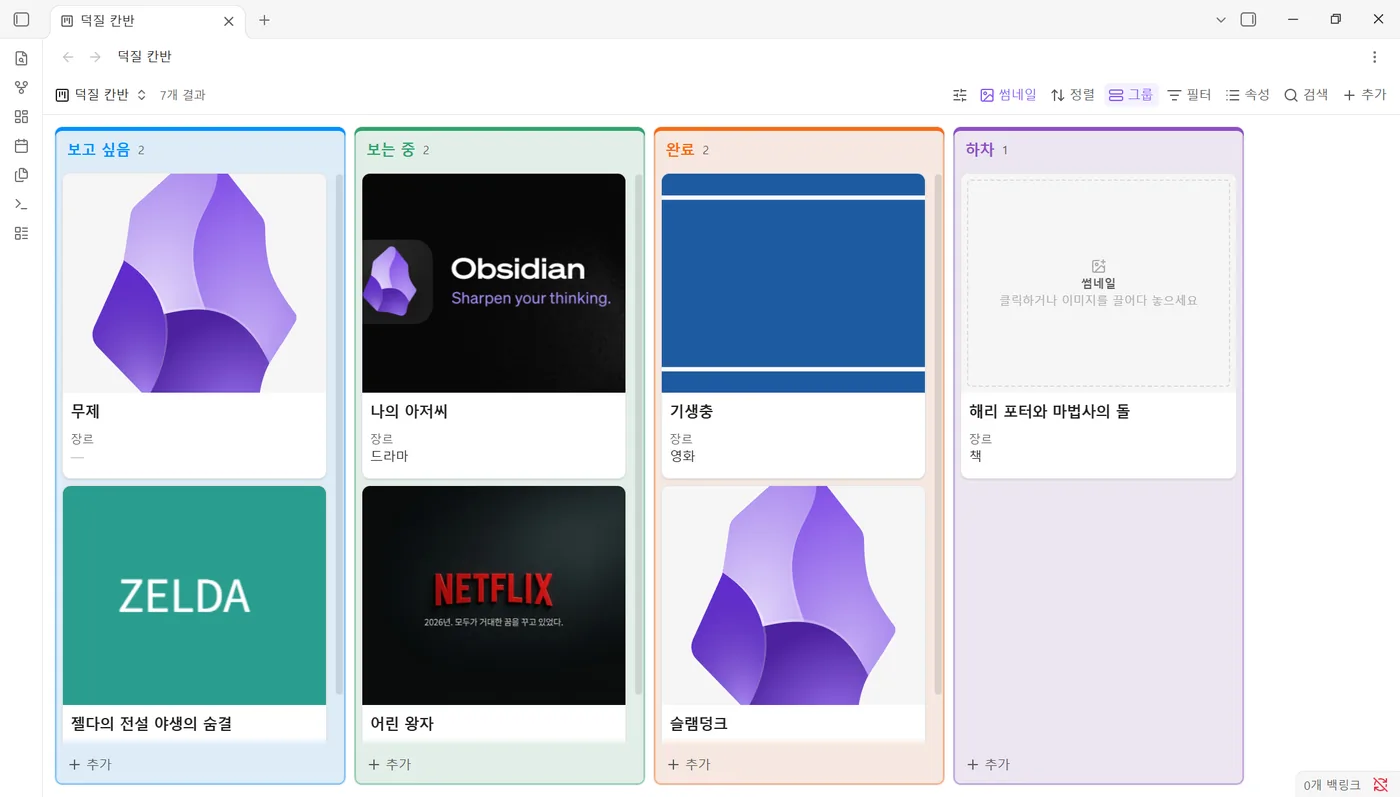
New in 1.7.0: thumbnails from a table, all headers at once, embeds that fit the page
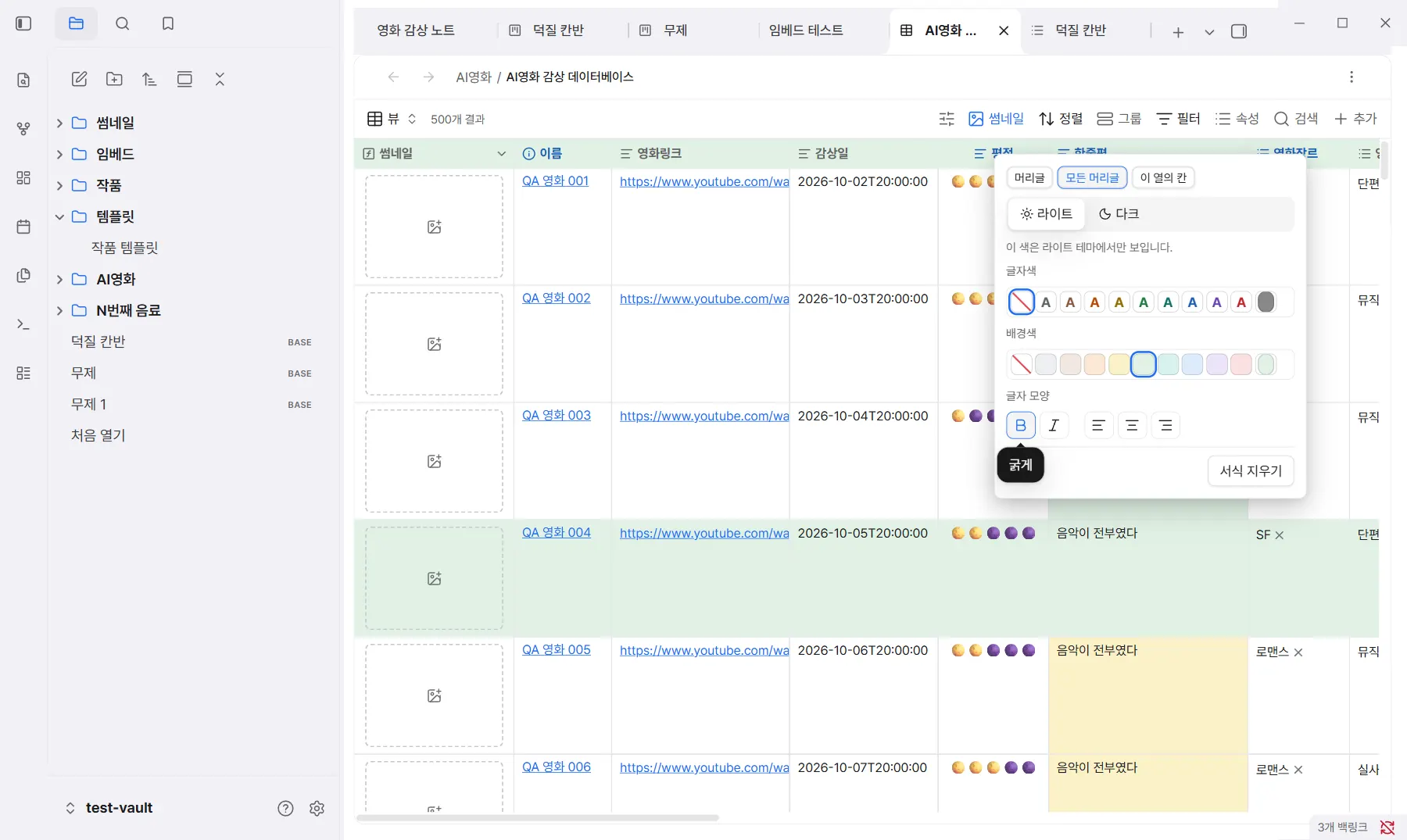
- Add or change a thumbnail right in a table or a list. A click anywhere in the thumbnail cell of a table, empty or not, opens the thumbnail window; in a list, a click on the thumbnail does. No more switching to cards or kanban and back. Before, a click on the empty frame in a table did nothing: the press put the keyboard focus on the frame, Obsidian then sized the cell to its content, and the frame shrank under the pointer before the click arrived. A press no longer moves the focus there. Shift, Ctrl and Alt clicks select cells and open notes as in Obsidian.
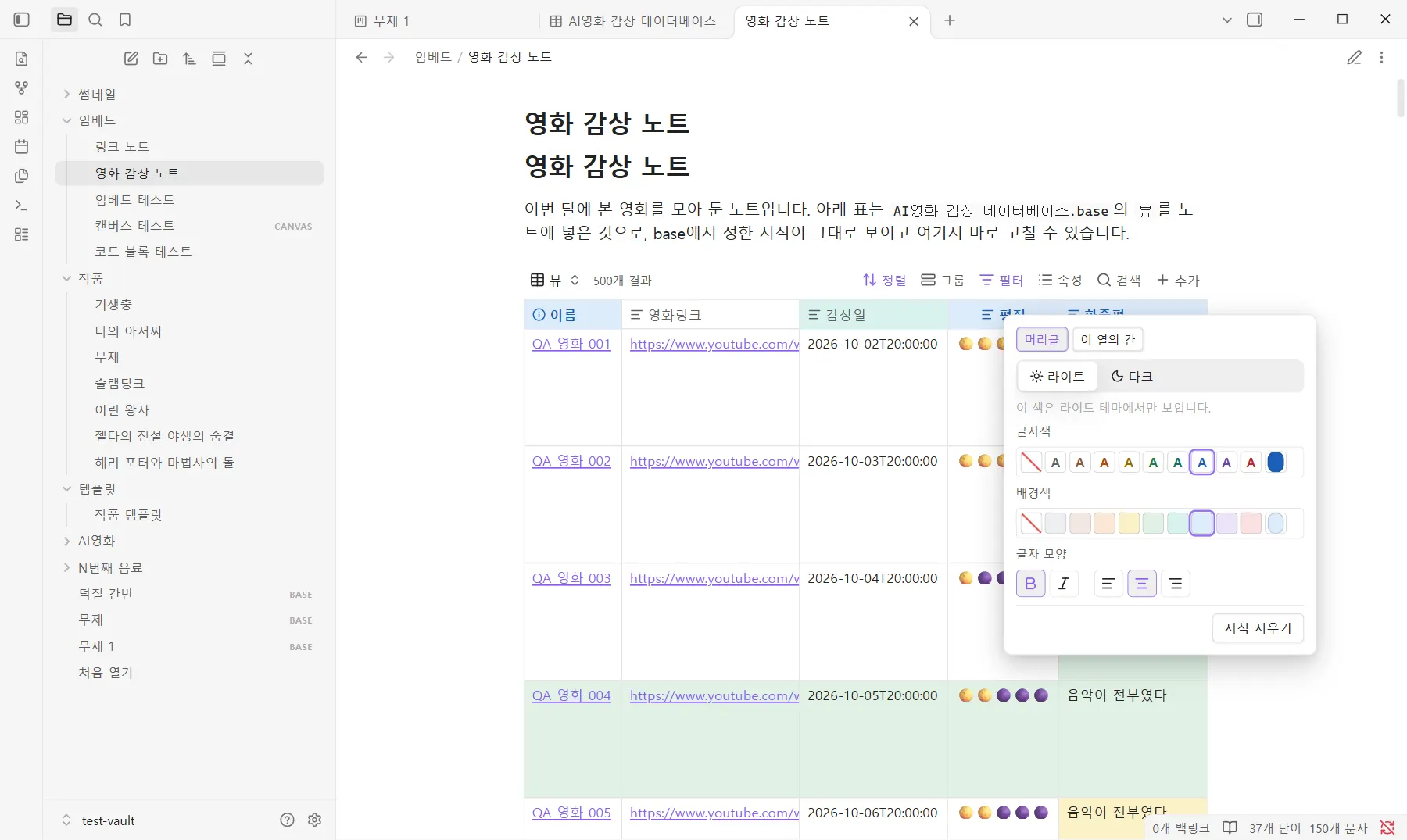
- Format all headers at once. In the format window of a header, All headers formats the whole header row in one go: colors for each theme, bold, italic and alignment. Each header can still have a format of its own on top. A change for all headers replaces only what it changes in each header: a new fill for all keeps each header's own text color. Clear formatting of all headers in the header menu brings the whole row back to Obsidian's look.
- Embedded bases keep the width of the text. A base embedded in a note now stays in the text column, as wide as the paragraphs around it, with readable line length on or off. A wider table moves sideways when you rest the mouse at its left or right edge, or drag it with the wheel button, as in 1.6.0. To spread one view out to the width of the note again, turn on Wider when embedded in a note for that view in the look panel.
1.6.0: move through tables like a spreadsheet
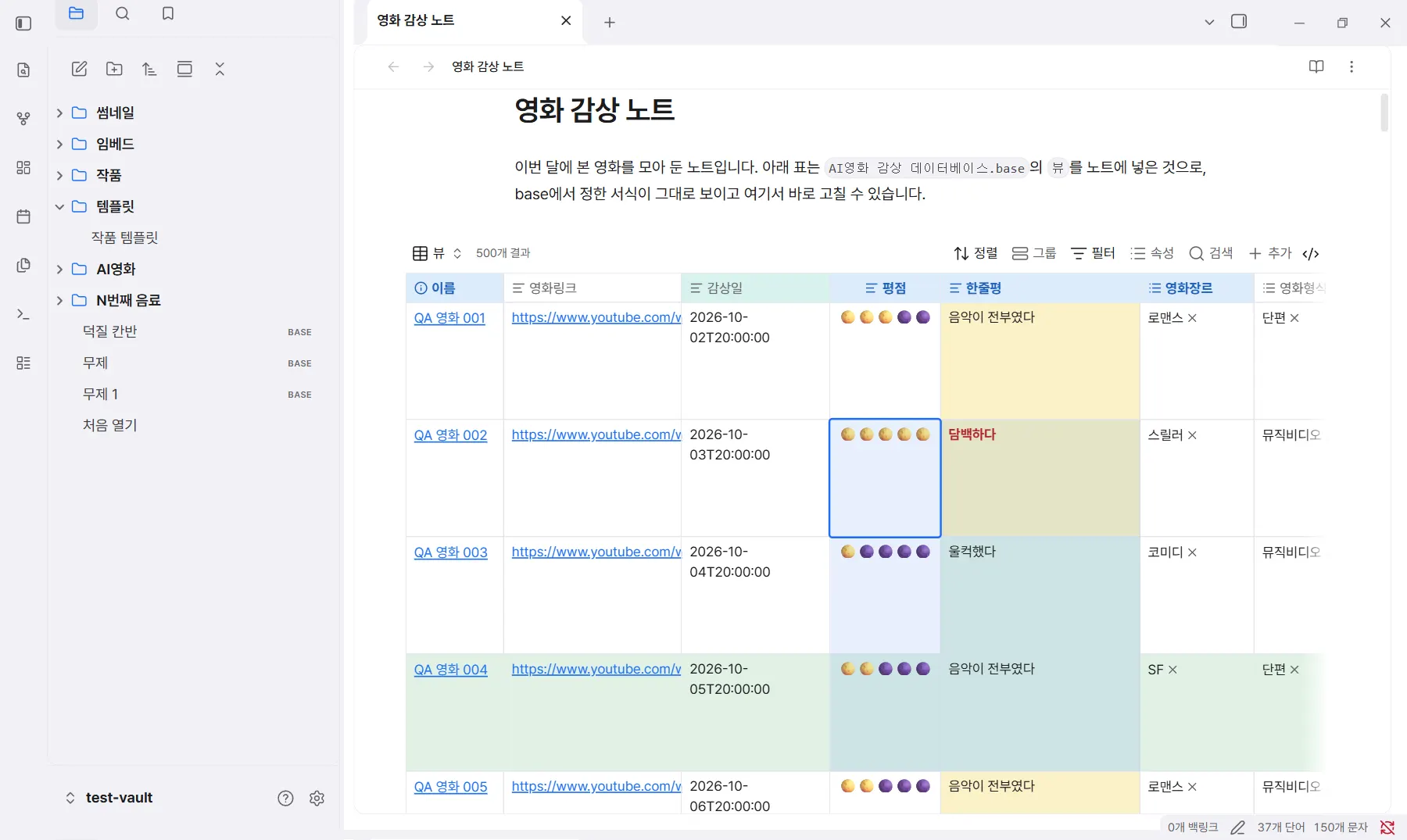
- A click selects, the keys move. A click on a table cell selects the cell instead of editing it. The arrow keys, Tab, Home, End and the page keys move it, and Shift extends the selection: the keyboard navigation Obsidian Bases already has, now one click away, in Bases tabs and in tables embedded in notes.
- Enter, F2, a double-click or a second click on the selected cell edits it; Escape goes back to the value before editing. While a table holds the focus, F2 edits the cell instead of renaming the note.
- In a note, the note scrolls along with the selected cell. Links, checkboxes and thumbnail buttons still work with a single click.
- In the selection, Delete and Backspace clear the cell, as in Obsidian; Ctrl + Z brings it back.
- Rest at an edge to move sideways. Rest the mouse at the left or right edge (the faded part) of a wide table or kanban in a note, and it moves that way, faster nearer the edge. It stops as soon as the mouse moves away, and does not move while the mouse only passes by or while the wheel scrolls the note.
- No more bar at the bottom of the screen. The 1.5.0 scrollbar that stayed at the bottom of the screen is gone; the table's own scrollbar is back, and the soft edges and the wheel-button drag stay.
- Your choice per view. Select cells like a spreadsheet and Move sideways at the edges in a note are on by default and can be turned off per view in the look panel (only turning one off writes
falseto that view).
1.5.0: see the whole base at once
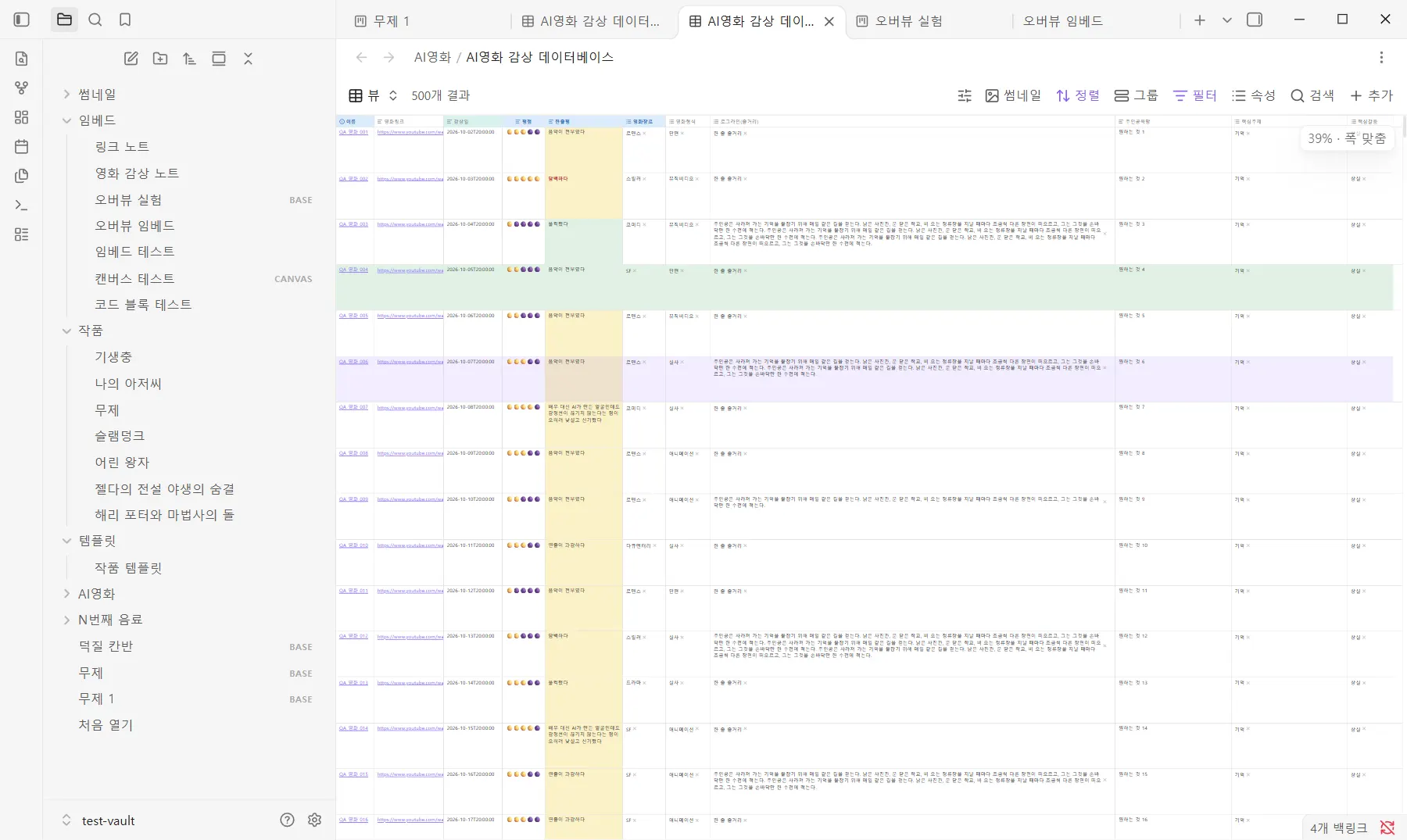
- Zoom like a spreadsheet. Hold Ctrl (Cmd on a Mac) and turn the wheel over a table, cards, list or kanban view, or pinch on a touchpad: one notch is one step, from 30% to 150%. On the way the zoom stops where every column (or kanban column) fits the width exactly, and the level shows for a moment at the top right. The toolbar, the fonts and Obsidian's own zoom stay as they are.
- Each view keeps its zoom on this device, and a base embedded in a note keeps its own zoom for that note. No file changes.
- Four commands zoom in, zoom out, go back to 100% and fit the width. Resizing columns and rows follows the mouse at any zoom.
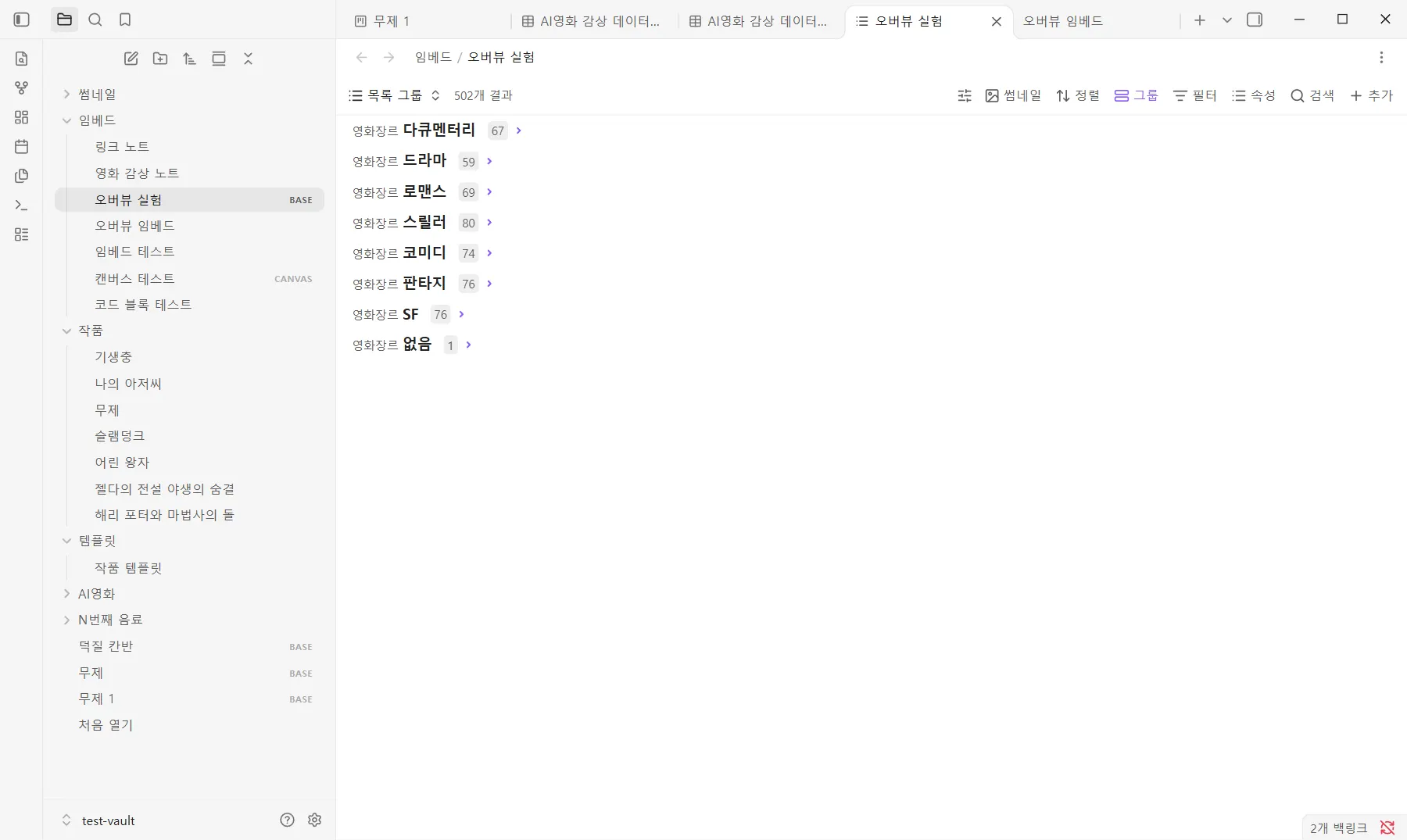
- Fold every group at once. Group headings show how many notes each group holds. Alt + click (Option + click on a Mac) a heading to fold every group, and again to unfold them all, in lists, cards and tables, embedded ones too. A plain click folds one group as before, and Obsidian keeps the folds as it always does. Two commands fold and unfold all groups. Kanban columns keep their own counts.
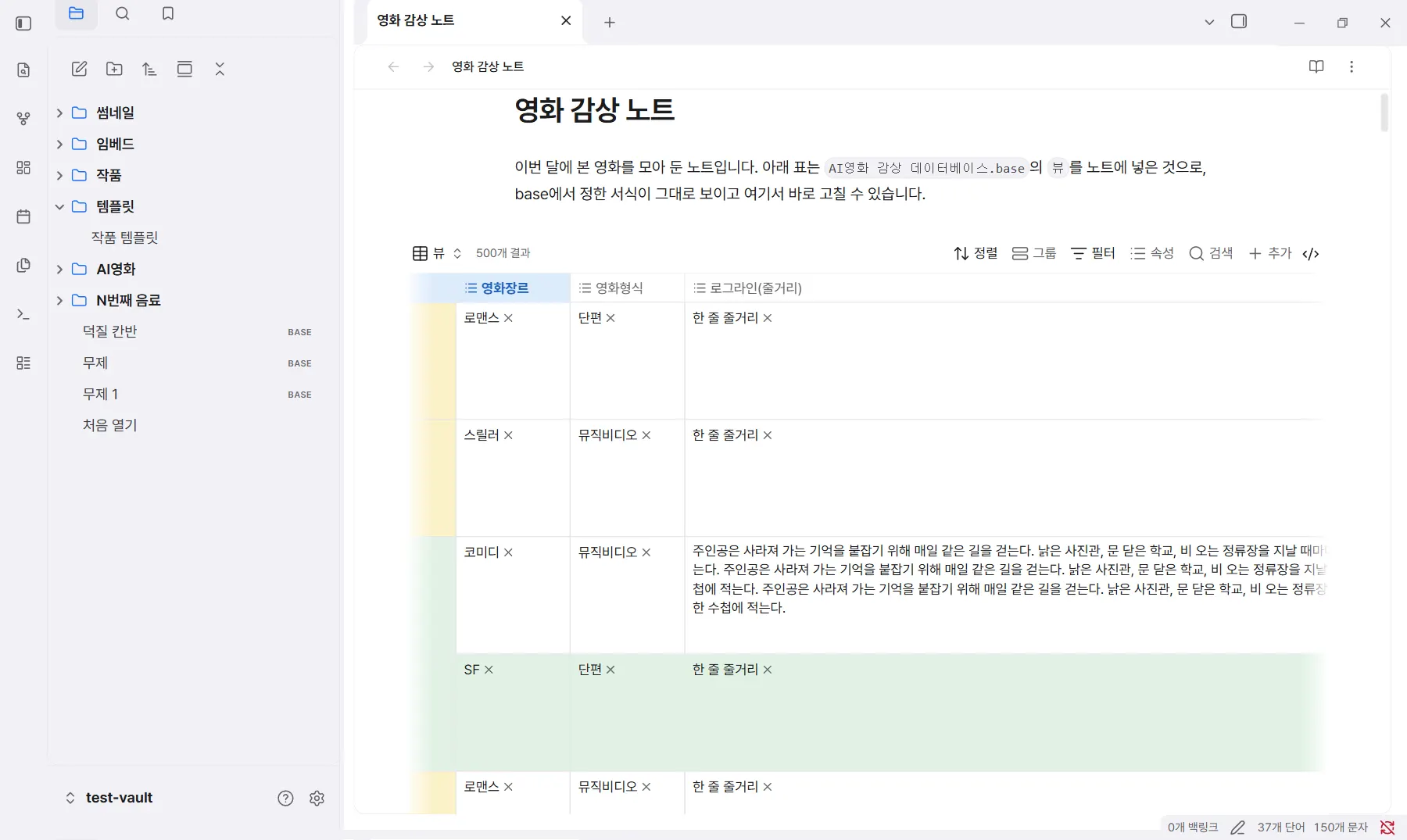
- Wide tables in notes. An embedded table or kanban wider than the text spreads out as far as it needs, up to the width of the note, centered on the text.
- The side where there is more to see fades out softly (since 1.6.0, resting the mouse there moves the table that way).
- Hold the wheel button and drag to move the table sideways and the note up and down (in a Bases tab too). A wheel click on a link still opens it in a new tab.
- Embeds in callouts, lists, quotes and embedded notes, hover previews, canvas cards and phones keep the width of the text. On a canvas, Ctrl + wheel and the wheel button keep zooming and moving the canvas.
- Your choice per view. Group counts and Wider when embedded in a note are on by default and can be turned off per view in the look panel. Only turning one off writes to the base (
falsein that view); turning it back on removes it again.
| Every group folded | A wide table in a note |
|---|---|
 |
 |
1.4.0: table formats in embedded bases
- Formats show where a base is embedded. A table view embedded in a note (
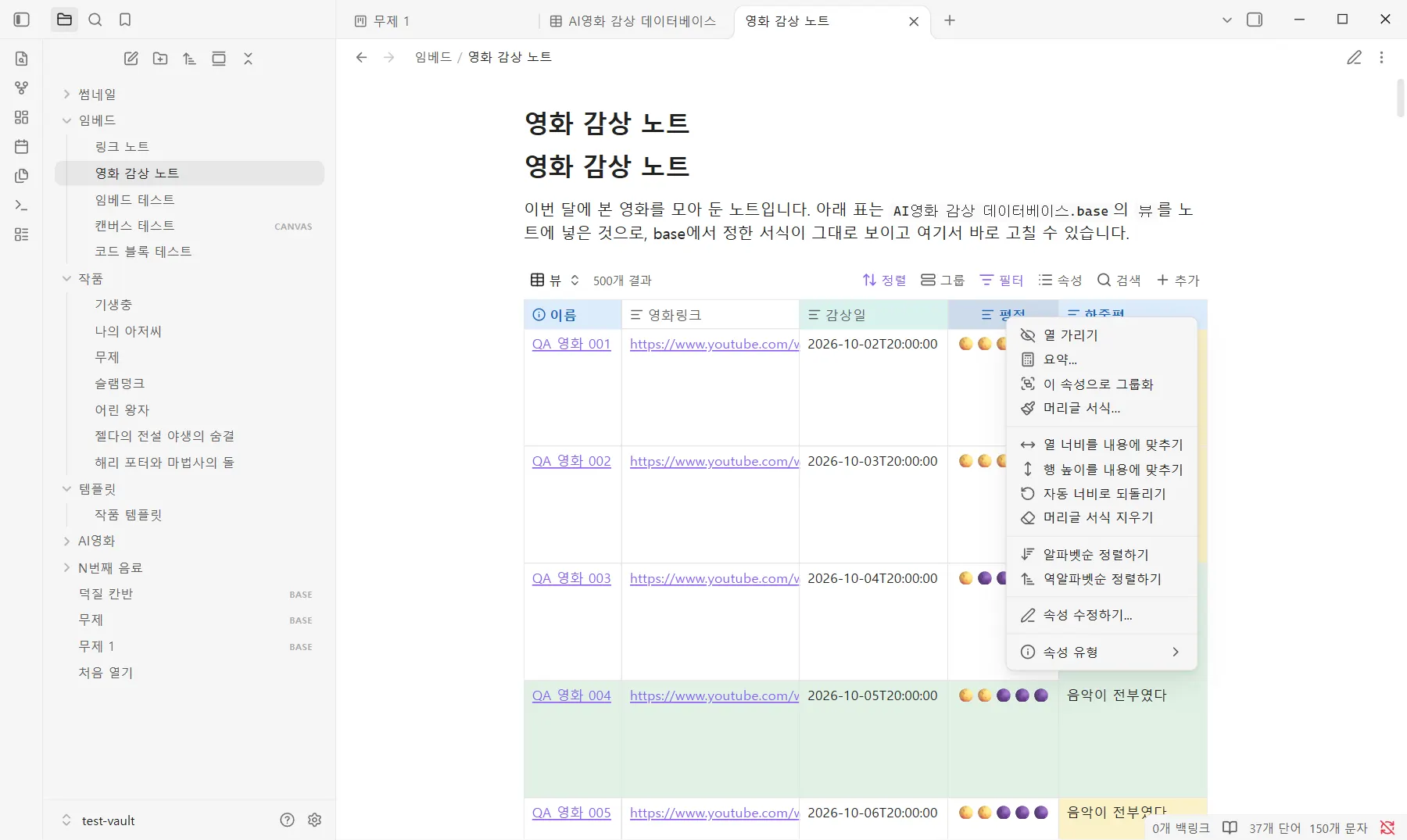
![[file.base#view]]), written in a```basecode block, shown in a hover preview or on a canvas card shows the formats set in the base, in reading view and live preview, with each theme's own colors. - Change them right there. Right-click a header, a cell or a dragged selection of an embedded table for Format cells…, fitting and clearing, as in a Bases tab. Double-clicking a column or row line, dragging the row line and the three table commands work too.
- Saved by Obsidian, where it keeps the base. A change made in an embedded
.basefile goes to that file, and an open Bases tab and the note follow each other. A change made in a code block goes to that code block, which Obsidian writes back in its own layout (as when you resize a column there). - Right-click the text of a cell. The table menu now opens on the text of a cell too, not only on its empty part, and the right-click no longer starts editing the cell. A cell you are editing keeps its editing menu; links keep theirs.
- Fitting measures text. Fitting a column narrows a wide column as well as widening a narrow one.
| Header menu in an embedded table | |
|---|---|
 |
Thumbnails, group colors and the look panel stay in Bases tabs; elsewhere an embedded base keeps Obsidian's own look. |
1.3.0: format and fit tables like a spreadsheet
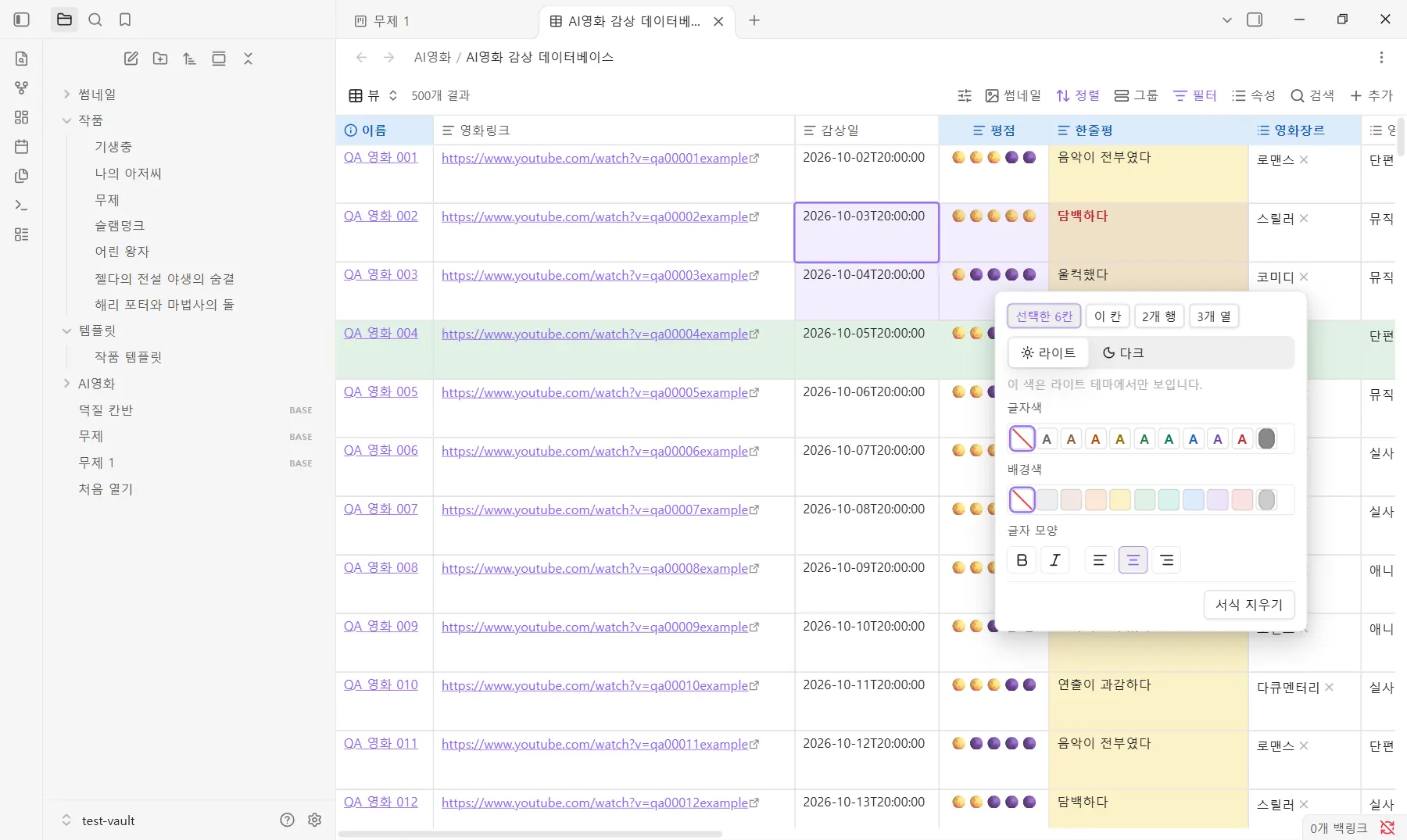
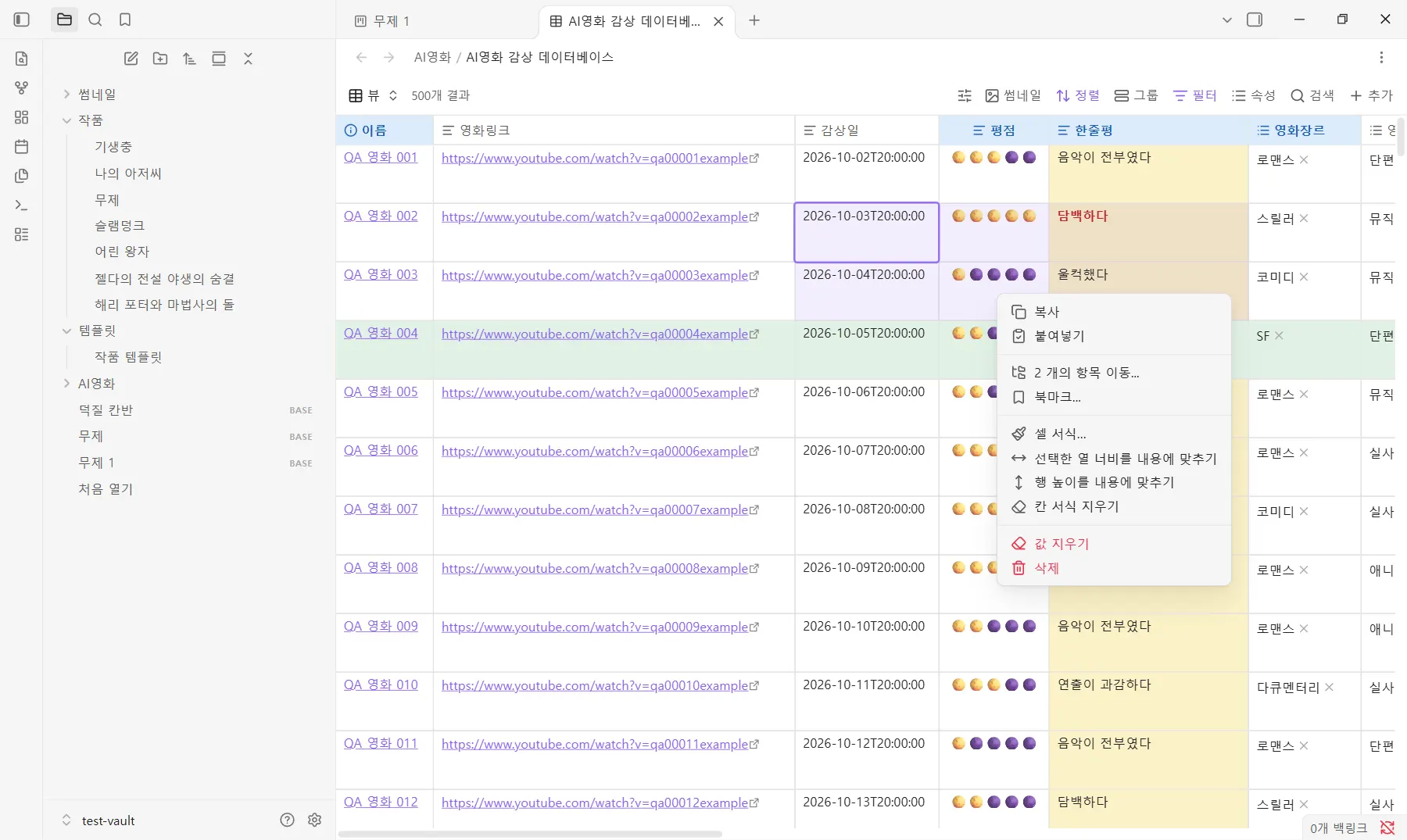
- Right-click to format. Right-click a header, a cell or cells you dragged over: Format cells… joins Obsidian's own menu. Set text color, fill (nine palette colors or any color), bold, italic and alignment for the header, the column, rows, one cell or the selected cells. A cell shows its column's format, then its row's, then its own.
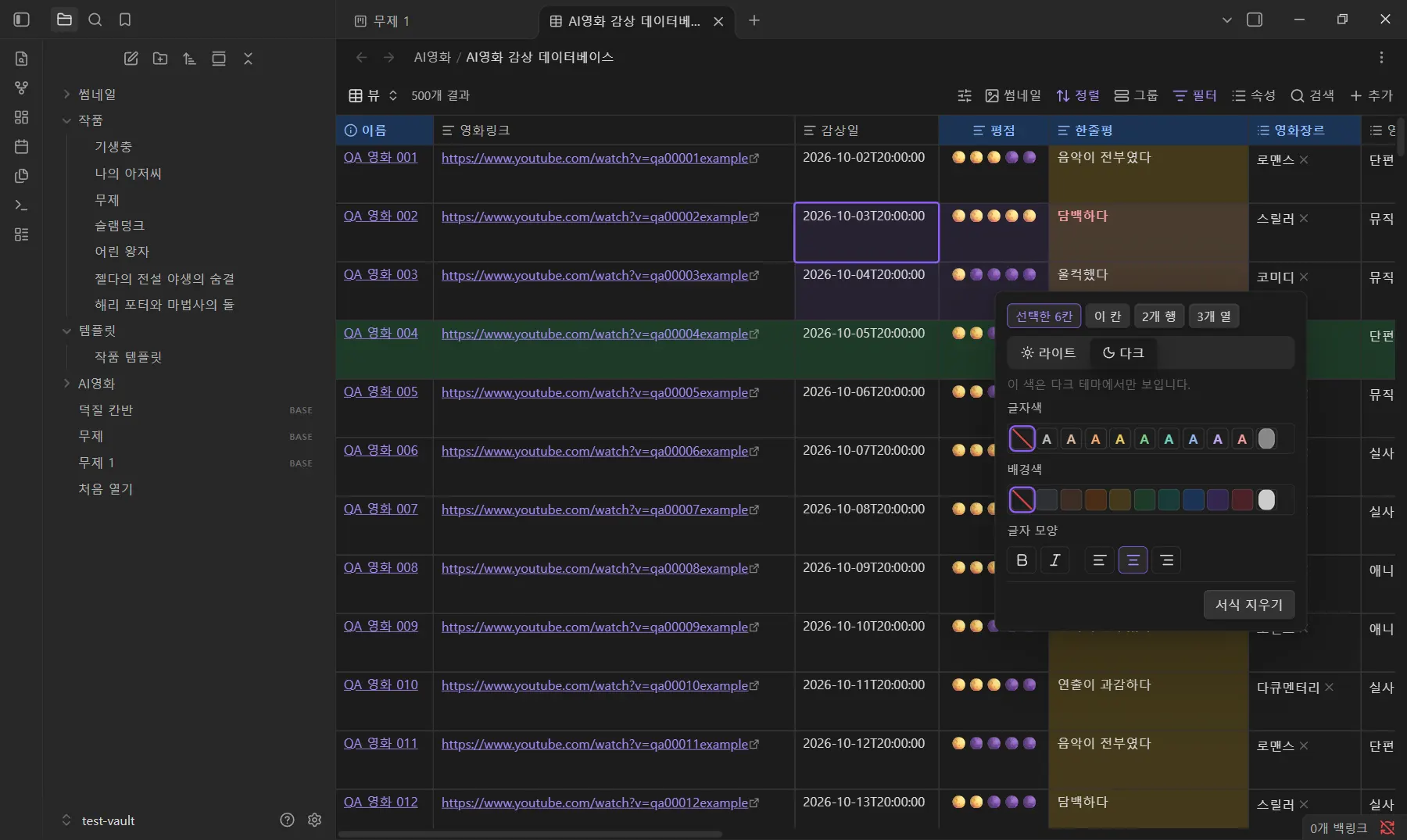
- Light and dark colors are kept apart. Colors set in the light theme show in the light theme only, and dark ones in the dark theme only. The ☀/☾ tabs of the format window set the other theme's colors without switching. Bold, italic and alignment apply in both.
- Double-click to fit. Double-click the line between two column headers to fit the column to its content (long text wraps within the row height); double-click again for Obsidian's automatic width. Double-click the line under a row to fit the rows to the lowest of Obsidian's four row heights that shows everything, or drag it to step between them. Bases draws all rows of a view at one height, so rows are fitted per view.
- Look panel and commands. Table views get a Table format section (fit all columns, fit rows, clear all) and three commands.
- Stored in the view, nothing else touched. Formats live in that view's
achmageLook.format; widths and heights are Obsidian's owncolumnSizeandrowHeight, so they stay if you remove the plugin. Row and cell formats follow renamed and moved notes.
| Selection menu | Dark theme |
|---|---|
 |
 |
1.2.0: each view its own look
- Every view keeps its own look. Card size, column width, row height, list thumbnail size, thumbnail shape and fit, dashed frames, tidying, hover and group look are set per view. Changing the cards view never touches the kanban, list or table view of the same base.
- The Thumbnails button works on the view on screen. Turning thumbnails on or off in every view is a separate button under This base.
- Everything is set in the base file. The plugin settings only hold connections (Cloudflare R2, Eagle). Thumbnail property, image folder, saving and new-kanban settings are set per base; look settings per view.
- Nothing is rewritten on update: values set in earlier versions keep applying until you change them in a view.
1.2.0 release notes · 1.1.0: each base keeps its own setup
What it adds
- Drop-in thumbnails. Turn on thumbnails for a base with one click. Every card without an image shows a dashed frame: click it, or drop an image file or a web image on it. In a table, click the thumbnail cell; in a list, the thumbnail.
- One thumbnail window, four sources. Drop or paste (Ctrl+V) an image, enter an image address, upload to Cloudflare R2, or pick from the Eagle app. The window says which property and folder the image goes to.
- Paste anything as the address. A web address on its own or inside a Markdown or HTML image, a wiki link or path to an image in the vault, an
obsidian://link, a file path on your computer, or adata:image. Vault images are linked without a copy; addresses already on Cloudflare R2 are not uploaded again. - YouTube links. A YouTube link becomes the video's preview image, and a ▶ button on the thumbnail opens the video. Other web addresses in the link property get a small open button.
- New kanban views show their cards at once, grouped by a status property (or the one from the settings) instead of stopping at “Choose a property”.
- One look panel. The sliders button next to “Thumbnails” holds This view (layout, size, shape, fit, frames, hover), This base (thumbnail property, link property, image folder, saving, new kanban, every view on/off) and Groups (colors shared by the base, look of this view). Sections fold, and the panel always fits in the window.
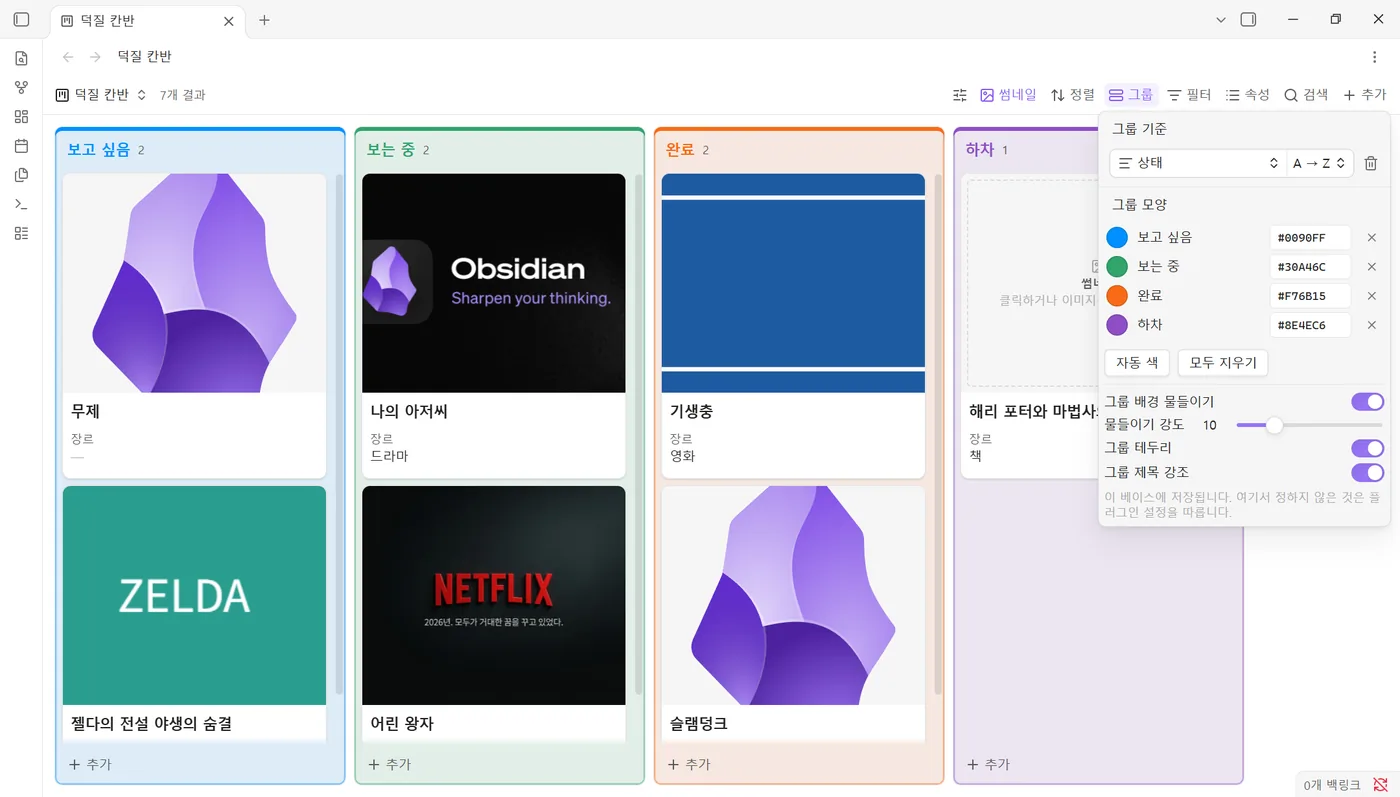
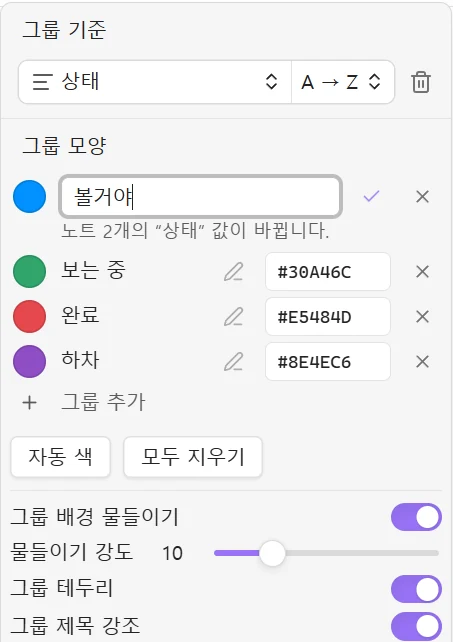
- Group colors, rename and add groups. Give each group its own color. The pencil next to a group renames it in every note of that group; Add group creates an empty group, such as a new kanban column.
- Hover details. Cards lift slightly under the mouse; table and list rows get a light highlight.
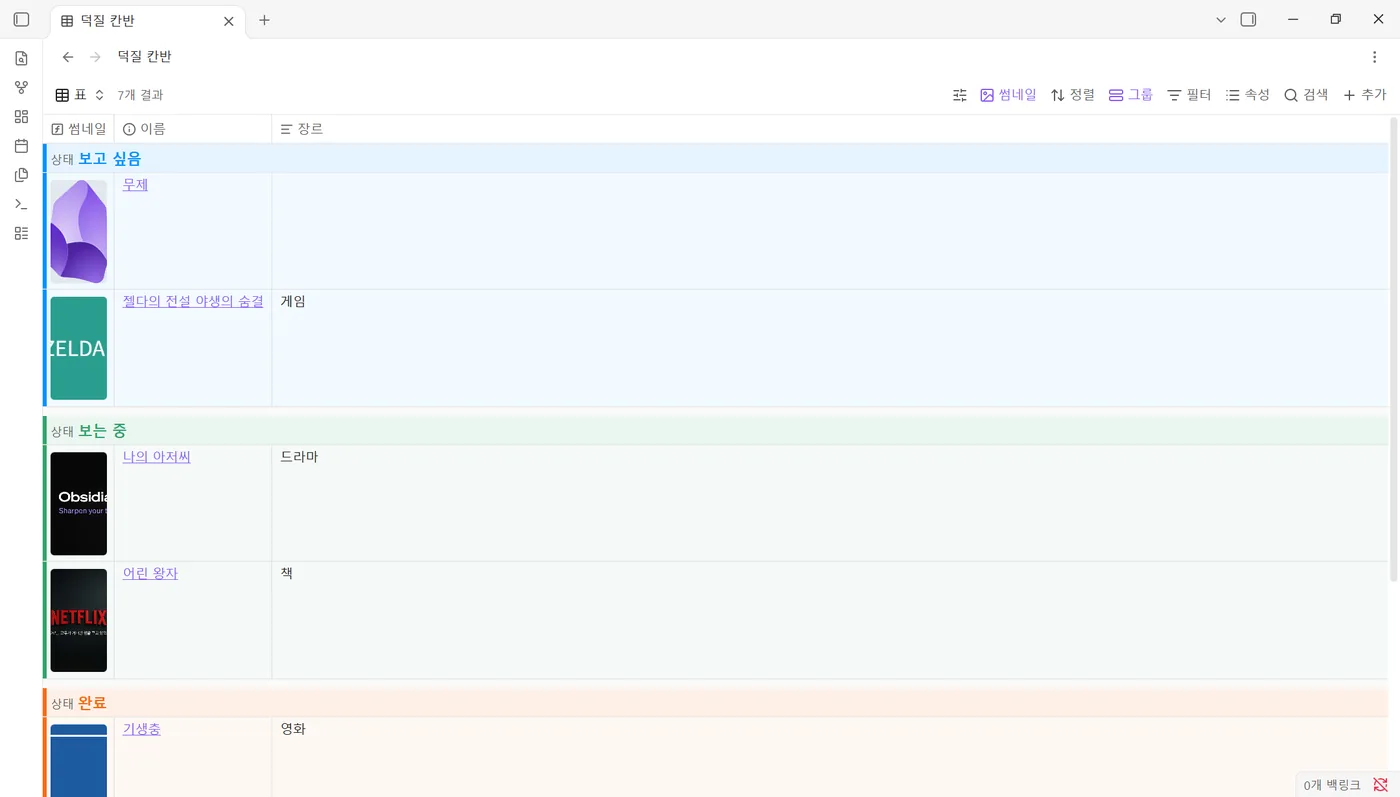
- Table format. Colors, bold, italic and alignment for headers (one or all at once), columns, rows and cells, per theme, from the right-click menu; double-click a border to fit a column or the rows. In Bases tabs and wherever the base is embedded.
- Overview. Zoom any view with Ctrl + wheel or a pinch, down to the width that fits; see how many notes each group holds and fold every group with Alt + click; embedded tables keep the width of the text, and resting the mouse at an edge moves them sideways.
- Move like a spreadsheet. A click selects a table cell; the arrow keys, Tab, Home, End and the page keys move it, Enter or F2 edits it. In a note, the note follows the selected cell.
| Group menu | Thumbnail window | Look panel |
|---|---|---|
 |
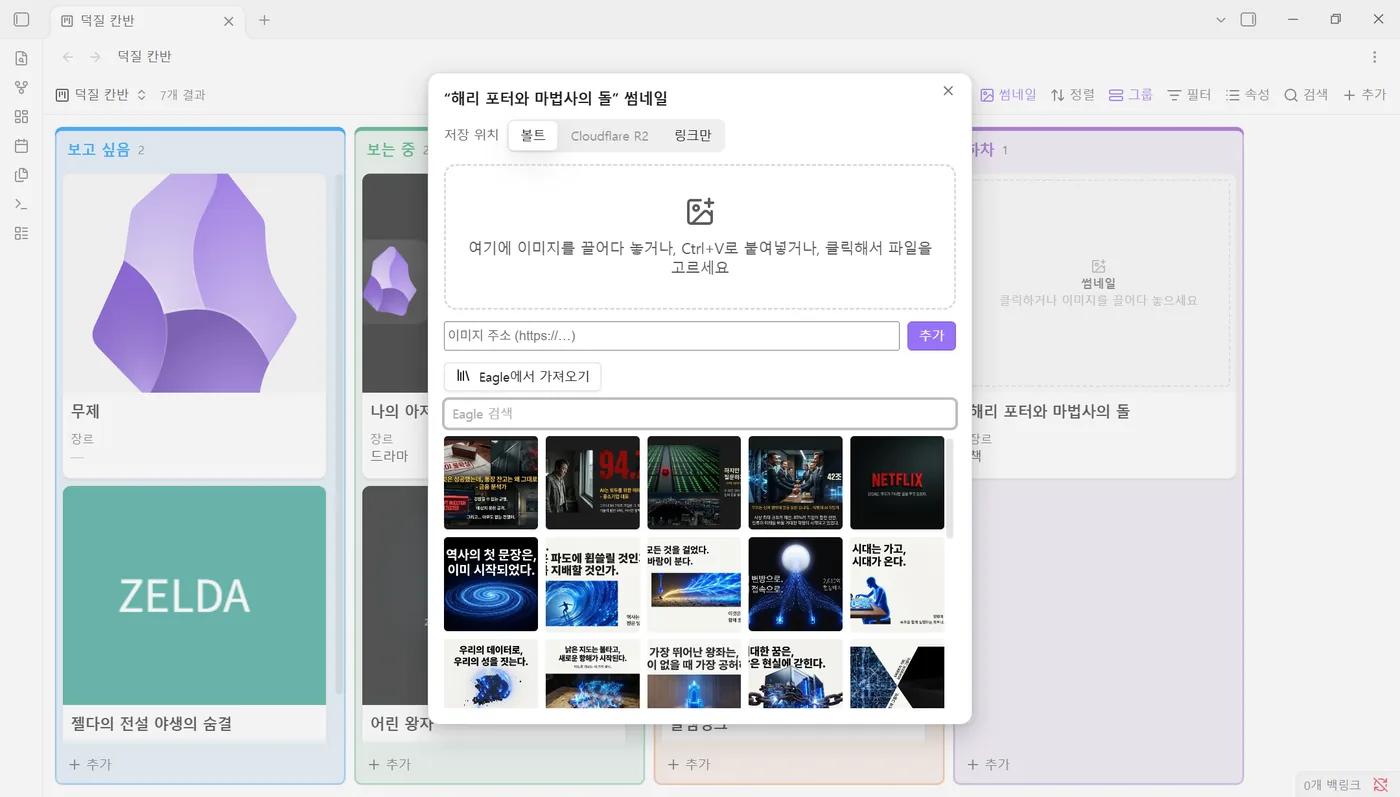 |
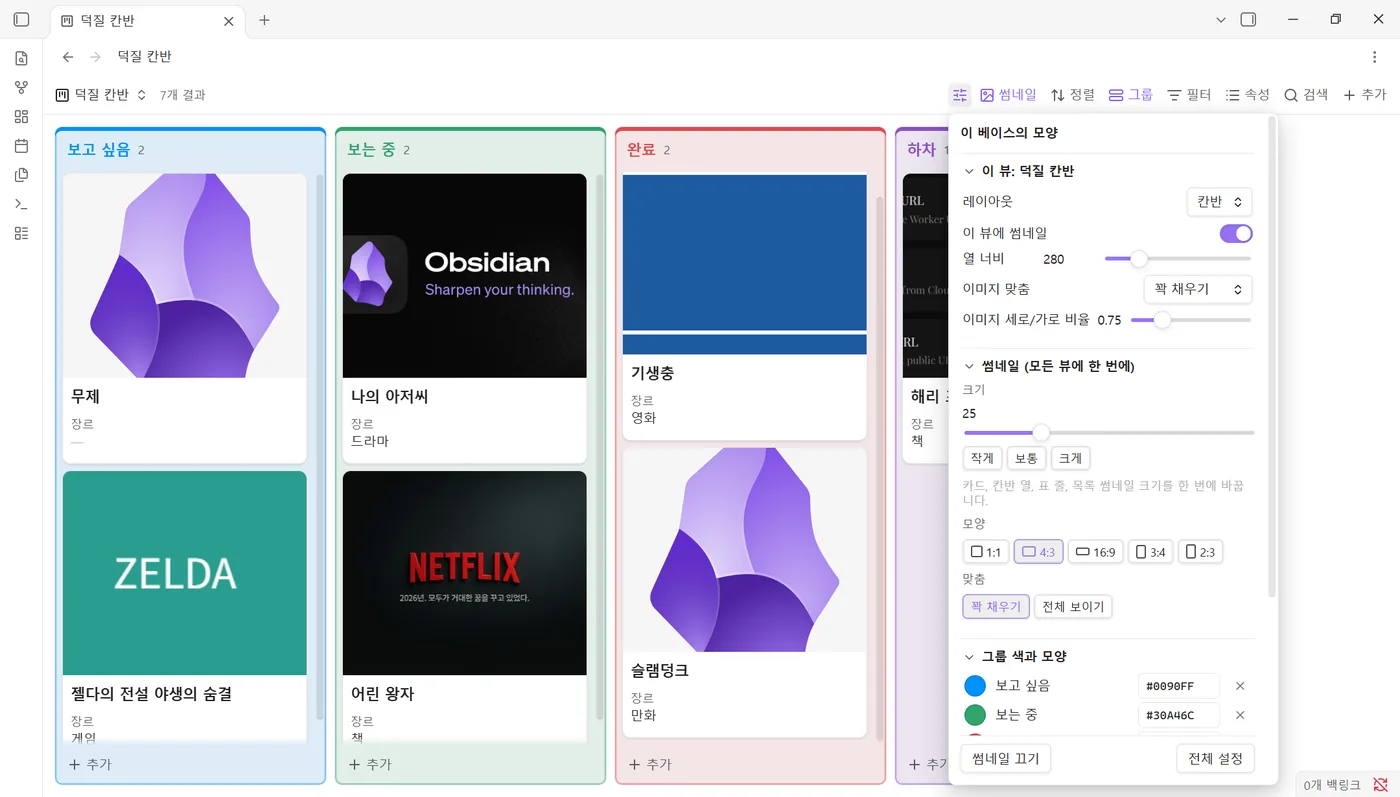 |
| YouTube link | New kanban | Rename a group |
|---|---|---|
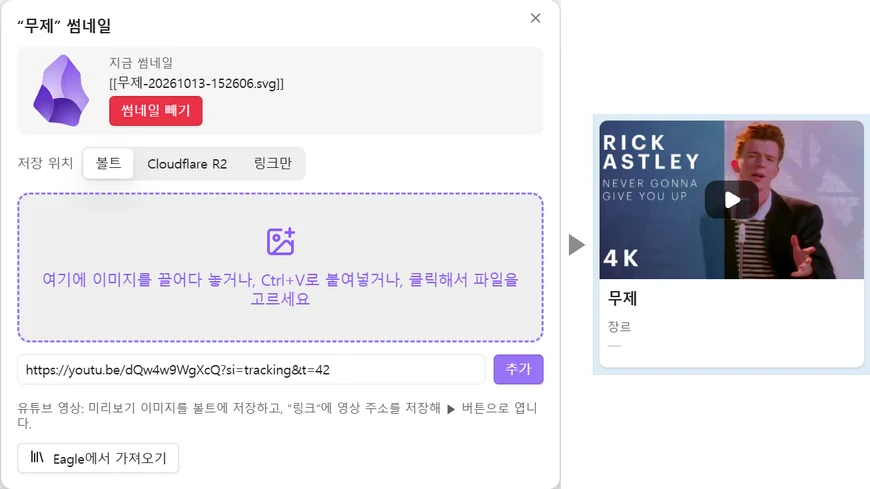 |
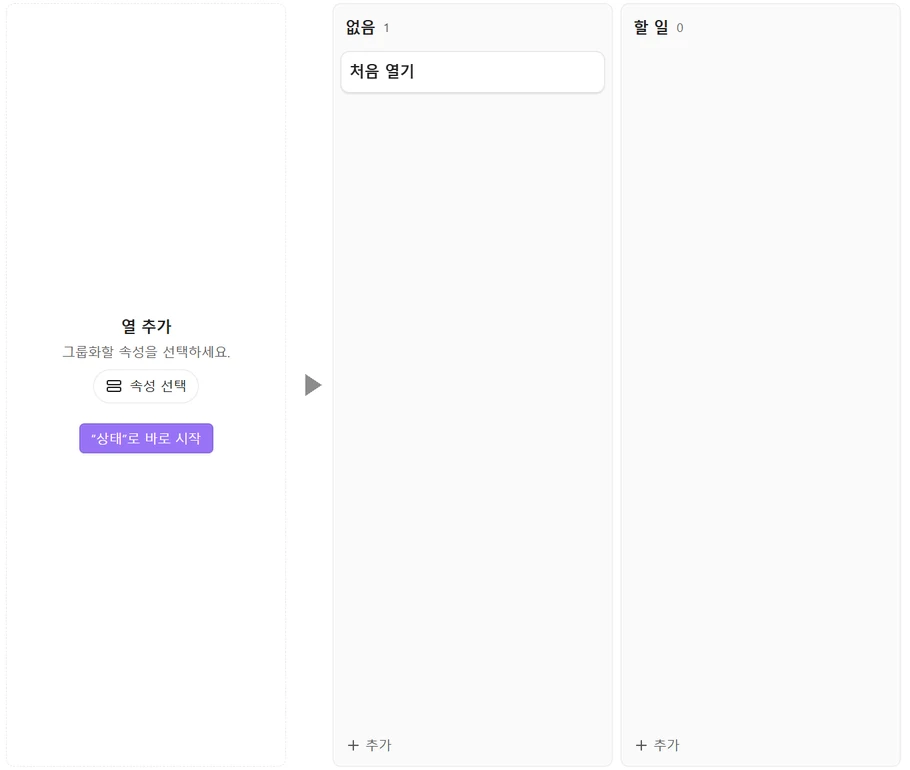 |
 |
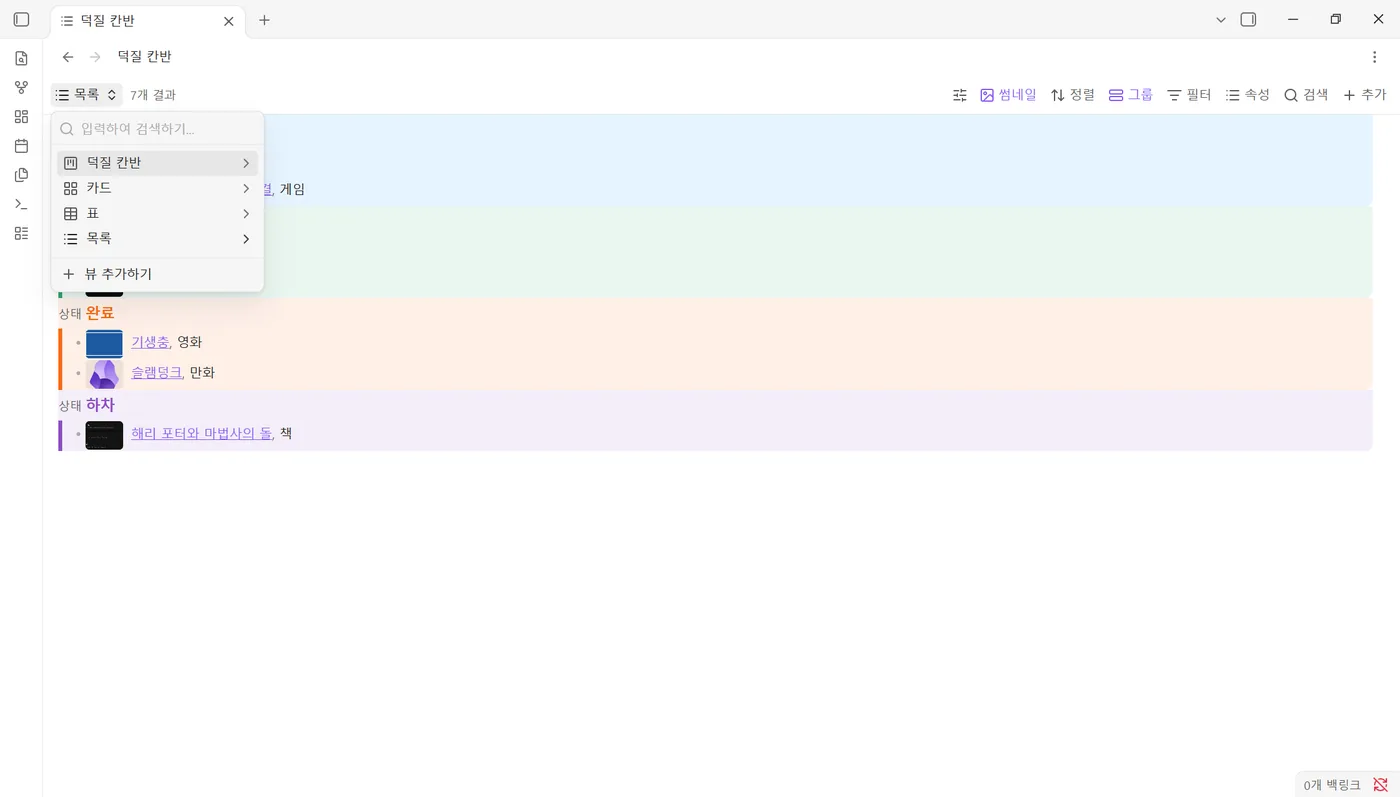
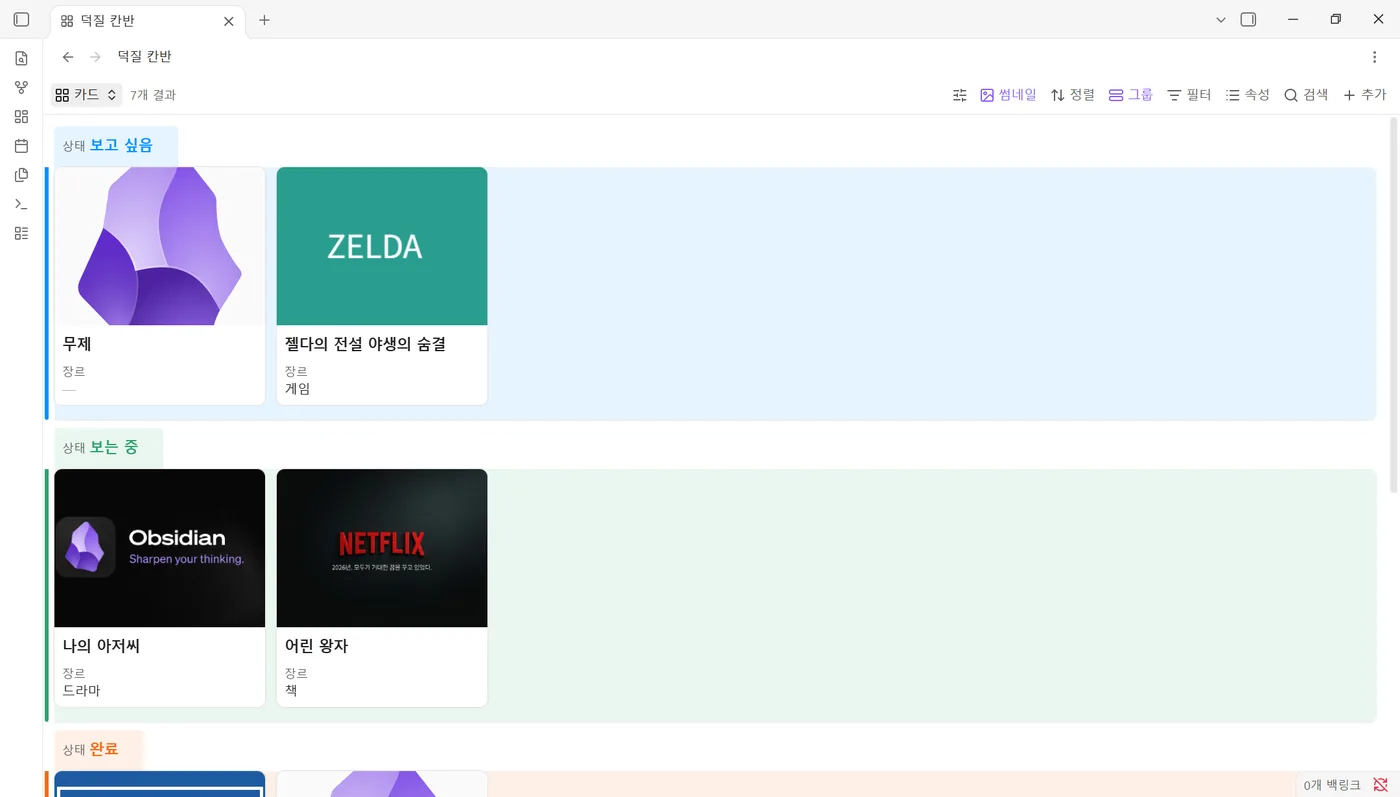
| Table | List | Cards |
|---|---|---|
 |
 |
 |
How to use
- Open a
.basefile. Two buttons appear before Sort in the toolbar: a sliders button and Thumbnails. - Click Thumbnails to turn thumbnails on in the view you are looking at. Click again to turn them off.
- Click a dashed frame (or drop an image on it) to add a thumbnail to that note. In a table, click the thumbnail cell to add or change it; in a list, the thumbnail.
- Use the sliders button for this view's look, this base's settings and group colors, or open Group and use Group look.
- In a table, right-click a header or a cell → Format cells… (for a header, choose All headers to format the whole header row), or double-click the line between two headers (or under a row) to fit it. The same works in a table embedded in a note.
- To see more at once, hold Ctrl (Cmd on a Mac) and turn the wheel over a view, Alt + click (Option + click) a group heading to fold every group, or drag with the wheel button held to move around. In a note, rest the mouse at the left or right edge of a wide table to move it sideways.
- In a table, click a cell and move with the arrow keys, Tab, Home and End; press Enter or F2 (or click the selected cell again) to edit it, and Escape to go back.
You can also right-click a note → Add or change thumbnail, or use the command palette (Open the look panel of this base, Show or hide thumbnails in every view, the three table commands, the four zoom commands and Fold / Unfold all groups of the current view, for the active Bases tab or the embedded base you used last).
Your setup stays yours
- The plugin reads first: a base's own image property is found and used as it is.
- It writes only when you click, and only fills what is empty. Settings for one base are stored in that base and nowhere else.
- Look settings are stored per view, inside that view in the base file; base settings at the top of the base file. The plugin settings only hold connections.
- Table formats are set by hand, cell by cell or column by column, and stored in that view only. Opening a base never writes anything, and a table nobody formats stays exactly as it was. While a base is open, the plugin changes what Obsidian holds, unsaved edits included, and lets Obsidian save it, so a change you just made is never lost.
- The same goes for embedded bases: opening a note that embeds a base writes nothing, and a change made in the embedded table is handed to Obsidian, which saves it in the base file or in the note's code block, as it saves your own changes there.
- Zooming and folding groups never write to a file. The zoom is kept on this device only, as Obsidian keeps folded groups. Selecting cells, moving through them and resting at an edge never write anything either.
If you remove the plugin
Thumbnails are ordinary note properties ("[[image.png]]" or a web address), and the base files only use standard Bases settings (image, the image() formula). After removing the plugin, core Bases keeps showing every thumbnail; images stay in your vault. Only the extras go: dashed frames, ▶ buttons, group colors, table cell colors, the tidy table and list look, zoom, group counts, wide embeds, cell selection and edge moves (a click edits a cell at once again, as in Obsidian). Fitted column widths and row heights stay, because they are Obsidian's own settings. The achmageLook: entries left in base files are ignored by Obsidian, and kept when it saves; install the plugin again and the formats come back.
What it writes
- Notes: the base's thumbnail property (
thumbnailby default,썸네일in Korean), set to"[[image.png]]"for vault images or to a web address. Nothing is written to notes that have no thumbnail. A YouTube thumbnail also saves the video address in the link property, unless that property already holds another address. Renaming a group changes the grouping property in the notes of that group, only when you confirm it. - Images: saved in the base's image folder (
Thumbnailsby default), named after the note. - Base files: turning thumbnails on fills standard Bases settings where a view has none (
image,imageAspectRatio,rowHeight, column width, and animage()formula column for tables and lists). Plugin data is stored underachmageLook:keys in the same file: the base's own settings and group colors at the top, and each view's look inside that view. Adding a group writes the view'sgroupOrder, the setting Obsidian uses for groups in manual order. Table formats go to that view'sachmageLook.format(headerRowfor all headers,header,columns,rowsandcells, withlightanddarkcolors); fitting writes Obsidian's owncolumnSizeandrowHeight. Renaming or moving a formatted note updates its path in the bases that format it. - Code blocks: a base written in a
```basecode block keeps the same keys inside the code block, saved there by Obsidian. Its row and cell formats do not follow renamed notes. - This device only: the zoom of each view, in Obsidian's storage for this vault (at most 500 views; a view at 100% is not kept). Folding every group uses the storage Obsidian keeps for folded groups. Turning off Group counts, Select cells like a spreadsheet or Move sideways at the edges in a note writes
groupCounts: false,cellSelect: falseoredgeScroll: falseinto that view'sachmageLook, and turning on Wider when embedded in a note writeswideEmbed: true; going back to the default removes the key. AwideEmbed: falseleft by 1.5 or 1.6 means the same as the default now.
Cloudflare R2
Set up exactly like the CMDS Eagle plugin: Worker URL, API Key (the password you saved in the worker as UPLOAD_API_KEY) and Public URL. The image is sent to Worker URL/upload, and the note gets Public URL/key. If CMDS Eagle is installed in the vault, Import from CMDS Eagle in the settings copies its R2 settings. The API key is kept in Obsidian's secret storage, not in the plugin's settings file.
Disclosures
- Network use: only when you ask for it: downloading an image from an address you entered or dropped (YouTube previews come from
i.ytimg.com), uploading to your own Cloudflare worker, and talking to the Eagle app onlocalhost. No telemetry. - Files outside the vault: when you pick an image from Eagle, or paste the path of an image file on your computer, the plugin reads that one file (desktop only) and copies it into the vault.
- Bases interface: Bases has no public API for decorating its built-in views. The toolbar buttons, dashed frames, group colors, the Group menu section, table cell formats and the double-click on column and row lines are added to Obsidian's own Bases interface; the format items join Obsidian's menus through its public menu API. Embedded bases are found through the objects Obsidian keeps for the notes, previews and canvases that show them, and their changes go through Obsidian's own view settings. The zoom scales the view's own element with CSS and asks Bases to measure it again; folding every group uses the fold storage Bases keeps for its group headings. Moving through table cells is Bases' own keyboard navigation: the plugin only keeps a click from starting to edit the cell and gives the table the keyboard focus, and F2 is handled through Obsidian's public keymap scope while a table holds the focus. If a future Obsidian version changes that interface, these parts switch off quietly, while the commands, the thumbnail window and the base settings keep working.
Compatibility
Obsidian 1.13 or newer (cards, table, list). Kanban needs Obsidian 1.14. Table formatting was tested on Obsidian 1.15.1, 1.15.0 and 1.14.5 (Windows); embedded bases (notes, code blocks, hover previews, canvas cards) and the overview tools (zoom, group counts and folding, wide embeds) on 1.15.1; cell selection and edge moves on 1.15.1; thumbnails from tables and lists, all headers at once and embeds at the width of the text on 1.15.1. In embedded bases only table formats, the table tools and the overview tools are added.
License
MIT © Achmage
한국어
순정 Obsidian Bases(카드·칸반·표·목록)에 썸네일, 그룹 색, 엑셀 같은 표 서식을 더하는 애드온입니다. 별도 화면을 띄우지 않고, Bases는 그대로 쓰면서 이미지 넣기와 보기 좋게 정리하기만 쉽게 만듭니다.
1.7.0 새 기능: 표에서 바로 썸네일, 머리글 한 줄 통째로, 글 폭에 맞는 노트 속 베이스
- 표·목록에서 바로 썸네일 넣고 바꾸기. 표의 썸네일 칸은 비어 있든 이미지가 있든 아무 데나 누르면 썸네일 창이 열립니다. 목록은 썸네일을 누르면 됩니다. 이제 카드·칸반으로 바꿨다가 돌아올 필요가 없습니다. 지금까지 표의 빈 점선 칸을 눌러도 창이 안 뜨던 것은, 누르는 순간 틀에 포커스가 들어가 Obsidian이 그 칸을 내용 크기로 줄이면서 틀이 손 아래에서 쪼그라들었기 때문입니다. 이제 눌러도 포커스가 칸 안으로 들어가지 않습니다. Shift·Ctrl·Alt+클릭은 Obsidian 원래대로 칸 선택·노트 열기입니다.
- 머리글 한 줄 통째로 서식. 머리글 서식 창에서 모든 머리글을 고르면 머리글 한 줄 전체의 글자색·배경색(테마별)·굵게·기울임·정렬이 한 번에 바뀝니다. 한 칸씩 정하는 머리글 서식은 그대로 그 위에 얹힙니다. 엑셀처럼, 모든 머리글에 정한 것만 각 머리글의 같은 항목을 대신합니다(배경색을 한꺼번에 바꿔도 각 머리글의 글자색은 남음). 머리글 우클릭 메뉴의 모든 머리글 서식 지우기로 한 줄 전체를 Obsidian 원래 모습으로 되돌립니다.
- 노트 속 베이스는 글 폭 그대로. 노트에 넣은 베이스가 이제 위아래 문단과 같은 글 폭 안에 들어갑니다. "읽기 쉬운 줄 길이"를 켜도 세로 종이 한가운데 가로 표가 뚱뚱하게 끼어 있지 않습니다. 글 폭보다 넓은 표는 1.6.0처럼 왼쪽·오른쪽 끝에 마우스를 두거나 휠 버튼으로 끌어 옆으로 넘깁니다. 예전처럼 노트 폭까지 넓히고 싶은 뷰는 조절 패널 이 뷰의 노트에 넣으면 넓게 보기를 켜면 됩니다. (1.7.0 릴리즈 노트)
1.6.0: 표를 엑셀처럼 오가기
- 클릭은 선택, 방향키로 이동. 표의 칸을 누르면 편집이 아니라 칸이 선택됩니다. 방향키·Tab·Home·End·PageUp/PageDown으로 옮기고 Shift로 범위를 넓힙니다. Obsidian Bases에 원래 있던 키보드 이동을 클릭 한 번으로 쓰게 한 것이고, 베이스 탭과 노트 속 표 모두에서 됩니다.
- 편집은 Enter·F2·더블클릭, 또는 선택된 칸을 한 번 더 누르면 됩니다. Esc로 편집 전 값으로 돌아옵니다. 표에 초점이 있는 동안 F2는 노트 이름 바꾸기가 아니라 칸 편집입니다.
- 노트 속 표에서는 노트가 선택 칸을 따라 움직입니다. 링크·체크박스·썸네일 버튼은 지금처럼 한 번에 됩니다.
- 선택 상태에서 Delete·Backspace는 Obsidian 원래 동작대로 그 칸 값을 비우고, Ctrl+Z로 되돌립니다.
- 가장자리에 대면 옆으로. 노트 속 넓은 표·칸반의 왼쪽·오른쪽 끝(흐려진 부분)에 마우스를 잠깐 두면 그쪽으로 넘어갑니다. 끝에 가까울수록 빠르고, 벗어나면 바로 멈추며, 지나가기만 하거나 휠로 노트를 내릴 때는 움직이지 않습니다.
- 화면 아래 막대는 없앴습니다. 1.5.0의 화면 아래 가로 막대 대신 위의 두 방법을 쓰고, 표 아래의 원래 스크롤 막대가 다시 보입니다. 흐린 가장자리와 휠 버튼 끌기는 그대로입니다.
- 뷰마다 선택. 엑셀처럼 칸 선택과 노트에서 가장자리에 대면 옆으로는 기본으로 켜져 있고, 조절 패널에서 뷰마다 끌 수 있습니다(끌 때만 그 뷰에
false). (1.6.0 릴리즈 노트)
1.5.0: 베이스 전체를 한눈에
- 엑셀처럼 확대·축소. 표·카드·목록·칸반 위에서 Ctrl(맥은 Cmd)을 누른 채 휠을 굴리거나 터치패드를 핀치하면, 휠 한 칸에 한 단계씩 30%~150%로 바뀝니다. 도중에 모든 열(칸반 열)이 화면 폭에 딱 들어가는 폭 맞춤 배율에서 한 번 멈추고, 바꾸는 순간 오른쪽 위에 배율이 잠깐 뜹니다. 도구 막대·글꼴 크기·Obsidian 전체 배율은 그대로입니다.
- 배율은 뷰마다, 노트 속 베이스는 노트마다 이 기기에만 저장되고 파일은 바뀌지 않습니다.
- 명령 4개(확대·축소·100%로·폭에 맞추기)가 있고, 배율을 바꾼 표에서도 열 너비·행 높이 끌기가 마우스를 정확히 따라갑니다.
- 그룹을 한 번에 접기. 그룹 제목마다 노트 개수가 붙습니다. 제목을 Alt+클릭(맥은 Option+클릭)하면 모든 그룹이 접히고, 한 번 더 하면 모두 펴집니다. 목록·카드·표, 노트 속 베이스에서도 됩니다. 그냥 클릭은 지금처럼 한 그룹만 접고, 접힌 상태는 Obsidian이 원래 하던 대로 기억합니다. 명령 2개(모두 접기·모두 펴기)도 있습니다. 칸반은 원래 열마다 개수가 있어 그대로입니다.
- 노트 속 넓은 표. 노트에 넣은 표나 칸반이 글 폭보다 넓으면, 필요한 만큼(노트 폭까지) 글 가운데에 맞춰 넓게 펼쳐집니다.
- 더 볼 내용이 있는 쪽 가장자리는 부드럽게 흐려집니다(1.6.0부터는 그곳에 마우스를 두면 그쪽으로 넘어갑니다).
- 휠 버튼을 누른 채 끌면 표는 옆으로, 노트는 위아래로 손을 따라 움직입니다(베이스 탭에서도 됩니다). 링크를 휠 버튼으로 누르면 지금처럼 새 탭에서 열립니다.
- 콜아웃·목록·인용·노트 임베드 속, 링크 미리보기, 캔버스 카드, 휴대폰에서는 글 폭 그대로입니다. 캔버스에서는 Ctrl+휠과 휠 버튼이 지금처럼 캔버스를 확대·이동합니다.
- 뷰마다 선택. 그룹 개수 표시와 노트에 넣으면 넓게 보기는 기본으로 켜져 있고, 조절 패널에서 뷰마다 끌 수 있습니다. 끌 때만 그 뷰에
false가 쓰이고, 다시 켜면 지워집니다. - 읽기 모드의 노트 속 베이스에서 그룹 제목의 접기 화살표가 제목 글자 위에 겹쳐 그려지던 것을 제목 뒤로 옮겼습니다. (1.5.0 릴리즈 노트)
1.4.0: 노트에 넣은 베이스에도 표 서식
- 서식이 그대로 보입니다. 노트에 넣은 베이스(
![[베이스.base#뷰]]),```base코드 블록, 링크 미리보기, 캔버스의 베이스 카드에서도 베이스에서 정한 표 서식이 칠해집니다. 읽기 모드와 라이브 프리뷰 모두, 테마별 색도 그대로입니다. - 그 자리에서 고칩니다. 노트 속 표의 머리글·칸·선택 범위를 우클릭하면 **셀 서식…**과 맞춤·지우기가 베이스 탭과 똑같이 뜹니다. 경계 더블클릭, 행 높이 끌기, 표 명령 3개(마지막으로 누른 표 기준)도 됩니다.
- 저장은 Obsidian이. 파일로 넣은 베이스는 그
.base파일에, 코드 블록은 노트 속 그 코드 블록에 Obsidian이 저장합니다. 베이스 탭과 노트 속 표가 서로 따라 바뀝니다. 코드 블록은 Obsidian이 저장할 때 자기 방식으로 다시 씁니다(열 너비를 바꿀 때와 같음). - 글자 위 우클릭. 칸의 글자 위를 눌러도 표 메뉴가 뜨고, 우클릭만으로 칸이 편집 상태가 되지 않습니다. 편집 중인 칸과 링크는 원래 메뉴를 씁니다.
- 열 맞춤 바로잡기. 글자 칸을 글자 폭으로 재서, 넓은 열을 줄이는 맞춤도 됩니다.
- 썸네일·그룹 색·조절 패널은 지금처럼 베이스 탭에서만 꾸밉니다. (1.4.0 릴리즈 노트)
1.3.0: 표를 엑셀처럼
- 우클릭으로 서식. 머리글·칸·드래그로 고른 여러 칸을 우클릭하면 Obsidian 메뉴에 **셀 서식…**이 붙습니다. 머리글·열·행·칸·선택한 칸마다 글자색·배경색(팔레트 9색과 직접 고르기)·굵게·기울임·정렬을 정합니다.
- 라이트·다크 따로. 글자색·배경색은 테마마다 따로 저장되고 그 테마에서만 보입니다. 서식 창의 ☀·☾ 탭으로 테마를 바꾸지 않고 다른 테마의 색도 정합니다.
- 경계 더블클릭으로 맞춤. 머리글 사이 경계를 더블클릭하면 열 너비가 내용에 맞춰지고, 한 번 더 하면 Obsidian 자동 너비로 돌아갑니다. 행 아래 경계를 더블클릭하면 행 높이가 Obsidian의 네 단계 중 내용이 다 보이는 가장 낮은 단계로 맞춰집니다(Bases는 한 뷰의 모든 행이 같은 높이라 뷰 단위로 맞춥니다).
- 그 뷰에만 저장. 서식은 그 뷰의
achmageLook.format에, 열 너비·행 높이는 Obsidian 순정columnSize·rowHeight에 저장됩니다. 열어 보기만 해서는 아무것도 쓰지 않고, 노트 이름이나 위치를 바꾸면 행·칸 서식이 따라갑니다. (1.3.0 릴리즈 노트)
1.2.0: 뷰마다 자기 모양
- 뷰마다 따로 설정. 카드 크기·열 너비·줄 높이·목록 썸네일 크기·썸네일 모양과 맞춤·빈 칸 표시·정돈·호버·그룹 모양을 뷰마다 정합니다. 카드 뷰를 바꿔도 같은 베이스의 칸반·목록·표 뷰는 그대로입니다.
- 썸네일 버튼은 지금 보는 뷰에만. 모든 뷰를 한 번에 켜고 끄는 것은 이 베이스의 버튼으로 따로 합니다.
- 설정은 전부 베이스 파일 안에. 플러그인 설정에는 연결(Cloudflare R2, Eagle)만 남았습니다. 썸네일 속성·이미지 폴더·저장 위치·새 칸반은 베이스마다, 모양은 뷰마다 정합니다.
- 업데이트해도 아무 파일도 다시 쓰지 않습니다. 예전 버전에서 정한 값은 그 뷰에서 바꿀 때까지 그대로 적용됩니다. (1.2.0 릴리즈 노트)
1.1.0: 베이스마다 자기 설정 그대로
-
이미 해 둔 설정은 건드리지 않습니다. 자기 속성(
cover,banner등)으로 이미지를 보여 주던 베이스는 그 속성을 그대로 씁니다. 썸네일을 켜도 이미지가 없는 뷰만 채우고, 기존 이미지 설정·비율·맞춤·크기·열 너비는 바꾸지 않습니다. -
베이스마다 따로 설정. 조절 버튼 → 이 베이스에서 그 베이스만의 썸네일 속성·링크 속성·이미지 폴더를 정합니다. 입력하면 그 베이스 노트들이 쓰는 속성을 검색하고, 각 속성에 노트 몇 개·이미지 몇 개가 있는지 보여 줍니다.
-
열기만 해서는 아무것도 바뀌지 않습니다. 새 칸반 자동 묶기는 새로 만든 베이스나 방금 칸반으로 바꾼 뷰에만 적용합니다.
-
표·목록 이미지 정돈은 이 플러그인이 설정한 베이스에만 적용합니다. (1.1.0 릴리즈 노트)
-
썸네일 켜기 한 번: 도구 막대의 썸네일 버튼으로 지금 보는 뷰에 썸네일을 켭니다. 이미지가 없는 카드에는 점선 칸이 뜨고, 클릭하거나 이미지를 끌어다 놓으면 끝입니다. 표는 썸네일 칸을, 목록은 썸네일을 누르면 넣고 바꿉니다.
-
넣는 방법 네 가지: 파일 끌어다 놓기·붙여넣기(Ctrl+V), 이미지 주소, Cloudflare R2 업로드, Eagle 앱에서 고르기. 썸네일 창에 어느 속성·폴더로 저장되는지 표시됩니다.
-
주소 칸에 무엇이든: 웹 주소, 마크다운·HTML 이미지,
[[볼트 이미지]]·볼트 경로,obsidian://링크, 내 컴퓨터 파일 경로,data:이미지까지 알아서 알아봅니다. -
유튜브 링크: 영상 미리보기 이미지가 썸네일이 되고, 썸네일의 ▶ 버튼으로 영상을 엽니다.
-
새 칸반 바로 쓰기: "속성 선택" 빈 화면 대신 상태 속성으로 묶어 카드가 바로 보입니다.
-
조절 패널 하나로 전부: 이 뷰(레이아웃·크기·모양·맞춤·빈 칸·호버), 이 베이스(썸네일 속성·링크 속성·이미지 폴더·저장 위치·새 칸반·모든 뷰 켜기/끄기), 그룹(베이스 공통 색, 이 뷰의 그룹 모양)으로 나뉩니다.
-
그룹 색·이름 바꾸기·그룹 추가: 그룹마다 색을 정하고, 연필 버튼으로 그룹 노트 전부의 값을 한 번에 바꾸고, 빈 그룹(새 칸반 열)을 추가합니다.
-
호버 디테일: 카드는 살짝 떠오르고, 표·목록은 줄에 옅은 강조색이 깔립니다.
-
한눈에 보기: Ctrl+휠(또는 핀치)로 어느 뷰든 폭 맞춤까지 줄이고, 그룹마다 노트 개수를 보고 Alt+클릭으로 모든 그룹을 접고, 노트 속 표는 글 폭 그대로 두고 가장자리에 마우스를 두면 옆으로 넘어갑니다.
-
엑셀처럼 오가기: 표의 칸을 누르면 선택되고, 방향키·Tab·Home·End로 옮기며, Enter나 F2로 편집합니다. 노트 속 표에서는 노트가 선택 칸을 따라옵니다.
플러그인을 지워도: 썸네일은 보통 노트 속성("[[이미지.png]]" 또는 웹 주소)이고, 베이스 파일은 순정 Bases 설정(image, image() 수식)만 씁니다. 그래서 플러그인을 지워도 순정 Bases가 썸네일을 그대로 보여 주고, 이미지는 볼트에 남습니다. 사라지는 것은 점선 칸·▶ 버튼·그룹 색·표 칸 색·표·목록 정돈·확대 배율·그룹 개수·넓은 노트 속 표·칸 선택과 가장자리 이동 같은 꾸미기뿐입니다(칸을 누르면 다시 Obsidian처럼 바로 편집됩니다). 맞춘 열 너비와 행 높이는 Obsidian 순정 설정이라 그대로 남습니다. 남은 achmageLook: 항목은 Obsidian이 무시하고 저장할 때도 지우지 않으므로, 다시 설치하면 서식이 돌아옵니다.
노트에 쓰는 것: 그 베이스의 썸네일 속성 하나(기본 썸네일). 썸네일이 없는 노트에는 아무것도 쓰지 않습니다. 베이스 설정과 그룹 색은 .base 파일 맨 위의 achmageLook:에, 뷰 모양과 표 서식은 그 뷰 안의 achmageLook:에 저장되어 베이스와 함께 다닙니다. 베이스가 열려 있으면 Obsidian이 아직 저장하지 않은 변경 위에 고치고 저장은 Obsidian이 해서, 방금 한 변경이 사라지지 않습니다. 노트 속 베이스도 같습니다. 열어 보기만 해서는 아무것도 쓰지 않고, 바꾼 것은 Obsidian이 베이스 파일이나 노트의 코드 블록에 저장합니다. 코드 블록 베이스의 행·칸 서식은 노트 이름을 바꿔도 따라가지 않습니다. 확대 배율은 파일이 아니라 이 기기의 Obsidian 저장소에만(100%인 뷰는 남기지 않음), 그룹 접힘은 Obsidian이 원래 쓰는 곳에 남습니다. 그룹 개수 표시·엑셀처럼 칸 선택·노트에서 가장자리에 대면 옆으로를 끄면 그 뷰의 achmageLook에 groupCounts: false·cellSelect: false·edgeScroll: false가, 노트에 넣으면 넓게 보기를 켜면 wideEmbed: true가 쓰이고, 기본값으로 되돌리면 지워집니다. 1.5·1.6에서 남은 wideEmbed: false는 이제 기본값과 같은 뜻입니다. 모든 머리글 서식은 achmageLook.format의 headerRow에 저장됩니다. 칸을 고르고 옮기거나 가장자리에 마우스를 두는 것만으로는 아무것도 쓰지 않습니다.
Cloudflare R2: CMDS Eagle과 똑같이 Worker URL / API Key / Public URL을 입력하고, 노트에는 Public URL/키 주소가 들어갑니다. API Key는 워커에 UPLOAD_API_KEY로 직접 정해 넣은 비밀번호이며, Obsidian 보안 저장소에 보관합니다.
호환: Obsidian 1.13 이상(칸반은 1.14 이상). 표 서식은 Obsidian 1.15.1·1.15.0·1.14.5(Windows)에서, 노트 속 베이스(노트·코드 블록·링크 미리보기·캔버스 카드)와 한눈에 보기 기능(확대·축소, 그룹 개수와 접기, 넓은 노트 속 표)과 칸 선택·가장자리 이동, 표·목록 썸네일 클릭·모든 머리글 서식·글 폭에 맞는 노트 속 베이스는 1.15.1에서 확인했습니다. 노트 속 베이스에는 표 서식·표 도구·한눈에 보기 기능만 더합니다.